roundups
Best Home Espresso Setup 2026: Machine, Grinder, Accessories
Independent picks for the complete home espresso kit. Machine choice matters less than the grinder. Researched from spec sheets and owner forums.
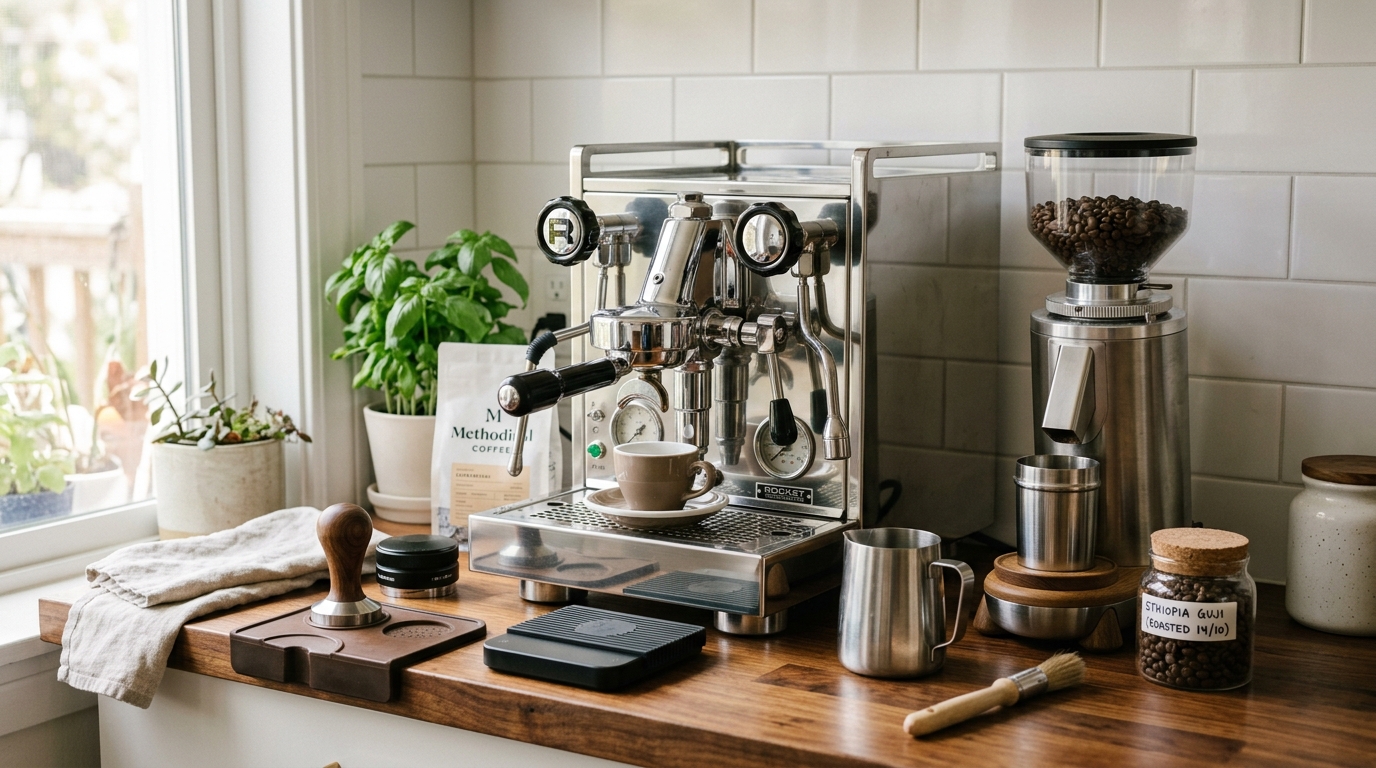
If you want to make actual cafe-quality espresso at home, you need three things in roughly equal measure: a machine that holds temperature stably, a grinder that produces a consistent fine grind, and fresh beans within 2-4 weeks of roast. Most “best home espresso” content treats the machine as 80% of the equation and the grinder as an accessory. That gets the priority backwards. The grinder matters more than the machine. A $400 machine paired with a $600 grinder makes better espresso than a $1,500 machine paired with a $50 blade grinder. We’ll cover both.
How we picked
Five criteria, in priority order for the entry-to-mid tier:
- Grinder pairing capability. A great machine is held back by a bad grinder. We weight the total setup, not just the machine.
- Temperature stability. PID-controlled machines (single or dual boiler) hold temperature within ±1°F; thermoblock machines without PID swing ±5-8°F.
- 9-bar pressure with capable pump. Vibratory pumps work fine; rotary pumps are quieter and last longer (matters above the $1,500 tier).
- Standard 58mm portafilter. 51mm and 54mm portafilters limit your accessory ecosystem; 58mm is the prosumer/commercial standard.
- Available outside the rabbit hole. Some excellent Italian machines have 8-week delivery windows. We focus on machines you can buy with reasonable lead times.
Quick comparison
| Product | Best for | Rating | Notes | |
|---|---|---|---|---|
| Manual lever — Flair 58 or Cafelat Robot | highest quality per dollar at the entry tier | ★★★★★ | $300-650. No pump, no heater. Add kettle. | Check price |
| Breville Bambino Plus + Baratza Encore ESP | best mid-tier electric kit under $1,000 | ★★★★★ | $500 machine + $200 grinder. PID, 54mm portafilter. | Check price |
| Gaggia Classic Pro + DF54 / Eureka Mignon | modifiable single boiler with prosumer parts | ★★★★★ | $450-550 machine + $400-600 grinder. 58mm portafilter. | Check price |
| Lelit Mara X + Eureka Mignon Specialita | best HX (heat exchanger) machine for mid-tier prosumer | ★★★★★ | $1,500-1,800 machine + $700 grinder. E61 group head. | Check price |
| Profitec Pro 600 + Niche Zero | dual-boiler prosumer for serious daily use | ★★★★★ | $2,500-3,000 machine + $850 grinder. Both will last 15+ years. | Check price |
The picks (by total budget)
Under $1,000 total — Breville Bambino Plus + Baratza Encore ESP
Best for the best $500-700 path to drinkable home espresso for solo or couple use
Breville Bambino Plus (espresso machine with steam wand)
The Bambino Plus is the rare entry machine that gets the priorities right: ThermoJet heating element hits temperature in 3 seconds, PID-managed temperature stability is genuinely good, and the auto-frothing steam wand makes milk drinks easier than the manual alternatives. The trade-off is a 54mm portafilter (smaller than prosumer 58mm), and a plastic-heavy build. Paired with the Baratza Encore ESP grinder, the total kit comes in under $700 and delivers cafe-quality espresso 80% of the time.
★★★★★ (3,200 reviews)
Check current price on Amazon →Pros
- PID temperature control out of the box
- 3-second heat-up via ThermoJet — fastest in the category
- Auto-frothing steam wand is genuinely good for beginners
- Compact footprint (smallest dual-purpose espresso machine on the market)
- Solid 2-year warranty with Breville support
Cons
- 54mm portafilter limits accessory ecosystem (vs prosumer 58mm)
- Plastic side panels feel cheap up close
- Single boiler — you can't pull a shot and steam milk simultaneously
- Pressurized portafilter ships standard; non-pressurized is an upgrade
$1,000-2,000 total — Gaggia Classic Pro + DF54 or Eureka Mignon
Best for users who want a prosumer-style 58mm portafilter without spending prosumer money
Gaggia Classic Pro (single-boiler espresso machine, 58mm)
The Classic Pro is the most-modifiable espresso machine in production. The 58mm portafilter accepts the full prosumer accessory ecosystem (precision baskets, distribution tools, naked portafilters). The PID can be retrofitted for $40-60 in parts. The OPV (over-pressure valve) can be tuned to 9 bar from the stock 11. Out of the box it's a 4.0/5 machine; with two weekends of modifications it's a 4.7/5 machine. Pair with a DF54 or Eureka Mignon Specialita grinder for the full setup.
★★★★★ (4,100 reviews)
Check current price on Amazon →$2,000-3,500 total — Lelit Mara X + Eureka Mignon Specialita
Best for serious home baristas who want a real E61 group head without dual-boiler complexity
Lelit Mara X (E61 heat exchanger, PID)
The Mara X is the entry point to true E61-group-head espresso. The heat exchanger means you can pull a shot and steam milk simultaneously (kind of — there's a brief temperature recovery between back-to-back drinks). Lelit's PID controls temperature precisely. The E61 group warms thermally and produces the temperature stability that's the hallmark of professional Italian machines. Pair with the Eureka Mignon Specialita grinder for $1,500-1,800 + $700 ≈ $2,200-2,500 all-in.
★★★★★ (680 reviews)
Check current price on Amazon →$3,500+ total — Profitec Pro 600 + Niche Zero
Best for serious daily users; the dual-boiler upgrade is real once you're making multiple milk drinks
Profitec Pro 600 (dual-boiler, E61, PID)
The Pro 600 is the dual-boiler answer for users who pull 2-4 drinks per session. The two boilers (one for brewing, one for steaming) eliminate the wait between back-to-back drinks. E61 group head, PID for both boilers, rotary pump option, and Profitec build quality means a 15-20 year machine. Pair with the Niche Zero grinder ($850) for a setup that genuinely competes with cafe equipment at home.
★★★★★ (290 reviews)
Check current price on Amazon →The manual lever path (often overlooked)
For users who want exceptional espresso without an electric machine entirely:
Best for users who want 58mm prosumer espresso without an electric machine or who travel
Flair 58 Manual Lever Espresso Maker
The Flair 58 is the most-sophisticated manual lever maker available — 58mm portafilter, pre-infusion, temperature-controlled group head (electric), and a press lever that gives you complete control over pressure and flow during the shot. Heat water in a separate kettle. Total cost: $600 + a kitchen kettle. The result is genuinely cafe-quality espresso, with the trade-off of a 30-second arm workout per shot.
★★★★★ (1,400 reviews)
Check current price on Amazon →What to avoid
- Sub-$200 “espresso machines” that brew through a moka-pot-style channel with low-pressure pumps. They make hot coffee. They do not make espresso.
- Bundles that include a blade grinder. Blade grinders cannot produce the consistent fine grind espresso requires. If a machine includes a grinder under $80, throw out the grinder.
- Capsule machines marketed as “espresso machines.” Capsule machines make coffee from pre-packaged capsules. They’re useful for low-effort routines; they are not espresso in any meaningful sense.
FAQ
Frequently asked questions
How much should I spend on the grinder vs the machine?
PID — is it really necessary?
How fresh do beans need to be?
Single boiler or dual boiler?
Is manual lever worth it?
What's the realistic minimum to make actual espresso at home?
Bottom line
Best under $1,000: Breville Bambino Plus + Baratza Encore ESP. Best $1,000-2,000: Gaggia Classic Pro + Eureka Mignon Specialita (mod the Gaggia for PID and OPV). Best $2,000-3,500: Lelit Mara X + Eureka Mignon Specialita. Best $3,500+: Profitec Pro 600 + Niche Zero. Best manual: Flair 58 + kettle.
Dive deeper: espresso machines, grinders, manual lever options, or setup guide.