roundups
Best Manual Lever Espresso Makers 2026 (Flair, Robot, Picopresso)
Manual lever espresso picks — Flair 58, Cafelat Robot, Picopresso. Cafe-quality espresso without electric machines, for travelers and purists.
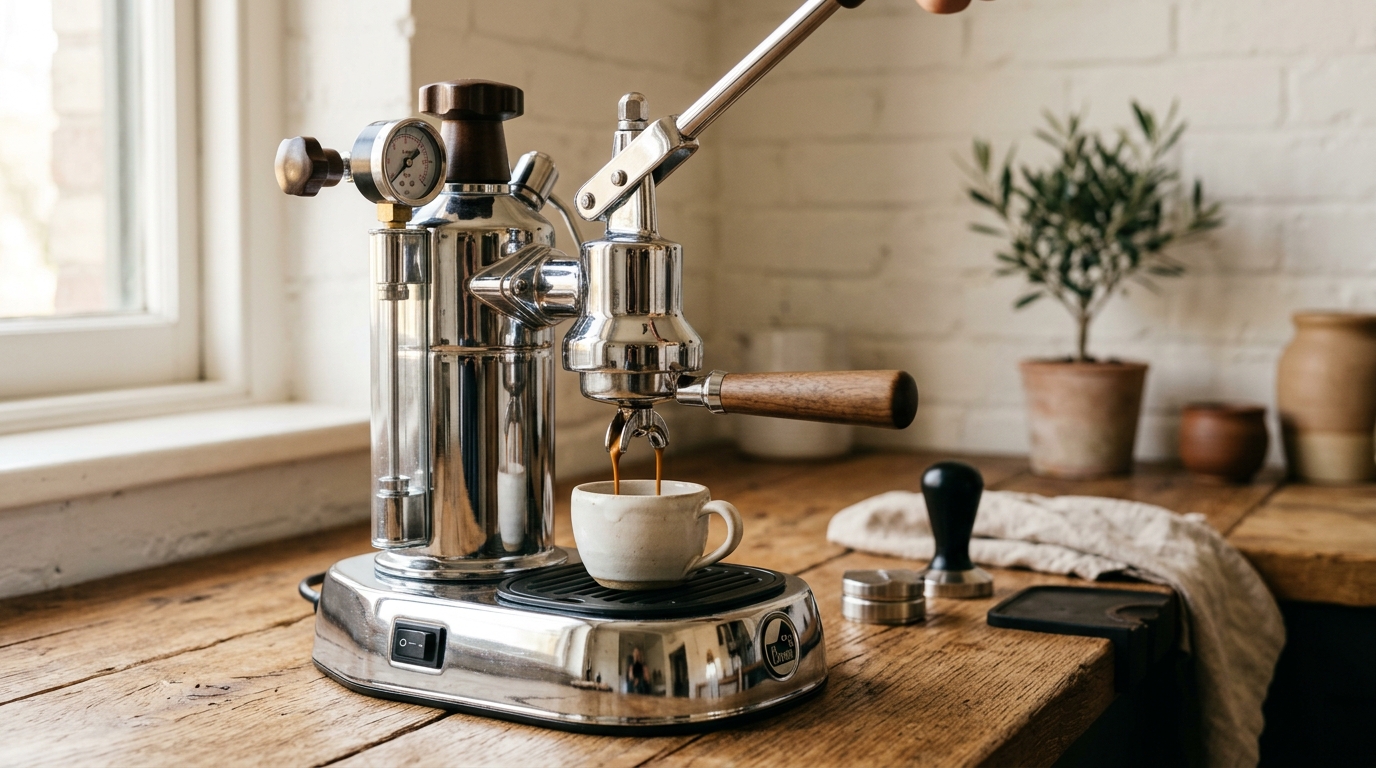
Manual lever espresso is the legitimate path that most “best home espresso” guides skip entirely. For $300-650 you get genuinely cafe-quality espresso, complete pressure control during the shot, and zero electrical dependence — plus the satisfaction of physically pulling each shot. The trade-off is the arm involvement and the need to heat water in a separate kettle. For travelers, quality-over-convenience users, and anyone who wants the best espresso per dollar at the entry tier, manual lever is the right answer.
When manual lever is the right call
Three situations where manual lever wins:
- Budget under $700 with quality as the priority. A Flair 58 + 1Zpresso JX-Pro grinder ($600 + $200) makes better espresso than a $1,200 Breville. The lever’s pressure control is finer than any pump-driven machine’s.
- Travel. Pico-style and Robot-style levers are small enough to throw in a suitcase. Brew espresso in a hotel room with the in-room kettle.
- Off-grid or low-electric environments. Cabins, sailboats, vans, rural settings without reliable 110V.
When it’s the wrong call: high-volume users (4+ drinks/session), milk-drink-heavy households (you’ll need a separate milk steamer), and anyone whose arm strength is limited.
Quick comparison
| Product | Best for | Rating | Notes | |
|---|---|---|---|---|
| Cafelat Robot Barista | quirky favorite; mechanical purity | ★★★★★ | $350-450. 58mm portafilter. No heater. Pressure gauges available. | Check price |
| Flair 58 | best manual lever overall | ★★★★★ | $600-650. 58mm portafilter. Electric group head heating. | Check price |
| Flair Neo Flex (entry tier) | cheapest legit manual espresso | ★★★★☆ | $120-180. 50mm portafilter. Plastic frame. | Check price |
| Wacaco Picopresso | travel; backpacker-portable | ★★★★★ | $130-160. 26mm basket. Hand pump. | Check price |
| ROK EspressoGC | compact countertop manual | ★★★★☆ | $190-240. 51mm. Hand levers. Stainless steel. | Check price |
The picks
Best overall: Flair 58
Best for best manual lever espresso period — the consensus pick from the home-espresso community
Flair 58 Manual Lever Espresso Maker
The Flair 58 is what manual lever espresso should be in 2026: 58mm prosumer portafilter, electric heating element in the group head (so you don't lose temperature during the shot), real pressure gauge built in, and a 30-second shot with smooth pressure control. The 58mm size means you can use the full prosumer accessory ecosystem (precision baskets, distribution tools, naked portafilters). Pair with a 1Zpresso JX-Pro for $800 total — a setup that genuinely competes with $2,000 electric machines.
★★★★★ (1,400 reviews)
Check current price on Amazon →Pros
- 58mm portafilter — full prosumer accessory ecosystem
- Electric group head heating means stable shot temperature
- Pressure gauge gives real-time feedback during the shot
- No electricity for the water (use any kettle)
- Excellent build quality — replaceable parts, designed for longevity
Cons
- $600-650 — not the cheapest entry point
- No milk steaming — need a separate steamer (Subminimal NanoFoamer or stovetop)
- Arm involvement: 30-second shot with sustained downward pressure
- Counter footprint is real (about 18 inches tall when stored)
Quirky favorite: Cafelat Robot
Best for users who want mechanical purity and excellent espresso with zero electronics
Cafelat Robot Barista (Manual Espresso Maker)
The Robot is the lever espresso maker for purists. Two arms you press downward at the same time. No electrical heating element. No pressure gauge in the base model (Barista version adds gauges). Just leverage, pressure, and a 58mm portafilter. The community-favorite for users who want to subtract complexity rather than add it. Slightly less expensive than the Flair 58 (\$350-450 vs \$600+) and equally capable of cafe-quality shots once you've learned the technique.
★★★★★ (920 reviews)
Check current price on Amazon →Best entry tier: Flair Neo Flex
Best for cheapest path to real espresso for users not ready to commit \$600+
Flair Neo Flex (entry manual espresso)
The Neo Flex is the lowest-cost legitimate manual espresso maker. 50mm portafilter (smaller than prosumer 58mm), plastic structural frame, no electric heating. You preheat the group head with kettle water before pulling. The trade-off vs the Flair 58 is the smaller portafilter and lack of group-head heating; the trade-off vs the Robot is build feel. But at \$120-180, it's the cheapest legitimate entry point to home espresso — and you can upgrade to the 58 later without losing the workflow.
★★★★☆ (2,200 reviews)
Check current price on Amazon →Best for travel: Wacaco Picopresso
Best for travelers, camping, backpacking — best portable espresso under \$200
Wacaco Picopresso
The Picopresso is the smallest serious-espresso device. About the size of a thermos, holds 18g in a 26mm basket, hand-pumped pressure with a gauge readout. The basket is smaller than full-sized portafilters (which limits dose), but the pressure delivery is genuinely 9 bar and the shots are real espresso. For users who travel and refuse to drink hotel coffee, the Picopresso plus a hand grinder (1Zpresso Q2) fits in a Dopp kit.
★★★★★ (1,800 reviews)
Check current price on Amazon →What manual lever skips
Three real limitations to know about:
- No milk steaming built in. You need a separate device — Subminimal NanoFoamer ($50-80) for handheld electric whisk, Bellman stovetop steamer ($160), or a French-press microfoam technique (free).
- One shot at a time. Pulling back-to-back drinks requires re-heating water in the kettle. Add 60-90 seconds per additional shot.
- Physical effort. 30-60 seconds of sustained downward pressure per shot. For users with limited grip strength or wrist issues, this is real friction.
FAQ
Frequently asked questions
Does manual lever really make espresso as good as a $1,500 electric machine?
Flair 58 or Cafelat Robot — which to pick?
Do I need a temperature-controlled kettle?
How long does a manual lever maker last?
Can I make a latte with a manual lever maker?
Will my arms get tired?
Bottom line
Best overall: Flair 58. Best mechanical purist: Cafelat Robot. Best entry tier: Flair Neo Flex. Best travel: Wacaco Picopresso.
Pair with the 1Zpresso JX-Pro hand grinder and a kettle for under $900 total — a setup that competes with electric machines 2-3x the price.