roundups
Best Stovetop Espresso Makers 2026
The best stovetop espresso makers reviewed: Bialetti Moka Express, Brikka, Venus, Alessi 9090, and Grosche Milano compared for flavor, build, and value.
 Elena Marchetti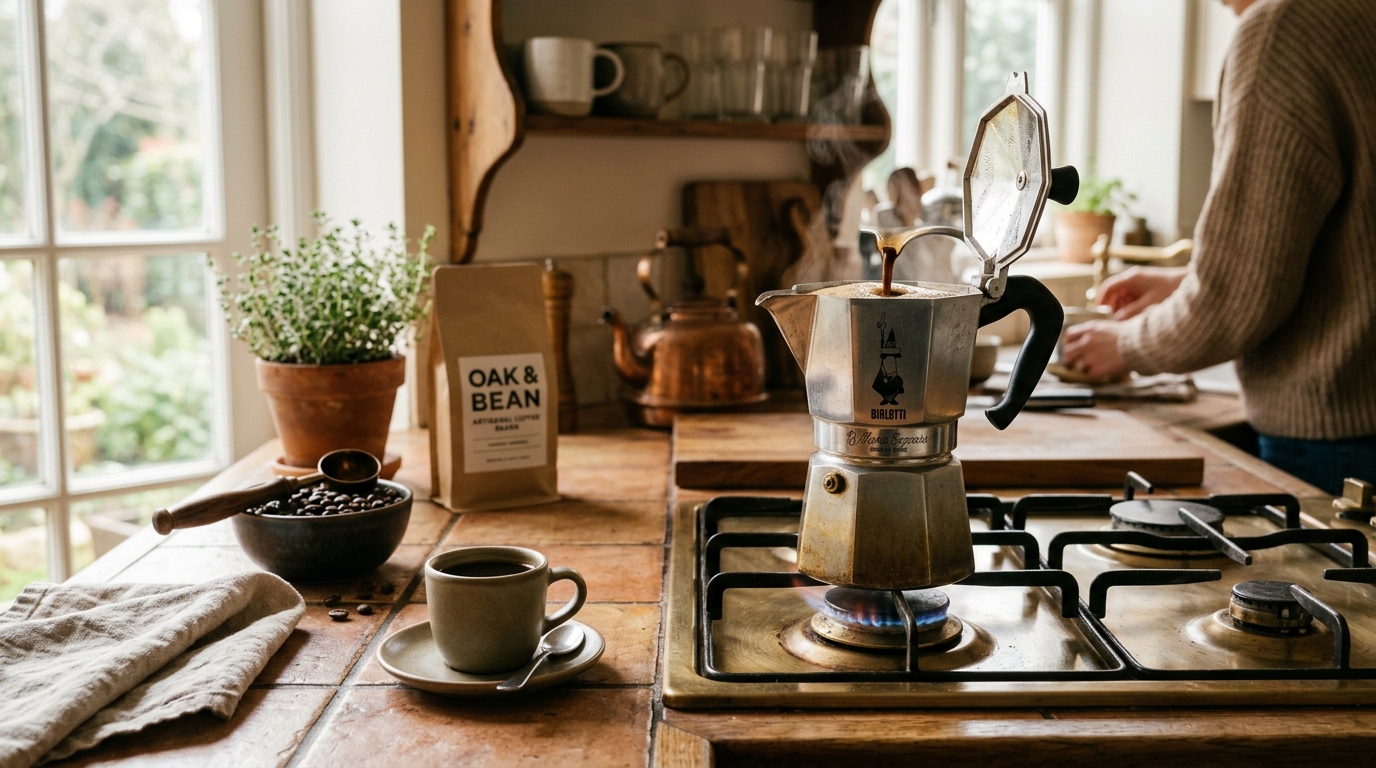
The best stovetop espresso maker is the Bialetti Moka Express — it brews rich, concentrated coffee in 4-5 minutes on any gas or electric stovetop and the 3-cup version runs under $40. For induction cooktops, choose the Bialetti Venus instead. For crema reminiscent of a real espresso machine, the Bialetti Brikka is the only stovetop pot that delivers it consistently.
Why stovetop espresso makers are worth owning
Stovetop espresso makers — commonly called moka pots after the brand that popularized them — are among the most efficient coffee devices ever designed. An aluminum octagonal body, a rubber gasket, a filter basket, and a pressure mechanism: the entire device has fewer than ten components, brews in 4-5 minutes, and requires no electricity, no paper filters, and no pods.
What you get is concentrated coffee at roughly 1-2 bars of pressure — stronger and more extracted than drip coffee but less pressurized than true espresso at 9 bars. Calling moka pot output “espresso” is a traditional Italian shorthand rather than a technical description. What it produces is excellent: rich, heavy-bodied coffee with enough concentration to mix into lattes, use as a base for cold brew espresso drinks, or drink straight in a small cup.
The stovetop espresso maker fills a practical niche that neither drip coffee nor pump espresso machines occupy cleanly: low cost, minimal counter space, no consumables, and a brew profile far closer to espresso than any pour-over or drip method.
What to look for before buying
Material: aluminum vs. stainless steel. Aluminum moka pots heat faster and are more thermally responsive — the result is slightly better extraction consistency for most users. The trade-offs: aluminum is not induction-compatible and reacts slightly with acidic compounds over time, contributing a faint metallic character on the first few brews from a new pot. Stainless steel is more durable, dishwasher safe, and works on induction, ceramic, and gas stovetops. Both materials produce excellent coffee when used correctly.
Size. Moka pot sizes are labeled by espresso cup output — 1, 2, 3, 4, 6, 9, 12 cups — but a “cup” here is a small 2 oz espresso-style serving. A 3-cup moka pot brews about 6 oz of concentrated coffee: roughly two small cups or one diluted mug. The filter basket must be filled completely each time — you cannot brew a half-batch in a large pot without poor extraction and excessive bitterness. Buy the size that matches your typical serving count.
Crema. Standard moka pots produce little to no crema because the brewing pressure (1-2 bar) is insufficient to emulsify coffee oils the way an espresso machine does at 9 bar. The Bialetti Brikka adds a weighted pressure valve that raises internal pressure enough to generate genuine crema — the only stovetop device that does this without pressurized portafilter tricks.
Induction compatibility. Standard aluminum moka pots will not heat on induction cooktops. If you have induction, buy a stainless steel model specifically, or use a stainless induction adapter disk with an existing aluminum pot.
Replacement gaskets. The rubber gasket that seals the two halves of the pot degrades with heat exposure and typically needs replacing every 1-2 years. Bialetti sells replacement gaskets cheaply and widely. Before buying any lesser-known brand, confirm that replacement gaskets are available from the manufacturer.
Quick comparison
| Product | Best for | Rating | Notes | |
|---|---|---|---|---|
| Bialetti Moka Express | best overall stovetop espresso maker | ★★★★★ | Aluminum. 1-12 cup sizes. Gas and electric only. The original since 1933. | Check price |
| Bialetti Brikka | best for crema | ★★★★★ | Aluminum. 2 or 4 cup only. Pressure valve generates real crema. | Check price |
| Bialetti Venus | best for induction stovetops | ★★★★★ | Stainless steel. 1-10 cup sizes. Works on all heat sources. | Check price |
| Grosche Milano | best budget alternative to Bialetti | ★★★★☆ | Aluminum. 3-12 cup sizes. Affordable with available replacement gaskets. | Check price |
| Alessi 9090 | best premium heirloom build | ★★★★★ | Stainless steel. Induction-ready. Designer piece built to last decades. | Check price |
The picks
Best overall: Bialetti Moka Express
Best for anyone wanting the definitive stovetop espresso experience
Bialetti Moka Express Stovetop Espresso Maker
The Bialetti Moka Express is not merely a good moka pot — it is the moka pot every other stovetop maker is measured against. Invented in 1933 by Alfonso Bialetti, the octagonal aluminum body has been produced without meaningful change for over 90 years and over 300 million units sold. The aluminum body heats quickly, the filter basket is sized for consistent extraction when filled level, and the gasket-and-plate seal has been refined over decades of production. The 3-cup size brews about 6 oz of concentrated coffee in 4-5 minutes — two small espresso-style servings or one regular mug. The Moka Express does not produce crema and is not true espresso, but it makes exceptional concentrated coffee that no pod machine matches. Works on gas and electric stovetops; not induction-compatible.
★★★★★ 4.7 · 65,000 reviews
Check current price on Amazon→Pros
- Perfected over 90 years — one of the most tested kitchen devices ever made
- Widely available replacement gaskets and filter plates from Bialetti and third parties
- Brews in 4-5 minutes with minimal cleanup
- Available in 1-cup through 12-cup sizes to match any household
- Under $40 for the 3-cup — exceptional value for the brew quality
Cons
- Not compatible with induction cooktops
- Produces no crema without modification
- Aluminum requires hand-washing only — no dishwasher
- Easy to over-extract on high heat; technique matters
Best for crema: Bialetti Brikka
Best for stovetop drinkers who want crema without buying a pump espresso machine
Bialetti Brikka Stovetop Espresso Maker
The Brikka is Bialetti's modified moka pot engineered to produce actual crema. It accomplishes this through a weighted pressure valve on the upper chamber that holds back the brew until internal pressure reaches approximately 3 bar — higher than a standard moka pot and sufficient to emulsify coffee oils into crema. The result is a denser, heavier-bodied cup with a thin layer of genuine crema that holds for several minutes. The Brikka is available in 2-cup and 4-cup sizes only and requires slightly more attention during brewing — heat regulation matters more, and the valve must be seated correctly. If you want the visual and textural experience of espresso crema without a pump machine, this is the only stovetop device that gets you there.
★★★★★ 4.5 · 12,000 reviews
Check current price on Amazon→Pros
- Generates real crema — the only stovetop espresso maker that does this reliably
- Noticeably denser, richer cup profile than a standard moka pot
- Same Bialetti build quality with widely available replacement parts
- Works especially well with medium-dark roast espresso blends
Cons
- Available in 2-cup and 4-cup sizes only — no larger options
- Requires more precise heat control than the standard Moka Express
- Valve must be cleaned regularly to maintain proper pressure
- Not induction-compatible
Best for induction: Bialetti Venus
Best for induction stovetop owners who want Bialetti quality in a stainless steel body
Bialetti Venus Stainless Steel Moka Pot
The Venus is Bialetti stainless steel and induction-ready — the direct answer to the Moka Express for households with induction cooktops. Construction switches from aluminum to 18/10 stainless steel, adding weight, durability, and induction compatibility while retaining the characteristic octagonal form and quality gasket seal. Stainless heats slightly less evenly than aluminum, so medium heat and a slower pace produce the best results. The cup is clean and rich — similar to the Moka Express in character but without the faint metallic note some users detect on first use with new aluminum. Available from 1-cup to 10-cup sizes. Dishwasher safe unlike aluminum, which simplifies daily cleanup considerably.
★★★★★ 4.6 · 28,000 reviews
Check current price on Amazon→Pros
- Works on induction, gas, electric, and ceramic cooktops — the most versatile choice
- Dishwasher safe — easier daily care than aluminum
- Durable 18/10 stainless steel construction with no corrosion risk
- Available in 1-cup through 10-cup sizes
- No metallic taste that some users notice with new aluminum pots
Cons
- Heats less evenly than aluminum — lower heat setting recommended
- Costs more than the equivalent aluminum Moka Express
- Slightly heavier than aluminum versions of the same size
Best budget alternative: Grosche Milano
Best for budget buyers who want genuine moka pot quality without the Bialetti price
Grosche Milano Stovetop Espresso Maker
The Grosche Milano is the best alternative to Bialetti for buyers prioritizing value. The aluminum construction and octagonal form follow the classic moka pot blueprint. What Grosche delivers that cheaper knockoffs do not: consistent gasket quality, a properly sized filter basket, and replacement gaskets available directly from Grosche. Brew quality is very close to the Moka Express — in side-by-side tastings, most drinkers cannot distinguish them. The Milano is typically 10-20 percent less expensive and widely available at big-box retailers. Works on gas and electric stovetops. If you are new to moka pots and want a lower-risk first purchase before committing to Bialetti, the Milano is the right starting point.
★★★★☆ 4.4 · 9,500 reviews
Check current price on Amazon→Pros
- Meaningfully cheaper than the Bialetti Moka Express
- Replacement gaskets available from Grosche directly
- Brew quality matches the Moka Express in blind tastings
- Solid construction for the price — not a flimsy knockoff
Cons
- Not induction-compatible
- Fewer long-term parts sources than Bialetti, which has decades of aftermarket support
- No crema, same as any standard moka pot
Best premium: Alessi 9090
Best for buyers who want a precision-built heirloom stovetop espresso maker
Alessi 9090 Espresso Maker
The Alessi 9090 is what the moka pot becomes when designed by Richard Sapper and manufactured to near-jewelry-grade tolerances. Where a Bialetti costs \$30-40 and is designed for mass production, the 9090 is machined from 18/10 stainless steel with a self-leveling lid, a heat-resistant handle rated for oven temperatures, and a body thickness that resists the dents and warping that affect aluminum pots over years of daily use. Induction-compatible and works on all heat sources. Brew quality is excellent and consistent — shot-to-shot variation is minimal compared to lighter aluminum pots. This is a genuine heirloom purchase: a pot built to outlast every other appliance in your kitchen with nothing more than occasional gasket replacement.
★★★★★ 4.6 · 2,100 reviews
Check current price on Amazon→Pros
- Machined 18/10 stainless steel — heirloom build quality built to last decades
- Induction-compatible and works on all heat sources
- Self-leveling lid and heat-resistant handle improve daily workflow
- Exceptional shot-to-shot consistency exceeds most aluminum moka pots
- Museum-quality design by Richard Sapper — the Alessi 9090 is a permanent MoMA collection piece
Cons
- Costs $150-200 — four to five times the price of a Bialetti Moka Express
- Overkill for casual or first-time moka pot users
- Heavier than equivalent aluminum pots of the same size
What to skip
Unbranded clones under $15. Amazon carries moka pots from unrecognizable brands at $8-15. The problems are consistent: gaskets that fail within weeks of daily use, undersized filter baskets that force under-filling, and tolerances loose enough that upper and lower chambers do not seal reliably — some units spray scalding water from the seal partway through a brew. None have replacement parts. Do not buy these.
Electric “moka pot” machines. Several brands sell countertop electric espresso machines that look like moka pots but use a pump rather than stovetop heat. These are not moka pots — they are entry-level pump espresso machines in disguise. If you want a pump machine, buy a dedicated espresso machine. If you want a moka pot, buy a stovetop version. The hybrid category satisfies neither use case well.
Oversized pots for one-person households. A 12-cup moka pot requires its basket to be filled completely to brew properly — partial fills produce bitter, over-extracted, sputtery results. If you brew for one person daily, buy a 3-cup pot. A 6-cup pot brewed at half capacity is not a 3-cup pot.
Anything aluminum for induction. Standard aluminum moka pots will not heat on induction cooktops at all. Do not buy an aluminum pot if your kitchen runs on induction — it simply will not work.
Technique: why heat control is everything
The single biggest variable in moka pot brewing is heat level. Every bitter, burnt, or thin moka pot cup traces back to heat that was too high. The correct technique: fill the lower chamber with water just below the pressure valve, fill the basket level without tamping or pressing the grounds, assemble tightly, and place on medium-low heat. When you first hear gurgling sounds of coffee entering the upper chamber, reduce to low. When the gurgling becomes an aggressive, sputtering sound, remove from heat immediately — the extraction is complete and prolonged heat only burns the coffee.
Total brew time from a cold stovetop is 4-5 minutes. For a detailed breakdown of grind size, water temperature, and cleanup, read the complete moka pot guide.
FAQ
Frequently asked questions
What is the difference between a moka pot and a real espresso machine?
Can a moka pot work on an induction cooktop?
How much coffee does a 3-cup moka pot actually make?
How long do moka pot gaskets last?
Should I tamp the coffee grounds in a moka pot?
What grind size works best in a stovetop espresso maker?
Bottom line
Best overall: Bialetti Moka Express. Best for crema: Bialetti Brikka. Best for induction: Bialetti Venus. Best budget alternative: Grosche Milano. Best premium heirloom: Alessi 9090.
For technique and grind guidance, read the complete moka pot brewing guide and see moka pot vs. espresso for a full comparison of the two methods. For the right grind setting, the espresso grind size guide covers where moka pot sits on the spectrum. For beans that work well in stovetop brewers, the best espresso beans roundup covers medium-dark blends ideal for concentrated brewing.