guides
Moka Pot vs Espresso Machine: Which Should You Buy?
Moka pot vs espresso machine: real differences in pressure, taste, cost, and workflow to choose the right brewer for home.
 Elena Marchetti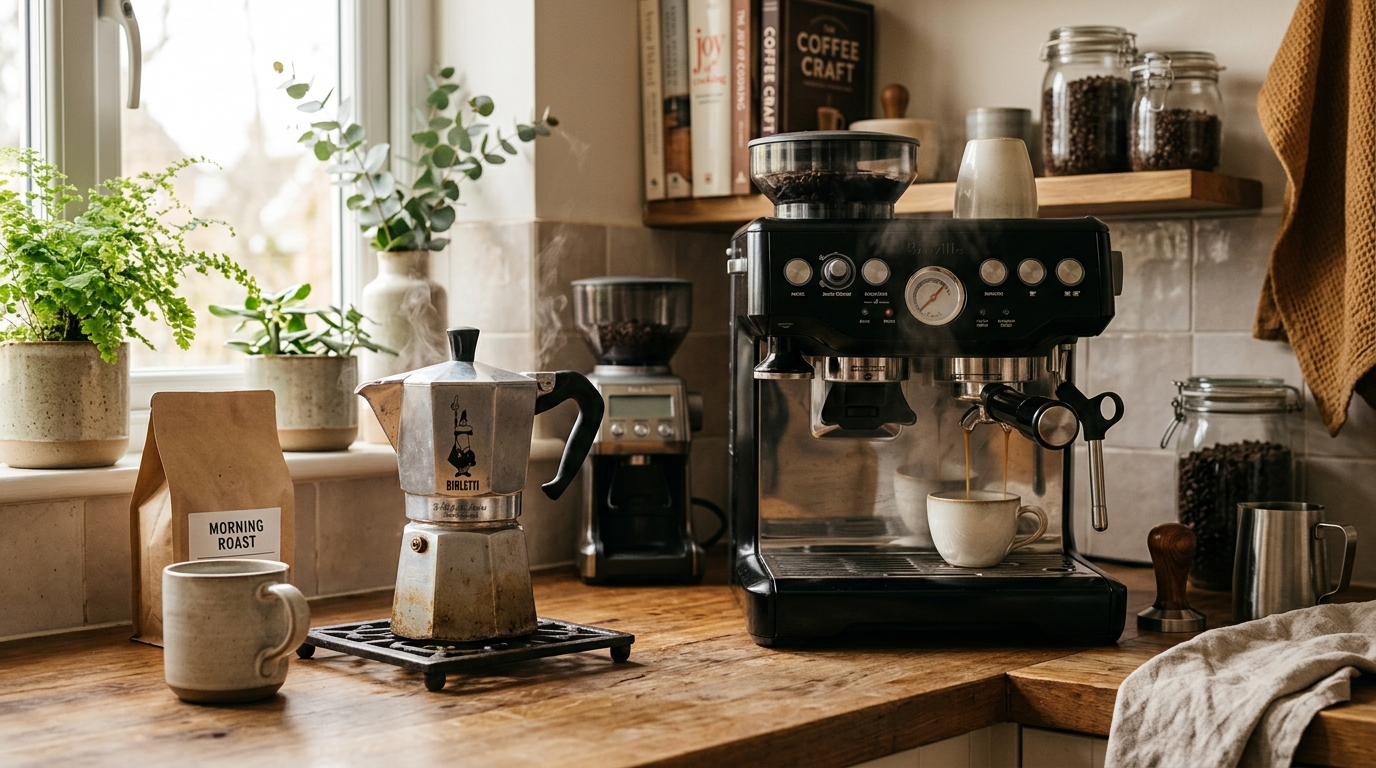
A moka pot brews strong, full-bodied stovetop coffee for $30-50 with almost no learning curve. An espresso machine delivers true 9-bar espresso with crema and steam capability starting around $400-700 for a capable setup. For bold coffee on a budget, the moka pot is hard to beat. For true lattes and cappuccinos, only an espresso machine will do.
How each brews: the fundamental mechanical difference
The moka pot and the espresso machine share a surface-level similarity — both use heat and pressure — but the mechanics are entirely different, and those differences produce entirely different drinks.
The moka pot is a stovetop device consisting of three chambers: a lower water reservoir, a filter basket that holds the ground coffee, and an upper chamber that collects the brewed coffee. Fill the bottom with cold water up to the safety valve, fill the basket with medium-fine grounds, and apply heat. As the water heats, steam pressure builds in the lower chamber and forces hot water upward through the grounds and into the top chamber. The pressure involved is approximately 1-2 bar.
The result is a strong, dark, intensely flavored coffee that brews in 5-7 minutes. The character sits somewhere between a strong drip and true espresso: heavier in body than drip, more bitter, and more concentrated — but not as thick or syrupy as real espresso, and without crema.
The espresso machine uses an electric pump to force water at 9 bar of pressure through a tightly packed portafilter basket of finely ground coffee over 25-30 seconds. That pressure is not incidental — it is what emulsifies coffee oils and dissolved CO2 into crema, and what produces the thick, concentrated shot that can hold up through several ounces of steamed milk. Budget machines with pressurized baskets simulate crema chemically; true 9-bar machines extract it from the coffee itself.
The physics matter here. A 4-5x pressure difference is not a minor variation — it determines the texture, concentration, and flavor of the finished drink, and it determines whether you can make a real latte.
Side-by-side comparison
| Product | Best for | Rating | Notes | |
|---|---|---|---|---|
| Brew pressure | Espresso machine: 9-bar pump pressure | — | Moka pot: 1-2 bar steam pressure — not true espresso | — |
| Crema | Espresso: thick golden crema on every shot | — | Moka pot: no real crema; light foam dissipates quickly | — |
| Entry cost | Moka pot: $30-50 for a quality Bialetti | — | Espresso: $400-700 minimum for machine plus burr grinder | — |
| Brew time | Moka pot: 5-7 minutes, mostly passive | — | Espresso: 30 seconds per shot after 15-20 minute warm-up | — |
| Milk-based drinks | Espresso: true lattes and cappuccinos with crema | — | Moka pot: can add frothed milk but lacks espresso concentration | — |
| Learning curve | Moka pot: minimal — add water, add grounds, apply heat | — | Espresso: 2-4 weeks of active dial-in before shots are reliable | — |
| Portability | Moka pot: stovetop-ready, travel-friendly, no electricity | — | Espresso machine: countertop only; requires an electrical outlet | — |
| Maintenance | Moka pot: rinse after use; replace gasket once a year | — | Espresso machine: daily backflushing, monthly descaling, group head cleaning | — |
Taste and extraction: what you are actually drinking
This is where the distinction matters most, and where the marketing around moka pots creates the most confusion.
Moka pot coffee is genuinely excellent — rich, full-bodied, and far more satisfying than drip for people who prefer intensity. Italian households have relied on the moka pot for nearly a century for good reason. But calling it espresso is technically wrong, and the difference matters when you are deciding which machine to buy.
True espresso at 9 bar measures roughly 8-12% total dissolved solids (TDS). The pressure emulsifies oils and suspended CO2 into crema — the reddish-gold foam on a properly extracted shot. Those emulsified oils give espresso its thick, syrupy mouthfeel and intense aroma. This concentration is why a double espresso still tastes like coffee when poured over 6-8 oz of steamed milk.
Moka pot coffee brews at 1-2 bar. Without sufficient pressure to emulsify oils, there is no real crema — just a thin dark foam that dissipates fast. TDS sits around 3-5%, meaning moka coffee is more concentrated than drip but nowhere near espresso intensity. The flavor profile also skews darker and more bitter, particularly if you leave the pot on heat too long after the coffee begins flowing.
From a practical standpoint: a shot of moka pot coffee poured into 6 oz of steamed milk produces a milky, lightly coffee-flavored drink. The same volume of steamed milk with a double espresso produces a proper latte because the concentration is there to hold up through dairy.
If you drink your coffee black or with a small splash of milk, a moka pot produces an outstanding result at a fraction of the cost. If your morning drink is a latte, flat white, or cappuccino, the moka pot will disappoint — not because the coffee is bad, but because the physics do not support those drinks.
Cost reality: what you actually spend
The cost gap between these two methods is significant at every tier.
Moka pot entry cost is among the lowest of any coffee brewing method. A 3-cup Bialetti Moka Express costs around $30. The 6-cup version — the most popular size, producing about 300ml of coffee for two servings — runs $35-40. You do not need electricity, a special grinder, or any accessories beyond a heat source and ground coffee. Add a decent hand grinder for $40-60 and your total setup costs under $100.
Pre-ground coffee from any grocery store works fine in a moka pot. Medium-fine espresso blends are widely available and produce good results without any special knowledge.
Espresso machine entry cost is a different category. The minimum budget for a setup that produces genuinely good espresso is around $300-500 for the machine plus $100-200 for a burr grinder. Below that, you are buying pressurized-basket machines that simulate crema without real extraction, and blade-ground coffee that makes dial-in essentially impossible.
The standard entry recommendation is the Gaggia Classic Pro ($500) paired with the Baratza Encore grinder ($170) for around $670 all-in. The Breville Barista Pro (~$700) bundles a machine and built-in grinder in one unit and is a strong alternative. At $1,000-1,500, machines like the Rancilio Silvia Pro offer commercial internals in a home body.
The break-even calculation matters for espresso: if you currently spend $5-7 per day on café lattes, a $700 home setup pays for itself in roughly 4-5 months.
Daily workflow: what making coffee actually looks like
Moka pot routine (in order):
- Fill the lower chamber with cold water up to the pressure valve — do not overfill
- Fill the filter basket with medium-fine grounds and level the surface; do not tamp
- Assemble the pot and place it on the stovetop over medium heat
- Watch and listen; as soon as coffee begins flowing and gurgling into the upper chamber, remove from heat
- Run the base briefly under cold water to stop extraction, then pour immediately
Total: 6-8 minutes, almost entirely passive. The one critical step is removing the pot from heat promptly — leaving it on too long over-extracts the final coffee and produces noticeable bitterness.
Espresso machine routine (in order):
- Turn on the machine and allow 15-25 minutes for thermal stabilization (or 3-5 minutes with fast-warm-up machines like the Breville Barista Pro)
- Weigh and grind 18g of beans fresh; adjust grind size if yesterday’s shots ran fast or slow
- Distribute grounds evenly in the portafilter basket, then tamp level with consistent pressure
- Lock the portafilter, place a scale and cup underneath, start the shot
- Target 36-38g of espresso output in 25-30 seconds; note the result and adjust tomorrow
- Steam milk if making a latte; purge and wipe the steam wand immediately after
- Rinse the portafilter and knock out the spent puck
Total: 10-15 minutes, most of it active. Dialing in the grind requires daily micro-adjustments for the first several weeks until you fully understand your machine, beans, and grinder.
When a moka pot makes more sense
Choose a moka pot if:
- Budget is the primary constraint. No other brew method delivers this quality at $30-50. The moka pot is the best value in coffee, full stop.
- You drink coffee black or with minimal milk. Moka pot coffee on its own is excellent. A splash of hot milk or a quick froth from a handheld wand produces a satisfying drink without any latte engineering.
- You want reliable, repeatable results with minimal effort. Learn one technique — medium heat, remove from flame when coffee flows — and you get consistent output every morning forever.
- You travel or camp regularly. A moka pot works on gas, camping stove, or electric burner. It weighs almost nothing. Induction-compatible stainless versions (like the Bialetti Venus) work on all cooktop types.
- You want to explore stronger coffee before committing to espresso gear. A moka pot tells you clearly whether you actually want concentrated coffee — a useful $40 experiment before spending $700.
Best for bold stovetop coffee at any budget
Bialetti Moka Express 6-Cup Stovetop Coffee Maker
The Bialetti Moka Express is the original Italian stovetop coffee maker, unchanged in core design since 1933. The 6-cup size (300ml output) is the most practical for one or two daily servings. Made from food-safe aluminum with a patented safety valve, it is nearly indestructible with basic care. Replace the rubber gasket once a year and this pot outlasts multiple espresso machines. Available in 1, 2, 3, 6, 9, and 12-cup sizes to match any household.
★★★★★ 4.7 · 94,000 reviews
Check current price on Amazon→When an espresso machine makes more sense
Choose an espresso machine if:
- You drink lattes, cappuccinos, flat whites, or cortados. These drinks require a true espresso base. Moka pot coffee cannot substitute — the concentration and crema are not there.
- You are already spending $5-7 daily at a café. The break-even math on home espresso is straightforward. A $700 setup pays for itself in roughly 4-5 months if it replaces daily café visits.
- You enjoy process and craft. Pulling a well-dialed shot — watching the extraction timer, adjusting the grind by a single click, getting a perfect pour — is genuinely satisfying for people who enjoy precision. Many home baristas find it meditative.
- You want complete control over extraction variables. Espresso gives you precise levers: dose, grind size, extraction time, yield, water temperature, and pressure. If you are inclined to optimize systems, espresso is endlessly tunable.
Best for the best entry-level machine for serious home baristas
Gaggia Classic Pro Espresso Machine
The Gaggia Classic Pro is the gold-standard entry-level recommendation in home espresso. It uses a 58mm commercial-size portafilter, a 3-way solenoid valve for dry pucks and immediate repulling, and a commercial steam wand that textures real microfoam. The learning curve is genuine — plan 2-3 weeks before shots become reliable — but the machine produces espresso that competes with machines at twice its price once dialed in. Pair it with a Baratza Encore or Eureka Mignon Notte grinder for best results.
★★★★★ 4.5 · 8,100 reviews
Check current price on Amazon→What about moka pot lattes?
This question comes up often enough to deserve a direct answer: yes, you can combine moka pot coffee with steamed or frothed milk. The result is a pleasant hot milk drink with coffee flavor. It is not a latte in the café sense.
The issue is concentration. A double espresso at 8-12% TDS poured into 6-8 oz of steamed milk still tastes unmistakably like coffee. Moka pot coffee at 3-5% TDS, poured into the same milk volume, gets diluted to a point where the coffee flavor becomes subtle and mild. The drink is not bad — it is just a different, softer thing.
A few approaches that close the gap: use the smallest moka pot size (1 or 3 cup) to maximize concentration in less liquid, use a smaller amount of milk, or add cold foam with a handheld frother rather than steaming full milk. The Bialetti Brikka — a modified moka pot with a weighted pressure valve — produces slightly more concentrated output and a more crema-like foam, and it sits at around $50-60. It is a reasonable middle ground if you want the closest possible approximation without buying a machine.
For most people who are serious about lattes at home, the moka pot workaround eventually leads to buying an espresso machine anyway. Knowing that upfront saves one purchase.
FAQ
Frequently asked questions
Is moka pot coffee the same as espresso?
Can I make a latte with a moka pot?
Which is harder to use: a moka pot or an espresso machine?
Does a moka pot need special coffee?
What size moka pot should I buy?
Is a moka pot worth buying if I already have an espresso machine?
Bottom line
The moka pot wins on value, simplicity, and portability. For $30-50, it produces genuinely strong, full-flavored coffee with near-zero learning curve and minimal maintenance. If you drink coffee black, with a small amount of milk, or you are on a tight budget, it delivers outstanding enjoyment per dollar — more than many methods that cost ten times as much.
The espresso machine wins on capability and café-quality output. For $400-700 all-in, it delivers true 9-bar extraction, real crema, and the concentrated base that lattes and cappuccinos require. If your daily drink is a milk-based café beverage, an espresso machine is the only way to make it correctly at home.
For choosing an espresso machine: our full machine picks, the under-$500 guide, and the complete home setup walkthrough. For dialing in extraction after you buy: espresso grind size explained.