guides
How to Make Cuban Coffee with a Moka Pot
Learn to make authentic cafecito using a stovetop moka pot — the right coffee, heat technique, espumita method, and best moka pot picks.
 Elena Marchetti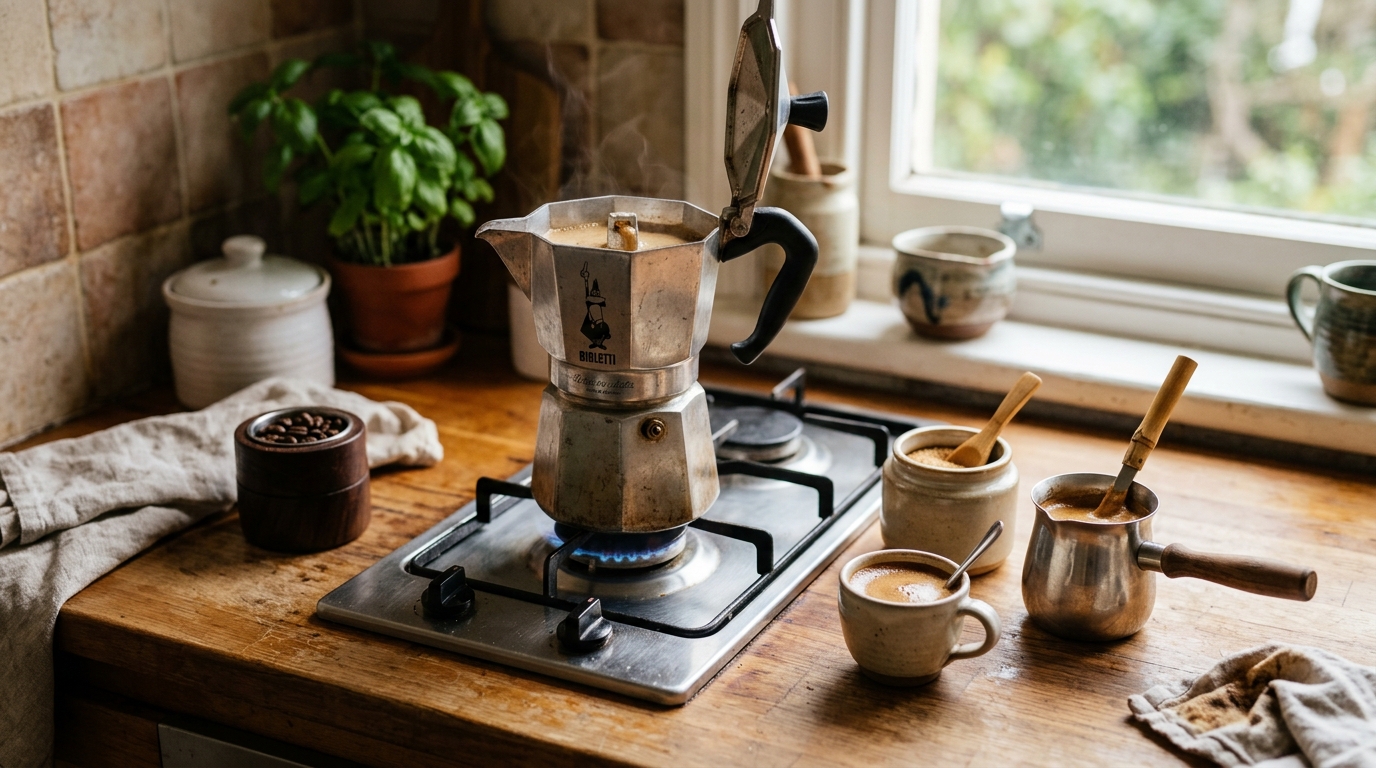
To make Cuban coffee (cafecito) with a moka pot: brew dark-roast Cuban coffee in a 3-cup Bialetti Moka Express, catch the first 5-10 ml of output in a small cup with 2-3 teaspoons of sugar, whip vigorously for 30-60 seconds until it forms a light-brown foam called espumita, then pour the rest of the moka pot over it. Total time under 10 minutes.
What is Cuban coffee (cafecito)?
Cuban coffee, known as cafecito, is a stovetop espresso drink made with dark-roast coffee and a characteristic sugar foam called espumita. It is the daily coffee of Cuban culture — served at breakfast, after meals, and shared as a social ritual throughout the day. In Miami, cafecito is sold from ventanitas (walk-up windows) in small cups and consumed standing, often multiple times a day.
The defining feature of authentic cafecito is the espumita: a thick, pale-tan foam created by whipping the first concentrated drops of moka pot output with granulated sugar. The foam forms a sweet, slightly caramelized layer over the strong coffee below. Without it you have strong black coffee. With it you have cafecito.
The drink is about 2 oz served black. A cortadito is the same base with a small pour of warm milk — roughly 1:1 coffee to milk. A colada is a larger shared portion of 6-8 oz with a cluster of small cups on the side, designed to be passed around a group. All three start from the same moka pot base and espumita technique.
The moka pot is the vessel. Authentic cafecito is not made with a pump espresso machine. The 1-2 bars of steam pressure in a stovetop moka pot produce a different extraction character than the 9 bars of a pump machine — more body, slightly less crema — and that character is precisely what the traditional espumita method depends on.
What you need to make cafecito at home
A 3-cup moka pot. The 3-cup is the traditional size for single-household use. It brews about 5-6 oz of concentrated coffee — enough for two to three 2 oz cafecitos. A 6-cup works for a colada or a larger group but takes longer to heat and is harder to control on a small burner. Do not use a 1-cup; the tiny output makes catching the first drops for espumita nearly impossible.
Dark-roast Cuban-style coffee. Cafe Bustelo, Pilon, and La Llave are the three brands sold in every Cuban household and used at virtually every ventanita in Miami. They are pre-ground to a fine, espresso-appropriate texture and dark-roasted to deliver the intensity required for proper espumita. Regular supermarket dark-roast espresso works as a substitute but produces a slightly milder, less traditional flavor.
White granulated sugar. Use regular white sugar, not raw or turbinado. Fine granules dissolve faster in the small amount of hot coffee you are whipping and produce a more stable foam. The quantity matters: 2 teaspoons per 2 oz serving is a starting baseline. Traditional Cuban households often use 3-4 teaspoons. The sugar is structural — it emulsifies with the coffee oils to create the foam — not just a flavoring.
A small cup for the espumita. You need a separate vessel from the moka pot collection chamber to catch the initial drops and whip them. A 4 oz espresso cup or small glass works. The cup should hold 6-8 oz to give you room to whip without spilling.
Best for traditional Cuban cafecito on gas or electric stoves
Bialetti Moka Express 3-Cup Stovetop Espresso Maker
The 3-cup Bialetti Moka Express is the standard vessel for cafecito and has been made in the same octagonal aluminum design since 1933. It heats quickly on low flame, produces a concentrated output well-suited to the espumita technique, and brews three 2 oz servings in under 5 minutes. Replacement gaskets are sold everywhere and last 1-2 years with daily use. Around $35.
★★★★★ 4.7 · 58,000 reviews
Check current price on Amazon→How to make Cuban coffee with a moka pot: step by step
1. Prepare your espumita cup before you start
Place 2-3 teaspoons of white sugar into a small heatproof cup and set it right next to the stove. You will need to move quickly when the coffee starts to flow, so do not wait until the moka pot is already brewing to measure out the sugar. Having the cup positioned and ready is the single most important setup step.
2. Fill the lower chamber with cold water
Unscrew the moka pot base and remove the funnel. Fill the lower chamber with cold filtered water to just below the pressure relief valve — the small metal valve on the side of the lower chamber. Cold water is traditional and gives you more time to monitor and control the flow. Overfilling above the valve pushes water into the coffee funnel and disrupts the extraction.
3. Fill the funnel with dark-roast Cuban coffee
Add Cuban-style dark-roast coffee to the funnel. Fill it to the rim without tamping or pressing down. Cuban-style pre-ground coffee is already quite fine and naturally dense in the funnel. Leveling off with your finger is sufficient. Using less than a full funnel produces weak output that cannot form proper espumita — always fill completely.
4. Assemble and place on medium-low heat with the lid open
Screw the upper chamber back onto the lower chamber firmly but not with force. Place the moka pot on the smallest burner at medium-low heat — on gas, a small flame that sits under the base without licking up the sides; on electric, around 3-4 out of 10. Open the lid. You need to watch and be ready to act the moment the first coffee appears.
The brew will take 3-5 minutes to start. Resist the urge to turn up the heat. Higher heat forces water through the coffee before it is properly heated and produces a harsh, scorched cup.
5. Catch the first drops — this is the critical step
The moment the first dark-brown coffee begins to emerge from the center tube into the upper chamber, immediately tilt the moka pot and pour those first 5-10 ml of output directly into the sugar cup. Then place the moka pot back on the burner and let it complete the brew.
You want the first 5-10 ml only — about one teaspoon to two teaspoons of liquid. These initial drops are the most concentrated output from the entire brew, highest in dissolved solids and coffee oils. They are the only drops that will emulsify properly with the sugar to form stable espumita. Mid-brew drops are too dilute.
If you miss the first drops and only catch mid-brew coffee, the foam will form but will be thin, unstable, and collapse quickly. Practice a few times. Once you have done it two or three times, the timing becomes intuitive.
6. Whip the espumita
As soon as the initial drops are in the sugar cup, begin whipping immediately with a small spoon. Use a vigorous circular motion — this is not gentle stirring but active beating. The mixture will change from dark liquid to a lighter brown foam within 15-20 seconds of continuous whipping. Keep going for 30-60 seconds total until the foam holds its shape and looks like a light-tan mousse.
The transformation works because the natural coffee oils from the concentrated initial drops emulsify with the sugar when agitated rapidly. The hotter the initial drops and the more vigorously you whip, the more stable the resulting foam. If it collapses back to liquid quickly, it was either too dilute (not enough first-drop oil) or not whipped vigorously enough.
7. Finish the brew and combine
Once the moka pot finishes — you will hear a gurgling sputter as the lower chamber empties — remove it from heat immediately. Do not let it continue sputtering; the first sputters mean the brew is done and continued heating produces harsh steam-driven extraction.
Spoon the espumita into your serving cup first. Then slowly pour the remaining moka pot coffee over the top of the foam. The foam will float. Give it a light stir to incorporate any sugar from the bottom of the espumita cup and serve immediately.
Getting the espumita right
The espumita separates cafecito from plain strong coffee and is the skill newcomers find most challenging. Three variables determine whether it succeeds:
Getting true first-drop output. Only the initial output from the moka pot has sufficient dissolved solids and oil content to emulsify with the sugar. If you miss this window and catch coffee that has been flowing for 30 seconds or more, the foam will be thin. Watch carefully and tilt the pot the instant you see coffee in the upper chamber.
Enough sugar for structure. The sugar is not just a sweetener — it is the structural component. Without enough sugar, the foam collapses within a minute. With the right amount (2-3 teaspoons for a 2 oz serving), it holds for 5-10 minutes. Increase the sugar if your foam keeps collapsing, and decrease only after you have consistent results.
Aggressive, continuous whipping. Cafecito espumita is made with a spoon, not a whisk or frother. That means you need to apply significantly more effort than you might expect. Whip in tight, fast circles for at least 30 seconds without stopping. You will see the color lighten visibly as the mixture incorporates air and emulsifies. Stopping too early produces a thin foam that collapses on contact with the coffee below.
Which moka pot is best for Cuban coffee?
| Product | Best for | Rating | Notes | |
|---|---|---|---|---|
| Bialetti Moka Express 3-cup | Traditional cafecito on gas and electric stoves | ★★★★★ | The authentic choice. Fast heat-up, reliable valve and gasket, classic pour spout. Around $35. | Check price |
| Bialetti Moka Express 6-cup | Making a colada for a group | ★★★★☆ | Brews about 12 oz. Slower to heat evenly than 3-cup but correct for a shared colada. Around $40. | Check price |
| Bialetti Venus 4-cup Stainless | Induction stovetops | ★★★★☆ | Stainless steel, induction-compatible, dishwasher-safe. Produces comparable output to the aluminum Express. Around $50. | Check price |
| Grosche Milano 3-cup | Budget alternative to Bialetti | ★★★★☆ | Good build quality at a lower price. Clean pour spout and standard gasket sizing. Around $25. | Check price |
The 3-cup Bialetti Moka Express is the default recommendation for cafecito. It is the size and brand used in Cuban households for decades, and its fast aluminum heat-up and reliable valve make the espumita-timing step consistently manageable. If you have an induction stovetop, the Bialetti Venus is the right substitute — it matches the Moka Express output closely in stainless steel.
Best for Cuban coffee on induction stovetops
Bialetti Venus Stainless Steel Induction Moka Pot
Aluminum moka pots do not work on induction ranges. The Bialetti Venus provides the same reliable output and valve design as the Moka Express but in stainless steel that is induction-compatible and dishwasher-safe. Available in 2, 4, and 6-cup sizes — the 4-cup is the closest match to the traditional 3-cup Moka Express output. Around $45-55.
★★★★★ 4.6 · 22,000 reviews
Check current price on Amazon→Which coffee to use for authentic cafecito
The three coffees used in traditional Cuban cafecito are all pre-ground, dark-roast espresso-style blends available in US grocery stores:
Cafe Bustelo is the most widely available Cuban-style coffee in the US, found in most major grocery chains. It has an intensely dark, robust flavor with low acidity and a slight bitterness that softens with the sugar foam. The yellow-and-red brick packaging is the standard household format. Cafe Bustelo is the starting point for anyone new to cafecito.
Pilon produces a slightly smoother profile than Bustelo with less harsh bitterness. Many Cuban households prefer Pilon for daily drinking and find Bustelo more suitable as an occasional stronger cup. Both brands are acceptable and largely interchangeable for cafecito.
La Llave is less common outside Florida and the Northeast but is widely considered the most authentic by longtime Cuban coffee drinkers. It has an earthier, slightly more complex profile than Bustelo or Pilon. If you can find it, try it alongside Bustelo to compare.
All three are pre-ground to a fine espresso-appropriate texture and do not require a grinder. This is part of the tradition — Cuban coffee has always been accessible without specialized equipment.
Variations: cortadito and colada
Cortadito is cafecito with a small pour of warm milk — typically a 1:1 ratio of coffee to milk in a 4 oz cup. Heat whole milk separately in a small saucepan or microwave to about 150°F, then pour it gently over a finished cafecito. A proper cortadito still has espumita on top — the milk goes under the foam or is poured alongside. Do not foam or steam the milk; a cortadito uses warm poured milk, not milk foam.
Cuban colada is a shared portion of cafecito — typically 6-8 oz brewed from a 6-cup moka pot, poured into a large polystyrene cup with four to six small 1 oz plastic cups alongside it. Each person takes one of the small cups, which are filled and passed around the group. The colada is explicitly social; drinking one alone misses the point. Make a colada for any occasion where you would otherwise offer a round of drinks.
FAQ
Frequently asked questions
Can I use regular espresso beans to make cafecito?
How much sugar should I use for Cuban coffee?
Why will my espumita not hold its shape?
What size moka pot should I use for Cuban coffee?
Is Cuban coffee the same as regular espresso?
Bottom line
Authentic cafecito comes down to three things: a 3-cup Bialetti Moka Express, pre-ground dark-roast Cuban coffee like Cafe Bustelo or Pilon, and the espumita technique of catching the first concentrated drops and whipping them with sugar until they form a light-brown foam. The first two are easy to get right immediately. The espumita technique usually takes two or three attempts before it becomes consistent. Once it does, you can make a proper cafecito faster and more affordably than any other espresso drink in your kitchen.
For more: how to use a moka pot, moka pot vs. espresso machine, espresso grind size guide, and best espresso beans.