guides
Breville Barista Express BES870XL Review: Is It Worth It?
Honest Breville Barista Express BES870XL review: built-in grinder, shot quality, steam power, and who should buy this all-in-one machine.
 Elena Marchetti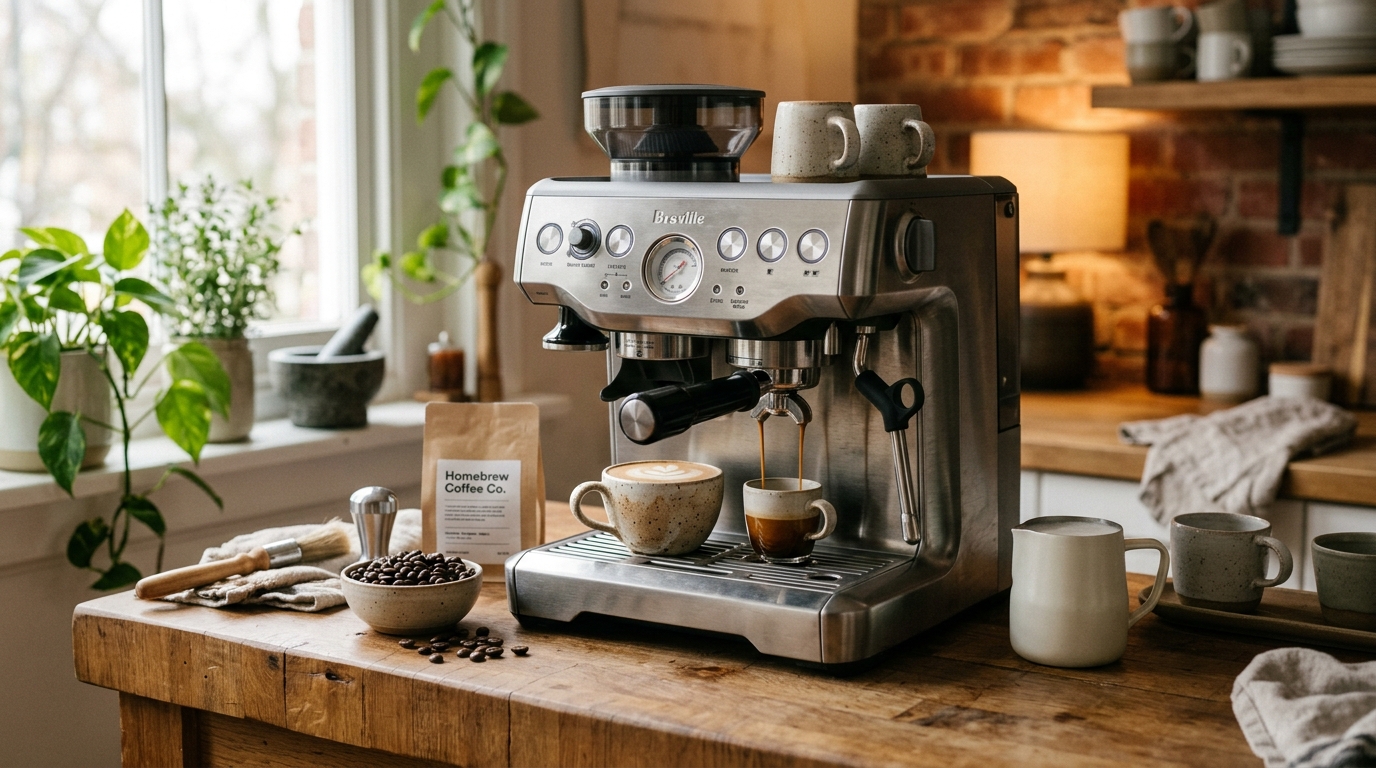
The Breville Barista Express BES870XL earns its place as the best-selling all-in-one espresso machine at its price point. At around $700, it combines a conical burr grinder and a 9-bar thermocoil espresso machine in a single unit — a genuine convenience advantage for most home setups. Serious baristas who plan to upgrade their grinder will outgrow it; everyone else gets good espresso from day one.
Who the Breville Barista Express BES870XL is for
The Barista Express BES870XL is designed for one specific buyer: someone who wants good espresso at home without managing two separate machines. If you want to grind beans, pull shots, and steam milk from a single appliance that takes up one counter footprint, this is the machine built for that.
It is not the right machine for every espresso enthusiast. Serious home baristas who understand that grinder quality is the most leveraged upgrade in the espresso workflow will find the built-in burr set limiting within 12-18 months of developing technique. For that group, a Gaggia Classic Pro or Breville Bambino Plus paired with a standalone Baratza Encore delivers a higher ceiling for roughly the same total investment.
The BES870XL fits best when you:
- Want one machine on the counter, not two separate units and the workflow coordination between them
- Pull one to three drinks per day and value a consistent routine over fine-tuned shot optimization
- Are newer to home espresso and want fewer variables to manage during the learning phase
- Have a budget around $700 and do not want to allocate an additional $150-200 toward a standalone grinder
What you get: features and hardware
Heating system. A thermocoil element heats water on demand rather than maintaining a full boiler at temperature. Brew-ready time is approximately 3 minutes from a cold start — fast enough that leaving the machine on while you grind your dose requires no waiting. Thermal consistency through a single session is reliable, and the thermocoil design is well-matched to home pull rates of two to four shots before a break.
Built-in conical burr grinder. The grinder features a conical burr set with 25 grind settings. The adjustment ring is stepless within each notch, giving more total resolution than the numbered settings suggest. For espresso, most users settle somewhere between settings 6 and 12 depending on roast level and desired extraction. The grind-by-time system doses directly into the portafilter using a programmed duration — adjustable to hit your preferred gram weight. The grinder is adequate and convenient; it is not the weak point for new espresso drinkers but becomes the limiting factor as technique develops.
Portafilter and baskets. A 54mm portafilter with both a dual-wall pressurized basket (which compensates for grind inconsistency) and a single-wall non-pressurized basket (which transmits puck quality directly to the cup). Most users start with the dual-wall and switch to the single-wall as their grind calibration tightens. The single-wall basket is where real espresso feedback begins.
Steam wand. A manual steam wand that rewards technique. Unlike the Bambino Plus with its automatic steam function, the BES870XL requires you to learn positioning, air introduction timing, and temperature management. Single-boiler operation means switching between brewing and steaming adds a 20-30 second wait as the boiler pressure builds. This is standard single-boiler workflow.
Pressure gauge and dose control. A visible pressure gauge during extraction provides real-time feedback on shot pressure — a useful diagnostic tool for beginners learning to identify over- and under-extraction. The dose dial controls grind duration, making it straightforward to achieve consistent dry dose weights once calibrated.
Side-by-side: how it compares
| Product | Best for | Rating | Notes | |
|---|---|---|---|---|
| Breville Barista Express BES870XL | best all-in-one value at $700 | ★★★★★ | Built-in grinder, 54mm, thermocoil, 3-min warm-up. Complete package in one unit. | Check price |
| Breville Barista Pro BES878 | best upgrade: 3-second heat-up and better grind control | ★★★★★ | ThermoJet heating, 30 grind positions, LCD display. ~$100-150 more. | Check price |
| Breville Bambino Plus | best for pairing with a separate grinder | ★★★★★ | 54mm, 3-second heat-up, automatic milk steaming. At $499, spend the savings on a standalone grinder. | Check price |
| Gaggia Classic Pro | best long-term value with standalone grinder | ★★★★★ | 58mm commercial portafilter, 15+ year lifespan, fully user-serviceable. ~$499 plus grinder. | Check price |
Shot quality: what to expect
The BES870XL consistently produces extraction-quality espresso that most home drinkers will find excellent. When the grind is dialed in and dose weight is consistent, the pressure gauge reads in the green 8-10 bar zone during the shot and the resulting cup has real crema, balanced acidity, and appropriate sweetness. For a fresh 18g dose from a medium-roast single origin, expect a 25-30 second pull filling a double shot.
The thermocoil heating system maintains consistent brew temperature through a session without the manual temperature management — known as temperature surfing — that older single-boiler designs require. This is a meaningful practical advantage for newer espresso drinkers: one fewer variable to track during calibration.
Shot quality limitations emerge at the grinder level. The built-in conical burrs produce acceptable particle distribution and grind uniformity for the price point but fall short of dedicated burr sets in the $150-plus range. If you develop your palate to taste grind quality directly — a skill that typically takes 6-12 months of daily pulling — you will start noticing the ceiling. The cup is good, consistently good, but not what a Niche Zero or Eureka Mignon would produce from the same beans on the same machine.
For most home use, the shot quality is genuinely above what the average café pulls. For advanced home baristas, the grinder — not the boiler or portafilter — is eventually what limits you.
The built-in grinder: honest assessment
This deserves its own section because it is the most consequential design decision in the BES870XL.
What it does well. The grinder is convenient, consistent within its range, and produces usable espresso grind from settings 5-15 depending on roast and extraction target. The grind-by-time dosing system is repeatable once set — pressing the button delivers a consistent dose into the portafilter every time, removing one step of weigh-and-adjust from the workflow. For a household where multiple people use the machine at different skill levels, that simplicity is a real advantage.
What it does not do. The built-in grinder cannot be replaced or upgraded. When you reach its ceiling — and dedicated espresso drinkers reliably do — the path forward is a new machine, not a grinder upgrade. By contrast, a Bambino Plus or Gaggia Classic Pro paired with a standalone Baratza Encore can be upgraded to a Eureka Mignon or Niche Zero without touching the machine itself, producing shot quality improvements that dwarf any machine-level upgrade.
The practical implication. If you are certain you want home espresso as a daily convenience with no plans to pursue the deeper hobby side — no intention to chase single origins, no desire to dial in grind size per bag — the built-in grinder serves you well for years. If you expect to develop serious espresso interest, the Bambino Plus at $499 (separable from any grinder) or the Gaggia Classic Pro system is a better long-term architecture.
Steam wand and milk texturing
The BES870XL manual steam wand produces genuine microfoam capable of latte art and proper cappuccino texture with practice. Unlike the Bambino Plus automatic wand, the BES870XL requires technique: how to position the tip at the right depth, how to introduce air in the first seconds, and when to stop to hit target temperature without scalding.
Most users develop adequate milk technique within two to three weeks of daily practice. Steam pressure is consistent and strong enough for a 6-oz pitcher of cold whole milk. For flat whites and cortados requiring smaller milk volumes, the wand handles precision texturing once technique is dialed in.
The single-boiler limitation applies here: you cannot brew and steam simultaneously. After pulling a shot, switch to steam mode and wait 20-30 seconds for pressure to build. This sequential workflow is standard for single-boiler machines and rarely bothers home users who are making one or two drinks at a time.
Maintenance and longevity
The BES870XL requires standard espresso machine maintenance: regular backflushing with the included cleaning disc and Breville cleaning tablets, periodic descaling based on water hardness (the machine signals when descaling is needed), and wiping the steam wand tip after each use.
A realistic lifespan with proper maintenance is 5-8 years of daily use. Breville machines are reliable but not designed for user-level repair in the way that machines like the Gaggia Classic Pro are. When something fails, professional service is typically the path — parts sourcing for older Breville models can be difficult outside authorized centers.
The built-in grinder requires occasional cleaning. Breville includes a grinder cleaning tablet that runs through the burrs to remove oils and residue. Running this monthly keeps grind quality consistent over time.
BES870XL vs Barista Pro: which to buy?
If you are deciding between the BES870XL and the Barista Pro BES878, the meaningful differences are:
Heat-up time. The Barista Pro uses a ThermoJet element that reaches brew temperature in approximately 3 seconds versus 3 minutes for the BES870XL thermocoil. For daily users who want to pull a shot immediately on waking up, this is a real-world advantage on every single use over the life of the machine.
Grind adjustment. The Barista Pro offers 30 grind adjustment positions with a dial that clicks more precisely. The BES870XL has 25 settings with stepless adjustment within each — adequate, but the Pro gives slightly finer resolution, which matters when chasing a half-notch shift between bags.
Display. The Barista Pro includes an LCD display for shot timing and temperature feedback. The BES870XL has a pressure gauge and indicator lights — useful but less precise as diagnostic tools.
Price. The Barista Pro costs approximately $100-150 more than the BES870XL. For most daily users, that premium is worth it — the 3-second heat-up alone pays back in convenience compounded over years of use. The BES870XL is the better pick if budget is the real constraint or if the machine will see lighter use.
Best for home espresso drinkers who want one all-in-one machine with built-in grinding
Breville Barista Express BES870XL
The Barista Express BES870XL is the best-selling all-in-one espresso machine at its price point for good reason. A built-in conical burr grinder, a 54mm portafilter with both pressurized and non-pressurized baskets, and a thermocoil boiler that hits brew temperature in 3 minutes give you a complete espresso workflow in a single unit. Shot quality is genuine — real crema, proper extraction, the full espresso experience — and the learning curve is manageable. The built-in grinder is the ceiling, not the floor: it delivers solid results from day one and limits you only if you develop advanced technique over time. For the majority of home espresso drinkers who want a consistent, convenient setup that pulls excellent drinks without managing two separate machines, the BES870XL delivers.
★★★★★ 4.5 · 14,200 reviews
Check current price on Amazon→Pros
- Built-in conical burr grinder eliminates the need for a separate unit and the workflow of managing two machines
- Both pressurized and non-pressurized baskets included — start forgiving and graduate to precise extraction as skill develops
- Visible pressure gauge during extraction provides real-time shot feedback for diagnosing extraction quality
- Consistent thermocoil temperature management requires no manual heat stabilization technique
- Compact for an all-in-one machine — grinder and espresso in roughly the same footprint as a machine alone
- Large installed user base means extensive community resources, tutorials, and calibration guides
Cons
- Built-in grinder cannot be upgraded — when you outgrow it, the only option is a new machine
- 3-minute thermocoil warm-up is meaningfully slower than the Barista Pro at 3 seconds or Bambino Plus at 3 seconds
- Single-boiler requires mode switching between brewing and steaming, adding 20-30 seconds to each milk drink
- 54mm portafilter is proprietary to Breville — fewer aftermarket basket options than the 58mm industry standard
- Machine repair typically requires authorized service; not user-serviceable in the way the Gaggia Classic Pro is
FAQ
Frequently asked questions
Is the Breville Barista Express BES870XL worth buying in 2026?
What is the difference between the BES870XL and the Barista Pro BES878?
Can you use pre-ground coffee in the Breville Barista Express?
How long does the Breville Barista Express last?
Is the built-in grinder good enough for espresso?
Does the BES870XL work with aftermarket baskets?
Bottom line
The Breville Barista Express BES870XL is the right machine for home espresso drinkers who want one complete setup in a single unit. The built-in grinder delivers real convenience; the thermocoil pulls genuine espresso; the pressure gauge gives you useful shot feedback during the learning phase. For one to three drinks per day from someone who values the all-in-one workflow, this machine performs reliably for years.
Where it falls short matters only to a specific buyer: one who expects to develop serious espresso technique and will eventually want to upgrade the grinder independently. That buyer is better served by a Bambino Plus or Gaggia Classic Pro paired with a standalone burr grinder from the start.
For everyone else, the BES870XL does exactly what it promises.
For a direct comparison against the Gaggia Classic Pro: Breville vs Gaggia — which to buy. To see all-in-one machines side by side: best espresso machines with grinder. For dialing in your grind after purchase: espresso grind size guide and how to dial in espresso.