guides
Breville vs Gaggia Espresso Machines: Which to Buy?
Breville vs Gaggia: an honest comparison of shot quality, steam power, build, and total cost so you can choose the right machine.
 Elena Marchetti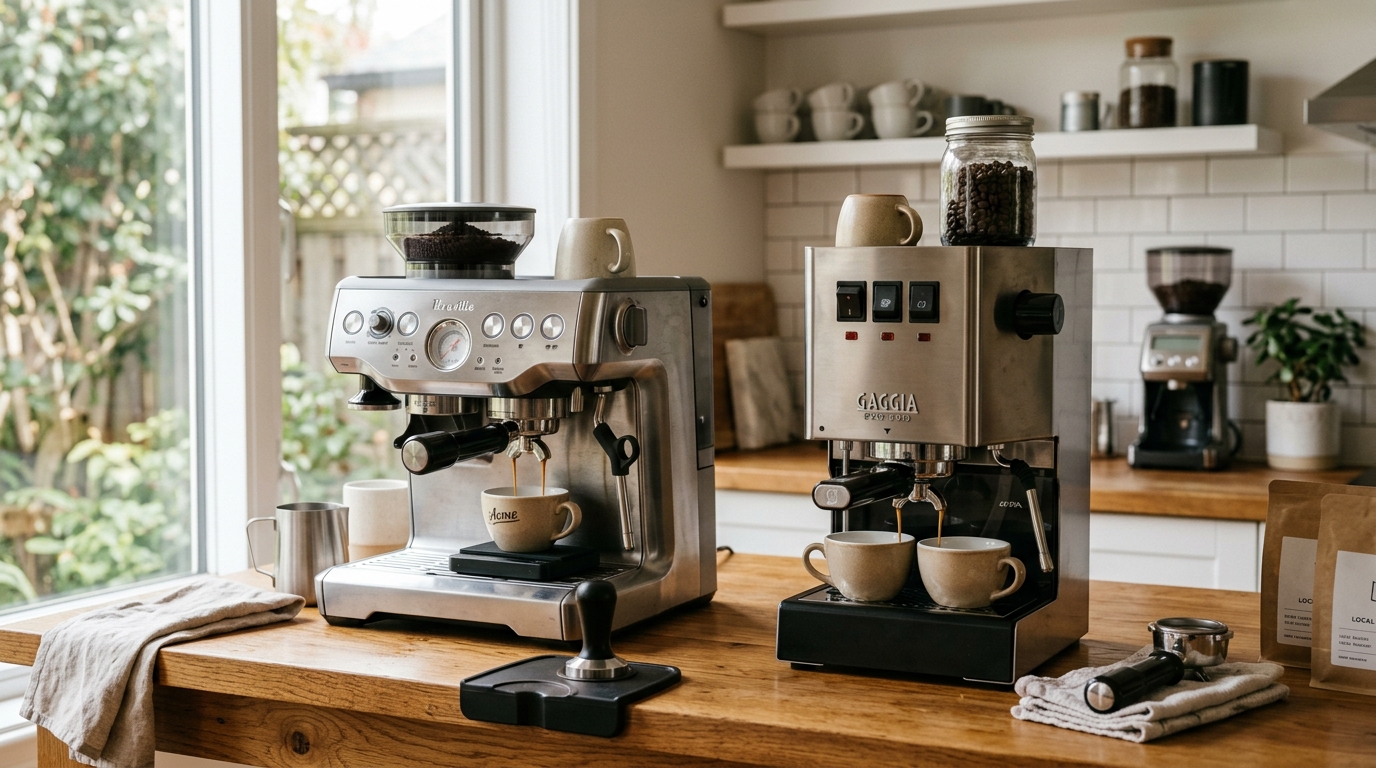
The Gaggia Classic Pro wins for serious home baristas who want to grow: at ~$499 it pairs with a dedicated burr grinder for a world-class setup around $700 total. The Breville Barista Express at ~$750 is the better buy if you want one box, minimal setup, and faster warm-up. Both pull excellent espresso — the right choice depends on how you weigh convenience against long-term upgrade potential.
The core lineup: which models are we comparing?
Breville and Gaggia each make a range of machines, but the head-to-head that matters for most buyers is between the Gaggia Classic Pro and either the Breville Barista Express or Breville Barista Pro. These three sit in the $499-899 range and target the same buyer: someone who wants real espresso without super-automatic ease — and who is willing to learn.
Gaggia Classic Pro (~$499-549): Gaggia’s benchmark entry-level machine, refined over several decades. A 58mm commercial-size portafilter group head, a 3-way solenoid valve for dry pucks and immediate repulling, a 15-bar pump pre-set to extract at 9 bar via the over-pressure valve, and a pannarello steam wand that most serious owners replace with the bare metal tip. No built-in grinder. Straightforward internals designed to last 10-15 years.
Gaggia Classic Evo Pro (~$549): A 2023 refresh of the Classic Pro. Key changes include a proper single-hole steam tip from the factory (no pannarello swap needed), slightly faster heat-up, and updated styling. The internal architecture is largely the same as the Classic Pro.
Breville Barista Express (BES870, ~$699-799): A single-boiler machine with a built-in conical burr grinder. Stepless grind adjustment, a 58mm non-pressurized basket, and a thermocoil heating system that reaches brew temperature in roughly 3 minutes. The all-in-one design is the core selling point — grind, dose, tamp, and pull in one workflow on one machine.
Breville Barista Pro (BES878, ~$799-899): The improved version of the Barista Express. It replaces the thermocoil with a ThermoJet element that reaches brew temperature in approximately 3 seconds, adds a 30-position burr adjustment system, and includes an LCD display for shot timing and temperature feedback. Same 58mm basket and steam capability as the Express.
Side-by-side comparison
| Product | Best for | Rating | Notes | |
|---|---|---|---|---|
| Built-in grinder | Breville: conical burr grinder included | — | Gaggia: no grinder — budget $150-200 for a Baratza Encore or similar | — |
| Portafilter size | Tie: both use commercial 58mm baskets | — | 58mm is the industry standard; compatible with the same aftermarket baskets and tools | — |
| Warm-up time | Breville Barista Pro: 3-second ThermoJet heat-up | — | Barista Express: ~3 min; Gaggia Classic Pro: 15-20 min for full thermal stability | — |
| Repairability | Gaggia: designed for home repair with widely available parts | — | Breville repairs often require authorized service centers; parts harder to source independently | — |
| Steam power | Gaggia Classic Evo Pro or bare-tip Classic Pro: stronger dry steam | — | Breville steam is capable but slightly wetter; both can texture microfoam with practice | — |
| Total system cost | Gaggia + Baratza Encore: ~$700; Breville Barista Express: ~$750 | — | Similar all-in price when you factor in the cost of adding a grinder to the Gaggia setup | — |
| Longevity | Gaggia: 10-15 year lifespan is common with basic maintenance | — | Breville machines typically last 5-8 years; thermocoil systems are reliable but not indefinitely repairable | — |
| Upgrade ceiling | Gaggia: significant gains from standalone grinder upgrades | — | Breville: the built-in grinder is difficult to replace, capping the upgrade path | — |
Build quality and longevity
This is one of the starkest differences between these two brands — and it matters for anyone thinking beyond a 3-5 year horizon.
Gaggia Classic Pro uses a stainless steel boiler, a brass group head, and a steel body. The internals are simple by design: a pump, a boiler, a solenoid, a pressure stat, and the group head. Replacement parts for every component are widely available from Amazon, specialty retailers like Whole Latte Love, and eBay suppliers. Many owners replace the OPV spring, steam tip, group head gasket, and shower screen themselves in under 30 minutes with basic tools and a guide from YouTube.
A Gaggia Classic Pro that is descaled regularly and has its group gasket replaced every 12-18 months can easily last 15 years. Forum threads of machines going 20+ years are not uncommon. This is genuinely user-serviceable equipment in the old-school sense.
Breville machines are well-built for their price but use more proprietary construction. The thermocoil and ThermoJet heating systems are reliable day-to-day but expensive or difficult to replace when they fail. Most Breville repairs are directed toward authorized service centers, and parts availability for older models often dries up as product lines are updated. The typical realistic lifespan is 5-8 years of daily use.
Neither machine is disposable — both are meaningful quality steps above $200-300 budget machines — but if you want equipment you can service yourself or pass down in a decade, Gaggia is the more honest choice.
Espresso shot quality
Both machines pull genuine, high-quality espresso from unpressurized 58mm baskets. The shot quality ceiling on either is real. The difference is how quickly you get there and how high that ceiling ultimately sits.
Gaggia Classic Pro rewards patience with the learning curve. The 15-20 minute warm-up is a real friction point for morning workflow, and the standard pannarello steam wand should be replaced with the bare metal tip before serious milk work. Once you have a good grinder dialed in and a stable thermal routine, the Classic Pro pulls shots that match or exceed machines at $1,000+. Many home baristas discover that upgrading from a Classic Pro only makes sense by jumping to dual-boiler territory at $1,500-2,000.
Temperature surfing — pulling the shot immediately after a brief cooling flush — is a common technique that extends the thermal stability window for those who find the full warm-up impractical in the morning. The Evo Pro reduces this friction with faster stabilization out of the box.
Breville Barista Express and Pro deliver acceptable espresso more quickly. The built-in grinder works well at its price point, the thermocoil/ThermoJet system reaches brew temperature fast, and the overall workflow has fewer variables to manage simultaneously. For someone pulling shots in their first month of espresso ownership, the Breville often produces more consistent early results.
The ceiling is lower, however. The built-in Breville grinder performs roughly on par with a standalone unit in the $80-120 range. When you develop enough skill to exceed what it offers — and serious baristas do — there is no path forward within the Breville ecosystem. The grinder and machine are one unit.
Steam wand and milk texturing
Both machines can produce genuine microfoam for lattes and cappuccinos. The experience of getting there differs.
The original Gaggia Classic Pro ships with a pannarello attachment — an automatic frothing sleeve — that produces larger, looser foam. Most experienced users remove it and use the bare metal wand tip, which delivers drier, hotter steam for proper microfoam. The swap takes under a minute and the bare tip is included with the machine. The Gaggia Classic Evo Pro ships without the pannarello and is ready for real texturing immediately.
Gaggia steam pressure is strong and consistent. With the bare tip, texturing a 6-oz pitcher of cold whole milk to flat white standard takes approximately 30-45 seconds in practiced hands.
Breville steam on the Barista Express and Pro is fully capable but slightly wetter than Gaggia. For home use — lattes, cappuccinos, and the occasional cortado — it is entirely adequate. Both machines run on a single boiler, which means pulling a shot and steaming milk requires a mode switch and 20-30 second wait between steps. This is standard single-boiler workflow and manageable for the vast majority of home baristas.
The grinder question
This is the most practically important point in this comparison, and it is consistently underemphasized in side-by-side machine reviews.
The grinder is responsible for roughly half of espresso shot quality. A poorly calibrated grind — too coarse, too fine, or too inconsistent in particle size — produces poor shots on even the best machines. This is why serious home baristas prioritize grinder quality above almost everything else.
The Gaggia Classic Pro’s primary disadvantage — no included grinder — is simultaneously its primary long-term advantage: you choose the grinder that fits your skill level and can upgrade it independently over time.
The standard Gaggia pairing is the Baratza Encore ($170) for beginners: affordable, reliable, consistent enough for excellent espresso with an unpressurized basket, and widely recommended in home espresso communities. As your skill develops, you can upgrade to a Eureka Mignon Notte ($300), a Fellow Opus ($195), or a Niche Zero ($700) while the Classic Pro remains the brewing platform. Each grinder upgrade produces meaningful shot quality improvements without replacing the machine.
The Breville built-in grinder performs roughly on par with a standalone unit in the $80-120 range — adequate for the machine but not exceptional. When you outgrow it, you cannot swap it out. The Breville becomes the bottleneck in its own system, and the only upgrade path is replacing the entire machine.
If you are certain you want to stay at beginner-intermediate skill level, the convenience of the Breville included grinder is a genuine advantage. If you expect to develop serious espresso skills over 2-3 years, the Gaggia plus separate grinder path has a meaningfully higher ceiling.
Which machine should you choose?
Choose the Gaggia Classic Pro if:
- You want to develop real espresso skill over time and want a machine that grows with you
- You prefer equipment that is repairable and long-lived — 10-15 years is realistic
- You are willing to budget an extra $150-200 for a standalone grinder
- You drink lattes and cappuccinos and want strong, dry steam from day one (choose the Evo Pro)
- You want component-level upgrades: better grinder, precision basket, OPV adjustment
Choose the Breville Barista Express or Pro if:
- You want one machine, one box, minimal counter equipment
- Quick warm-up is important — particularly the 3-second ThermoJet in the Barista Pro
- You are newer to espresso and want to limit variables during the learning phase
- You want a clean all-in-one setup that pulls good espresso without managing a separate grinder workflow
Best for serious home baristas who want to develop real skill over time
Gaggia Classic Pro Espresso Machine
The Gaggia Classic Pro is the most recommended entry-level machine in the home espresso community. A commercial 58mm portafilter, a 3-way solenoid valve for dry pucks and immediate repulling, and fully user-serviceable internals make this a machine you can realistically own for 15 years. Pair it with a Baratza Encore for a total investment around $700 and you have a setup that competes with machines at $1,500+. The learning curve is real, but the ceiling is high.
★★★★★ 4.5 · 8,100 reviews
Check current price on Amazon→Best for all-in-one convenience with fast heat-up and built-in grinding
Breville Barista Pro Espresso Machine
The Barista Pro is the best version of Breville's all-in-one concept. The ThermoJet heating system reaches brew temperature in about 3 seconds — no 20-minute warm-up ritual. Thirty burr positions give useful grind flexibility, and the LCD display shows extraction time and temperature at a glance. For someone who wants genuinely good espresso without managing two separate machines, the Barista Pro delivers. Shot quality is excellent within its range; the trade-off is a lower upgrade ceiling compared to a dedicated grinder setup.
★★★★☆ 4.4 · 5,200 reviews
Check current price on Amazon→FAQ
Frequently asked questions
Is the Gaggia Classic Pro worth buying over the Breville Barista Express?
Do I need a separate grinder for the Gaggia Classic Pro?
Which machine heats up faster?
Can both machines make lattes and cappuccinos?
How long do Gaggia vs Breville machines typically last?
Which is better for a complete beginner?
Bottom line
If your priority is long-term quality, repairability, and a machine that grows with your skill: Gaggia Classic Pro. Add a Baratza Encore, budget $700 total, and you have a setup that pulls shots alongside machines at $2,000+. The cost is a 15-20 minute daily warm-up and a steeper initial learning curve — both of which experienced baristas accept as part of the craft.
If your priority is convenience, speed, and one clean setup on the counter: Breville Barista Pro. The 3-second ThermoJet warm-up is genuinely useful for busy mornings, and the built-in grinder keeps the workflow simple. The trade-off is a lower upgrade ceiling and roughly half the machine lifespan compared to Gaggia.
For more machine picks across every budget: our complete espresso machine roundup, the under-$500 guide, and the beginner machine picks. For dialing in your grind after buying: the espresso grind size guide.