guides
Breville Barista Pro vs Barista Express: Which to Buy?
Breville Barista Pro vs Barista Express: heat-up time, grind control, shot quality, and price compared so you pick the right all-in-one machine.
 Elena Marchetti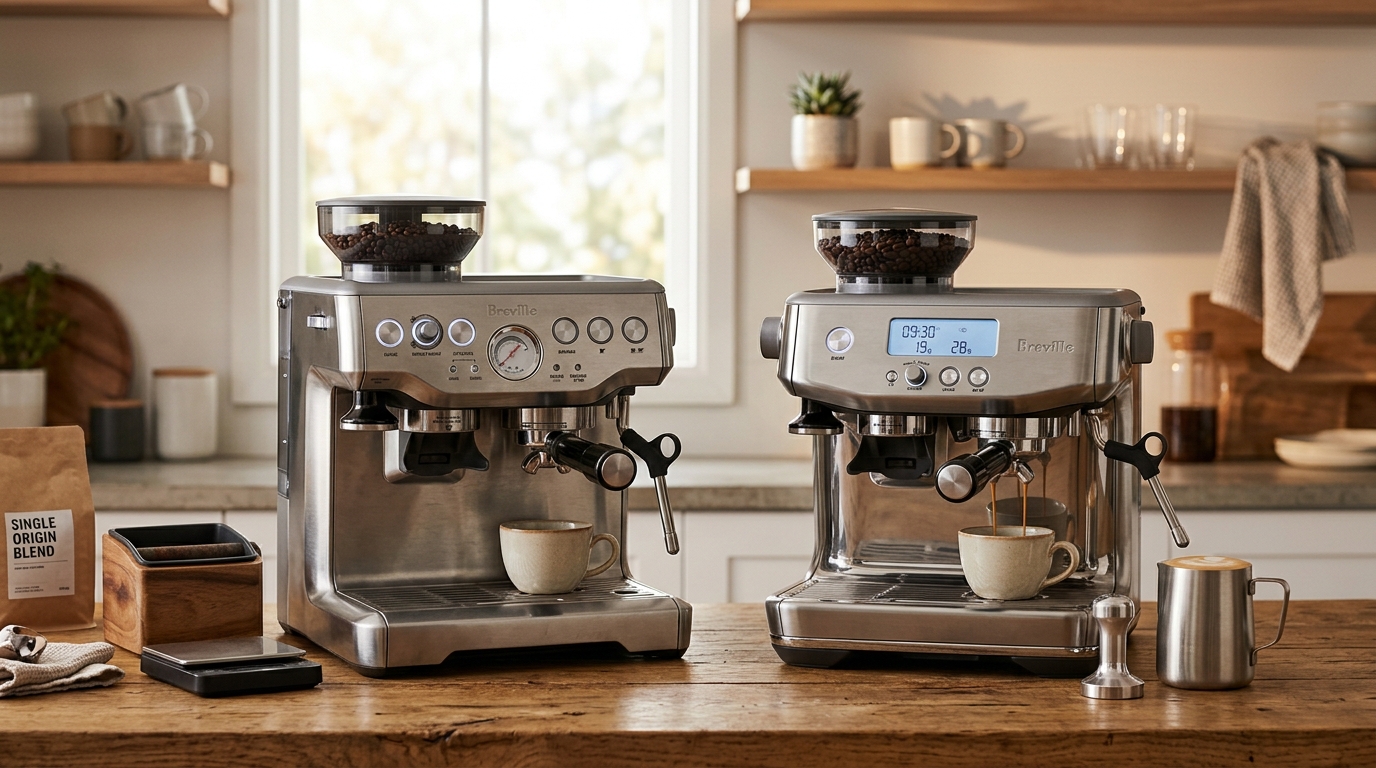
The Breville Barista Pro (BES878) is the clear upgrade choice: its ThermoJet element heats to brew temperature in 3 seconds versus the Barista Express’s 3-minute thermocoil warm-up, and its 30-position grind adjustment gives meaningfully more dial-in precision. If the ~$100-150 price gap matters, the Barista Express (BES870) is a proven all-in-one that still pulls excellent espresso — but the Pro’s faster workflow makes it the better machine for daily use.
Quick comparison
| Product | Best for | Rating | Notes | |
|---|---|---|---|---|
| Heating system | Barista Pro: ThermoJet (3-second heat-up) | — | Barista Express: thermocoil (~3 minutes to brew temperature) | — |
| Grind settings | Barista Pro: 30 positions for finer adjustment | — | Barista Express: 16 positions — adequate but less precise at the margins | — |
| Display | Barista Pro: LCD shows time, temperature, and grind setting | — | Barista Express: no display — you track shot time with a separate timer or by eye | — |
| Portafilter | Tie: both use a 54mm non-pressurized basket | — | Note: 54mm, not the commercial 58mm standard — limits some aftermarket basket compatibility | — |
| Steam wand | Tie: both use the same single-hole steam wand | — | Fully manual wand on both; capable of real microfoam with practice | — |
| Shot quality ceiling | Tie at this price tier — both produce excellent espresso | — | Grinder quality is the primary shared ceiling; not the heating system | — |
| Price | Barista Express: ~$699-799 is ~$100-150 less | — | Barista Pro: ~$799-899 — justify it with the daily time savings on heat-up | — |
| Footprint | Tie: both are nearly identical in size | — | Both are large all-in-one machines — plan for meaningful counter space | — |
Heating system: where the real difference lives
The single most impactful upgrade in the Barista Pro over the Barista Express is the ThermoJet heating element. In daily use this matters more than any specification on the comparison chart.
The Barista Express uses a thermocoil that takes approximately 3 minutes to reach a stable brew temperature of 93°C. That is not long in an absolute sense, but in practice it means either waiting before your first cup or developing a habit of switching the machine on while you grind and tamp — which partially defeats the convenience of an all-in-one. On rushed mornings, many owners end up pulling the first shot slightly under-temperature and accepting a suboptimal result.
The Barista Pro ThermoJet heats to brew temperature in approximately 3 seconds. The machine is ready to pull a shot almost immediately after switching on. This is not a marketing number — it reflects a genuinely different heating architecture that Breville also uses in its higher-end machines. The practical result is that your first shot of the day is pulled at full temperature, and the workflow from “machine off” to “espresso in cup” is meaningfully shorter.
If you pull one to two shots per day, the difference in heat-up time adds up to roughly 6-15 minutes per week saved — modest in absolute terms, but real in daily feel.
Grind control: 30 positions vs 16
Both machines use the same basic built-in conical burr grinder. The Barista Pro adds 30 grind positions where the Barista Express has 16, and adds a dedicated adjustment dial rather than a hidden internal collar on older Barista Express versions.
For beginners, 16 settings is adequate. Most home baristas find their preferred grind range and land within 2-3 positions of it. The problem appears when you start dialing in a new bean bag — roast level, freshness, and origin all shift the optimal grind — and the jumps between 16 settings feel coarse.
With 30 positions, the Barista Pro gives you finer steps between too-coarse and too-fine, which becomes more useful as your palate develops and you start identifying extraction issues that call for a half-step adjustment. It is not transformative for casual drinkers, but it is a real advantage for anyone who changes beans regularly or starts chasing more precise extraction.
Both grinders perform roughly on par with a standalone burr grinder in the $80-120 range — good for all-in-one, and the honest ceiling of both machines. See our espresso grind size guide for dialing in technique that applies to either machine.
LCD display and shot feedback
The Barista Pro’s LCD display shows extraction time, brew temperature, and the current grind setting. It is small and simple — this is not a touchscreen or an app-connected machine — but the information it surfaces is genuinely useful.
Tracking shot time matters because extraction time correlates directly with under- or over-extraction: a 25-35 second window at 1:2 ratio is the target for most single-origin espresso, and knowing where you land without a separate timer simplifies the feedback loop. On the Barista Express, you either use a phone timer or estimate by eye, which is an avoidable friction point.
Temperature readout is useful for diagnosing why a shot tastes off — brewing too hot produces bitterness; too cool produces sourness. Having that number on screen makes the diagnosis faster.
For beginners, the display is also a learning aid: it externalizes information that experienced baristas track mentally, which helps build intuition faster.
Shot quality and espresso output
Both machines pull genuinely excellent espresso from quality beans and a dialed-in grind. The shared ceiling is the built-in grinder, not the heating system — and at their price tier, that ceiling is real.
Expect clean, textured espresso with visible crema, good body, and accurate flavor when you are pulling at the right parameters. Neither machine will embarrass you compared to a well-run café shot. Both underperform against a dedicated standalone grinder setup (think Gaggia Classic Pro plus a Baratza Encore) if maximum shot quality is the only consideration — but for the all-in-one category, Breville is the benchmark.
One technical note: both machines use a 54mm portafilter basket, not the commercial standard 58mm. This is worth knowing because some aftermarket precision baskets and distribution tools are only made for 58mm. The VST, IMS, and Weber baskets that espresso enthusiasts often upgrade to are not available in 54mm from all makers. It is not a dealbreaker, but it is a long-term consideration if you plan to chase higher-end accessories.
For tamping and workflow accessories that fit both machines, see our best espresso tampers roundup.
Steam wand and milk drinks
Both machines use the same single-hole steam wand — a fully manual wand capable of producing proper microfoam for lattes, flat whites, and cappuccinos. There is no meaningful difference between the two machines in milk texturing capability.
Both run on a single boiler, so pulling a shot and steaming milk requires switching modes and waiting approximately 20-30 seconds between steps. This is standard single-boiler workflow and manageable for home use. If you regularly make multiple milk drinks in sequence — say, a morning latte plus a second drink for a partner — a heat exchanger machine or dual boiler would be the better upgrade path, not the Barista Pro.
The steam performance on both machines is solid. Texturing cold whole milk to latte-art standard is achievable with practice; the wand has enough pressure and steam volume for genuine microfoam.
Who should choose which machine?
Choose the Barista Pro if:
- You pull shots in the morning on a tight schedule and do not want to pre-heat for 3 minutes
- You change bean bags regularly and want finer grind adjustment
- You appreciate on-screen shot-time tracking and temperature display
- The ~$100-150 price difference is within your budget
Choose the Barista Express if:
- You are newer to espresso and want a proven, simpler starting point
- You typically allow a few minutes of warm-up time before pulling shots
- Budget is the primary constraint — the Barista Express at ~$699 is meaningfully less
- You do not plan to chase precision extraction and want good everyday espresso without complexity
Best for busy mornings where you need espresso in under 60 seconds
Breville Barista Pro Espresso Machine
The Barista Pro is the better daily driver in the Breville all-in-one lineup. ThermoJet heating reaches brew temperature in 3 seconds rather than 3 minutes, the LCD display shows extraction time and temperature at a glance, and 30 grind positions give you enough precision to dial in new beans without frustration. For most home baristas who pull one to two shots per day and want a clean, low-maintenance workflow, the Barista Pro justifies its premium over the Barista Express.
★★★★★ 4.5 · 6,800 reviews
Check current price on Amazon→Best for beginners who want a proven all-in-one at a lower entry price
Breville Barista Express Espresso Machine
The Barista Express is the machine that introduced most home baristas to all-in-one espresso, and it earns that reputation. The built-in conical burr grinder, 54mm basket, and thermocoil heating system produce genuinely good espresso. It lacks the 3-second heat-up and LCD display of the Barista Pro, but for someone building skills on a budget, those omissions are acceptable trade-offs at a ~$699 entry price.
★★★★☆ 4.4 · 14,200 reviews
Check current price on Amazon→FAQ
Frequently asked questions
Is the Breville Barista Pro worth the extra money over the Barista Express?
Do the Barista Pro and Barista Express use the same grinder?
What size portafilter do both machines use?
Can I make lattes and cappuccinos with either machine?
How long do Breville Barista Pro and Express machines typically last?
Which machine is better for complete beginners?
Bottom line
The Breville Barista Pro is the better machine for most buyers: the 3-second ThermoJet heat-up, 30-position grind adjustment, and LCD display all improve the daily workflow over the Barista Express without changing the fundamental all-in-one formula. Pay the ~$100-150 premium if you pull shots regularly and want a machine that is ready when you are.
The Breville Barista Express remains a strong choice for budget-conscious buyers or beginners who are newer to espresso. The 3-minute warm-up is manageable if you build it into your routine, and the shot quality is genuinely excellent for the price.
For more context: our full Barista Express review, the best espresso machines under $1,000, best espresso machines with a built-in grinder, and the how to dial in espresso guide for getting the most from whichever machine you choose.