roundups
Best Italian Moka Pots 2026 (Bialetti & Beyond)
Best Italian moka pots reviewed: Bialetti Moka Express, Venus, Brikka, De Longhi, Alessi compared for stovetop espresso quality and durability.
 Elena Marchetti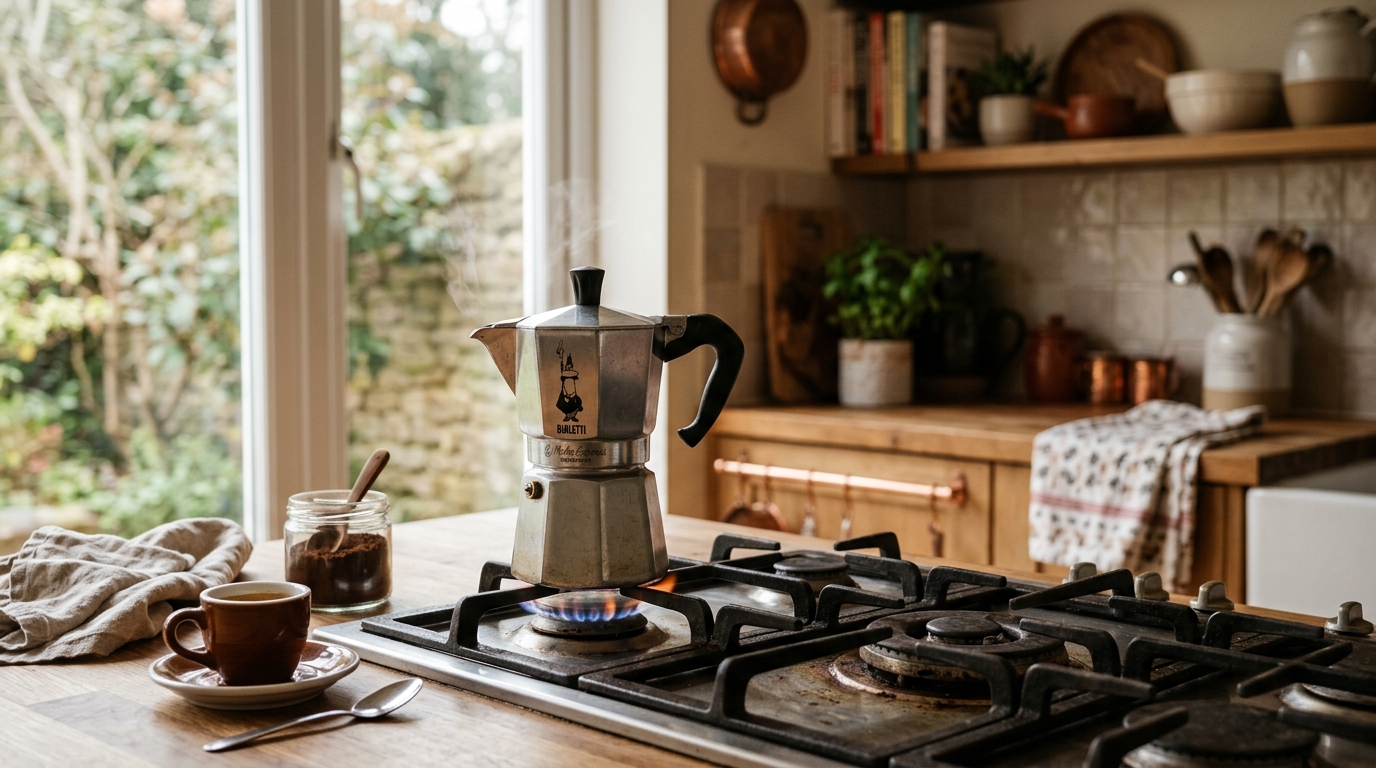
The best Italian moka pot is the Bialetti Moka Express 3-cup — the original, still the standard after 90 years, and genuinely hard to beat at under $40. For richer, crema-topped espresso-style coffee, the Bialetti Brikka adds a pressure valve that produces a noticeably fuller cup. Both ship from Italy and last decades with basic care.
Why the moka pot is still worth buying in 2026
The moka pot was invented by Alfonso Bialetti in 1933 and has changed almost nothing since. That is because the design works. Water in the lower chamber heats to near-boiling, pressure builds, and steam forces hot water up through a packed coffee bed and out through the spout — producing a concentrated, bold coffee that is stronger than drip, richer than Aeropress, and more accessible than espresso machines costing ten times as much.
For anyone who wants strong Italian-style coffee without a $500+ machine and grinder setup, a moka pot is the most honest recommendation. The best ones cost $30-80, last 20+ years, and produce coffee that — when brewed correctly — is genuinely excellent.
What to look for when buying a moka pot
Material. Classic Italian moka pots are cast aluminum, which conducts heat evenly and quickly. Aluminum pots should not go in the dishwasher and can oxidize if not dried promptly — that is the main trade-off. Stainless steel pots cost more, are dishwasher-safe, work on induction cooktops, and are somewhat easier to maintain, but they brew slightly slower and have less of the traditional character. If you have an induction cooktop, stainless steel is mandatory.
Size. Moka pots are rated in espresso cups (1, 3, 6, 9, 12). A 3-cup pot makes roughly 6 oz of concentrated coffee — right for one large cup or two espresso-sized servings. Critically, moka pots do not scale down: a 6-cup pot used half-full produces weak, uneven coffee. Buy the size that matches your actual daily volume.
Pressure valve. Standard moka pots rely on steam pressure alone, producing a rich but non-crema coffee. The Bialetti Brikka adds a weighted pressure valve on the spout that holds back flow until pressure peaks higher, releasing a spurt of concentrated coffee with a thin layer of crema. It is not espresso crema, but it is noticeably more textured and rich than a standard moka pot.
Brand integrity. The moka pot market is full of cheap imitations. Gaskets degrade faster, the basket holes are uneven, and the aluminum is thin enough to warp. Bialetti, De’Longhi, and Alessi use consistent manufacturing that matters over years of daily use.
Quick comparison
| Product | Best for | Rating | Notes | |
|---|---|---|---|---|
| Bialetti Moka Express 3-cup | best overall Italian moka pot | ★★★★★ | The original. Aluminum. Gas/electric stovetops only. | Check price |
| Bialetti Brikka 4-cup | best for crema-like espresso texture | ★★★★★ | Pressure valve adds crema and richer body. Aluminum. | Check price |
| Bialetti Venus 6-cup (Stainless) | best stainless steel moka pot | ★★★★★ | Induction-compatible. Dishwasher-safe. Stainless. | Check price |
| De Longhi Alicia EMK6 | best electric moka pot for stovetop-free brewing | ★★★★☆ | Built-in electric base. No stovetop required. Stainless. | Check price |
| Alessi 9090 Stainless | best design-forward premium moka pot | ★★★★☆ | Richard Sapper design. 18/10 stainless. Museum-quality build. | Check price |
The picks
Best overall: Bialetti Moka Express 3-cup
Best for anyone buying their first moka pot or replacing an old one
Bialetti Moka Express 3-Cup
The Moka Express is the moka pot that all others are measured against — and most fail to match. It uses octagonal die-cast aluminum construction with a thick safety valve, a durable silicone gasket, and precisely drilled filter basket holes that produce even extraction. The 3-cup version (6 oz output) is the ideal size for one person or two espresso-sized servings. When brewed correctly — low heat, lid open, off the burner the moment coffee starts gurgling — it produces a bold, clean, intensely aromatic cup that is genuinely different from anything a drip machine produces. The Moka Express costs $25-40 depending on size and retailer, and units from the 1980s and 1990s are still in daily use. Replacement gaskets are cheap and widely available. This is the starting point for Italian home coffee culture and one of the most defensible product recommendations in kitchen gear.
★★★★★ 4.7 · 28,400 reviews
Check current price on Amazon→Pros
- 90 years of manufacturing refinement
- Replacement parts cheap and widely available
- Octagonal design distributes heat evenly
- 3-cup is perfect for 1-2 servings
Cons
- Not induction-compatible (aluminum)
- Requires hand-washing and prompt drying
- No crema without a Brikka valve
Best for espresso texture: Bialetti Brikka 4-cup
Best for moka pot drinkers who want crema and a richer, espresso-like texture
Bialetti Brikka 4-Cup
The Brikka is Bialetti's pressure-boosted moka pot. A weighted valve on the spout holds back the coffee flow until pressure peaks significantly higher than a standard moka pot, then releases it in a concentrated burst that carries a thin but real layer of reddish-brown crema. The result is visibly different: richer body, more intense aroma, and a texture that bridges the gap between traditional moka coffee and true espresso. It comes only in 2-cup and 4-cup sizes; the 4-cup is the standard recommendation for daily use. The trade-off is that the Brikka requires slightly coarser grind than the Moka Express (too fine and the valve pressure causes grounds to push through the filter) and is less forgiving on technique. Once you dial it in, the cup quality noticeably outpaces the standard Moka Express.
★★★★★ 4.5 · 6,700 reviews
Check current price on Amazon→Pros
- Pressure valve creates real crema layer
- Noticeably richer body than standard moka pots
- Same durable Bialetti aluminum construction
Cons
- Less forgiving on grind and heat
- Aluminum only — no induction
- Pricier than the Moka Express
Best stainless / induction: Bialetti Venus 6-cup
Best for induction cooktop owners and anyone who prefers dishwasher-safe gear
Bialetti Venus 6-Cup Stainless Steel
The Venus is Bialetti's stainless steel entry in a rounded, contemporary body that works on all cooktop types including induction. The 18/10 stainless construction is dishwasher-safe (though hand-washing extends the gasket life), the mirror-polished exterior stays looking sharp, and the conical stainless body conducts heat efficiently. The tradeoff versus aluminum: stainless heats slightly slower and costs more. The 6-cup version (12 oz output) suits two-person households who want a pot that goes straight from stovetop to table. If you have an induction range, this is the moka pot to buy — it is the only category where the aluminum Moka Express cannot serve you.
★★★★★ 4.5 · 4,200 reviews
Check current price on Amazon→Pros
- Induction-compatible stainless steel
- Dishwasher-safe (hand-washing still recommended)
- Contemporary design fits modern kitchens
Cons
- Heats slower than aluminum
- More expensive than the Moka Express
- Larger 6-cup minimum may be too much for one person
Best electric: De Longhi Alicia EMK6
Best for office use or anyone without a suitable stovetop
De Longhi Alicia Electric Moka EMK6
The De Longhi Alicia takes the moka pot mechanism and mounts it on an electric base, eliminating the stovetop entirely. The heat element cycles at the right temperature for moka brewing, and the stainless carafe serves 6 espresso cups per batch. It is genuinely useful in office settings, dorm rooms, or for people whose stovetop heat is difficult to control. The output is classic moka coffee — bold and concentrated — not dramatically different from stovetop in the cup. The trade-off is that you trade the $30 simplicity of a Moka Express for $80-100 convenience. For most home users who have a functional stovetop, the classic Moka Express is a better buy. For offices and travel, the Alicia is the most reliable moka-style option.
★★★★☆ 4.2 · 3,100 reviews
Check current price on Amazon→Pros
- No stovetop needed — built-in electric heating
- Consistent temperature control
- Good for office or travel use
Cons
- More expensive than stovetop models
- Less portable than a classic moka pot
- Brewing speed slower than direct flame
Best premium: Alessi 9090 Stainless Steel
Best for design enthusiasts who want a moka pot that is also a collectible object
Alessi 9090 Moka Coffee Maker
Richard Sapper designed the Alessi 9090 in 1979 and it entered the permanent collection of the Museum of Modern Art in New York. It is made from 18/10 stainless steel with a rounded, sculptural body and a lid designed to trap and recirculate the first drops of coffee — a detail that actually produces a slightly more complex cup compared to a standard open-spout moka pot. It works on all stovetops including induction, is dishwasher-safe, and costs $200-300 depending on size. That price reflects the Italian design and manufacturing pedigree, not a proportional improvement in coffee quality over the $40 Moka Express. Buy the Alessi 9090 if you want an object that will outlast every appliance in your kitchen and earn comments from every guest who sees it on the stovetop. Do not buy it expecting dramatically better coffee than a Bialetti.
★★★★☆ 4.4 · 890 reviews
Check current price on Amazon→Pros
- Museum-quality Italian design
- Induction-compatible stainless steel
- Lid recirculation improves cup complexity
Cons
- $200-300 price is entirely about design, not proportional coffee improvement
- Heavier and bulkier than standard moka pots
What to skip
Generic aluminum moka pots under $20. These exist in abundance on Amazon under names you have never heard of. The aluminum is thinner, the gaskets degrade faster (and finding replacements is harder), and the filter basket holes are less precisely drilled — producing uneven extraction and grounds in the cup. A genuine Bialetti Moka Express costs $25-40 and lasts 20+ years. The price difference is not worth chasing.
Moka pots marketed as “espresso makers.” True espresso requires 9 bars of pressure. Moka pots produce 1-2 bars — strong, concentrated coffee, but not technically espresso. If someone promises “real espresso” from a stovetop device under $100, they are misleading you. The coffee is excellent; the claim is false. Buy accordingly.
Oversize pots (9-cup, 12-cup) for small households. A moka pot must be filled to the correct level to brew properly. Running a 12-cup pot half-empty produces weak, uneven coffee and strains the gasket. Match pot size to actual daily usage — three people at home means a 6-cup maximum.
How to brew a great moka pot cup
- Fill with cold or room-temperature water up to the safety valve, never above it.
- Use medium-fine ground coffee — finer than drip, noticeably coarser than espresso. Fill the basket level without tamping.
- Heat on low to medium-low heat with the lid open. Low heat is the single most important variable.
- Remove from heat when the gurgle starts. The gurgling sound means steam is pushing through — that coffee is bitter. Pull it off the burner the moment you hear it.
- Pour immediately. Do not let the coffee sit in a hot carafe; it continues extracting and turns bitter.
For more detail on technique, see the complete moka pot guide.
FAQ
Frequently asked questions
Is Bialetti the best moka pot brand?
What size moka pot should I buy?
Can I use a moka pot on an induction cooktop?
How is moka pot coffee different from espresso?
How do I clean a moka pot?
How long does a moka pot last?
Bottom line
Best overall: Bialetti Moka Express 3-cup. Best for crema texture: Bialetti Brikka 4-cup. Best for induction: Bialetti Venus. Best electric: De Longhi Alicia EMK6. Best design statement: Alessi 9090.
For technique that unlocks the best from any of these, read the complete moka pot brewing guide. Compare the moka pot to the Aeropress and capsule machines in our moka pot vs espresso machine breakdown, or learn how to use your moka pot for Cuban-style coffee. For the beans that work best in a moka pot, see our best espresso beans guide.