roundups
Best Espresso Travel Kits 2026
Best portable espresso travel kits: Wacaco Nanopresso, Picopresso, 1Zpresso Q2, and Flair Signature — honest picks for café-quality shots anywhere.
 Elena Marchetti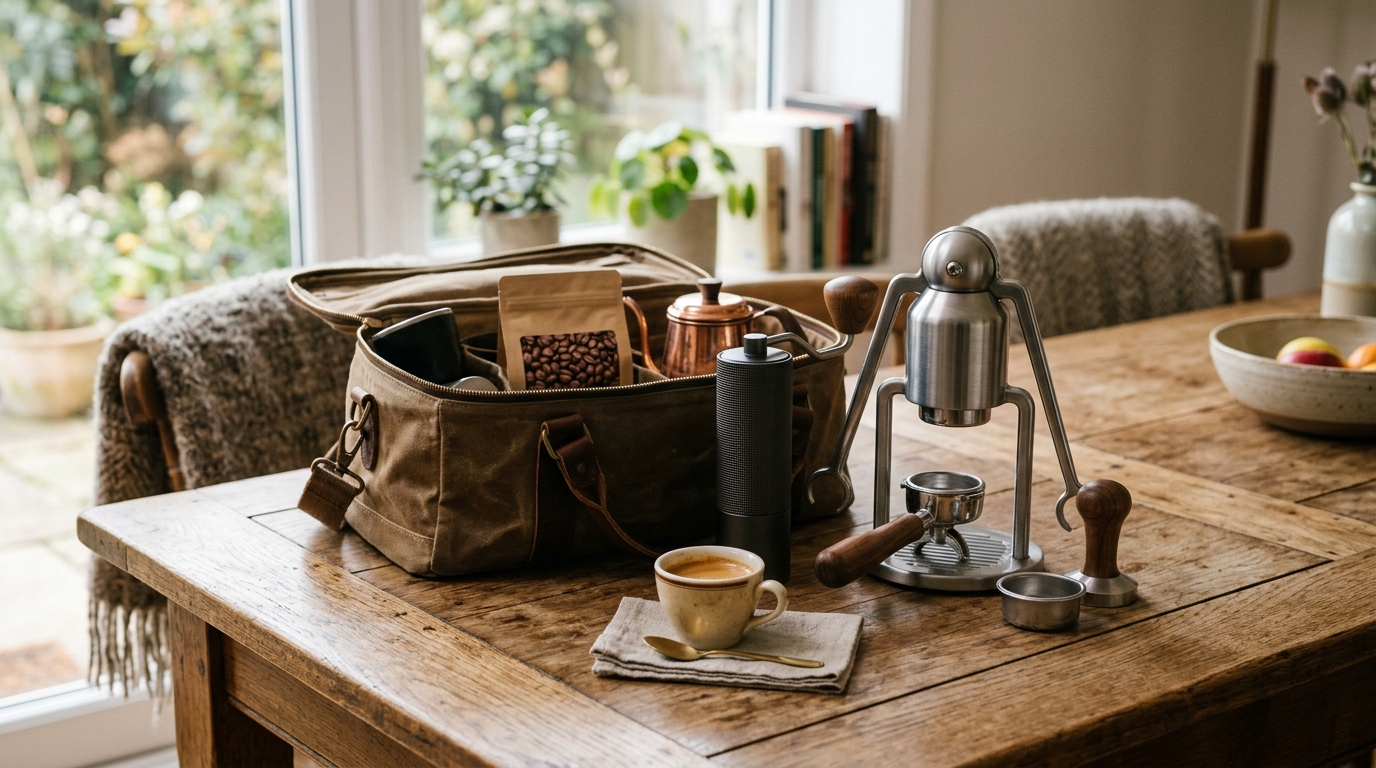
The best espresso travel kit centers on the Wacaco Nanopresso paired with a 1Zpresso Q2 hand grinder — together under $140, packable in a jacket pocket, and capable of shots that rival café espresso. For travelers who want specialty-grade extraction, the Wacaco Picopresso and Flair Signature step up meaningfully without requiring a power outlet.
What makes a travel espresso setup actually work
A travel espresso kit lives and dies on three variables: extraction pressure, grind quality, and workflow portability.
Most entry portable espresso makers advertise 20 bar of theoretical pressure but generate 7-9 bar at the puck via manual pumping — enough for espresso, but highly technique-dependent. The Wacaco Nanopresso is the clearest exception: its internal pumping cylinder delivers a consistent 18 bar with each stroke through a well-engineered pumping mechanism, not just marketing.
Grind quality is the hard constraint most travel kit buyers underestimate. Pre-ground coffee — even fresh, high-quality pre-ground — degrades in taste within hours of grinding and cannot be fine-tuned for your specific puck depth or extraction target. A compact burr hand grinder like the 1Zpresso Q2 or Timemore Slim Plus takes up less space than a protein bar and transforms shot quality completely.
Workflow portability means your kit sets up and cleans up in under 10 minutes total with no sink required. The best portable espresso setups use a damp cloth wipe and a rinse cup for cleanup — making espresso in a hotel room, at a campsite, or in an airport lounge fully realistic. If a setup requires rinsing multiple components under running water, it is not a practical travel kit.
What to look for when choosing
Self-contained vs. modular. The Nanopresso is self-contained — water reservoir, portafilter, and pump all in one unit. The Picopresso and Flair Signature are modular — you pour water directly during extraction. Self-contained is easier; modular gives more control over water temperature and volume.
Puck size. Larger puck diameters (58mm, like the Picopresso and Flair Signature) distribute water more evenly across the coffee bed and produce more nuanced extraction. Smaller pucks (like the Nanopresso’s 30mm) are easier to manage but have a lower ceiling on extraction quality.
Weight and packed size. The Nanopresso (336g) and Picopresso (196g) are pack-in-any-bag options. The Flair Signature (~1.5kg in its case) is more appropriate for a vacation home or cabin where you have a bag to check.
Hot water access. Every device in this guide requires hot water — between 88-96°C (190-205°F). A hotel kettle, camping stove, or portable travel kettle all work. Pack a travel kettle if you will be somewhere without one.
Quick comparison
| Product | Best for | Rating | Notes | |
|---|---|---|---|---|
| Wacaco Nanopresso | best all-in-one portable espresso maker | ★★★★★ | 18 bar. 30mm puck. 336g. Self-contained reservoir. ~$65. | Check price |
| Wacaco Picopresso | best portable maker for specialty-grade extraction | ★★★★★ | 18 bar. 58mm puck. 196g. Rewards skilled technique. ~$130. | Check price |
| 1Zpresso Q2 | best compact burr grinder for espresso travel | ★★★★☆ | Conical burr. 38mm. 178g. Folds to pocket size. ~$69. | Check price |
| Timemore Slim Plus | best budget travel hand grinder | ★★★★☆ | Conical burr. 38mm. 170g. Nests inside Nanopresso. ~$55. | Check price |
| Flair Signature | best lever espresso maker for longer trips | ★★★★☆ | Manual lever. 58mm. ~1.5kg in case. Machine-grade shots. ~$160. | Check price |
The picks
Best all-in-one travel espresso maker: Wacaco Nanopresso
Best for travelers who want reliable espresso with minimal setup time and kit space
Wacaco Nanopresso
The Nanopresso is the benchmark portable espresso maker for a reason. Its internal pumping cylinder generates a consistent 18 bar of pressure with each stroke — more than any other self-contained device at this size and price. At 336 grams and roughly the size of a tall water bottle, it fits in a jacket pocket or a small daypack side pocket. Setup is 90 seconds: add hot water to the reservoir, add grounds to the basket, screw the device together, pump 24 strokes. Cleanup is 60 seconds: disassemble, wipe the basket, rinse. For hotel rooms or anywhere you have access to a kettle, this is the easiest path to proper espresso away from home. The NS adapter accessory (sold separately) makes it compatible with Nespresso Original capsules, which is genuinely useful when traveling internationally and fresh ground coffee is hard to source.
★★★★★ 4.5 · 3,800 reviews
Check current price on Amazon→Pros
- 18 bar consistent extraction pressure via well-designed internal pump cylinder
- 336g and bottle-sized — fits a jacket pocket or small daypack side pouch
- 90-second setup, 60-second cleanup with no sink required
- Nespresso NS adapter available for capsule use when fresh grounds are unavailable
- Under $70 — the most affordable capable portable espresso maker available
Cons
- Manual pumping requires 20-24 strokes — a real effort for back-to-back shots
- Water reservoir holds only 80ml — enough for one shot, then refill
- Produces a single shot at a time; doubles require a second fill-and-pump cycle
- Stock carrying case is basic — a third-party neoprene pouch protects it better in a bag
Best for specialty-grade results: Wacaco Picopresso
Best for espresso enthusiasts who want specialty-level shots without a machine or power outlet
Wacaco Picopresso
The Picopresso uses a full 58mm puck diameter — the prosumer standard used in most home and commercial espresso machines — which means your shot dynamics, water distribution, and extraction profile match what a stationary machine produces. A well-dialed Picopresso shot is genuinely comparable to a shot from a $500-600 machine, assuming you have a quality grinder and fresh beans. The device weighs only 196g — lighter than the Nanopresso despite the larger puck size. The trade-off is workflow: the Picopresso is not self-contained. You pour hot water directly into the device during extraction, which requires more precise temperature management and technique than the Nanopresso. It rewards experience. If you pull shots at home and want to replicate that quality on the road, the Picopresso is the only portable device that genuinely delivers it.
★★★★★ 4.6 · 1,200 reviews
Check current price on Amazon→Pros
- 58mm puck diameter — the prosumer standard with the largest accessory ecosystem
- Shot quality rivals $500-600 stationary espresso machines when dialed correctly
- Lighter and more compact than the Nanopresso at only 196g
- Stainless steel construction throughout — more durable than most portable makers
- Works with standard 58mm accessories: tampers, distribution tools, precision baskets
Cons
- Not self-contained — you pour water directly into the device during extraction
- Steeper learning curve than the Nanopresso; proper technique is required for good results
- More expensive than the Nanopresso at around $130
- Requires a quality grinder dialed precisely for espresso — less forgiving than the Nanopresso
Best compact travel hand grinder: 1Zpresso Q2
Best for travelers who want a capable burr grinder in the smallest possible package
1Zpresso Q2
The 1Zpresso Q2 is the smallest quality hand grinder built specifically for espresso. At 178g with a folding handle that cuts the overall packed length by 40%, it is the only hand grinder that realistically fits into a shirt pocket or small camera bag compartment. The 38mm conical stainless steel burrs produce grind quality that competes with electric grinders at two to three times the price — uniform particle size, minimal fines, and consistent results across 15-20g doses. Adjustment is external and stepless, meaning you can move from espresso to filter grind and back without removing the burr set. For a Nanopresso or Picopresso pairing, the Q2 covers everything you need in the smallest footprint of any capable grinder on the market.
★★★★☆ 4.4 · 620 reviews
Check current price on Amazon→Pros
- Smallest capable espresso hand grinder available — 178g with folding handle
- 38mm conical stainless burrs outperform most electric grinders at two to three times the price
- External stepless adjustment — switch between espresso and filter without disassembly
- Folding handle cuts packed length by 40% for true pocket storage
- Consistent dose-to-dose results for 15-20g espresso doses
Cons
- Grinding 18g for espresso takes 60-90 seconds of hand cranking — not fast
- Small bean reservoir (20g max) means filling twice for back-to-back shots
- At $69, it costs slightly more than the Timemore Slim Plus for similar results
- Fewer settings in the coarser filter range compared to larger 1Zpresso models
Best budget travel grinder: Timemore Slim Plus
Best for travelers who want solid burr grind quality at the lowest travel grinder price
Timemore Slim Plus
The Timemore Slim Plus is the most affordable hand grinder worth pairing with a portable espresso maker. Its 38mm conical burrs produce grind quality meaningfully better than any blade grinder, and comparable to the 1Zpresso Q2 for most users, at around $55 — roughly $15 less than the Q2. The slim cylindrical body is 170g and engineered to fit inside the Wacaco Nanopresso outer casing, which is an intentional design choice that saves real bag space for Nanopresso travelers. The fold-flat handle is slightly less rigid than the 1Zpresso, but it is adequate for daily travel use. If you are new to travel espresso or working within a tighter budget, start with the Slim Plus before deciding whether to step up to the 1Zpresso tier.
★★★★☆ 4.3 · 1,800 reviews
Check current price on Amazon→Pros
- 38mm conical burrs deliver meaningfully better grind quality than any blade grinder
- Slim body designed to nest inside the Wacaco Nanopresso outer casing — saves bag space
- Under $60 — the most affordable capable espresso travel grinder
- 170g packed weight — the lightest option in this guide
Cons
- Fold-flat handle is less rigid and durable than competing 1Zpresso models
- Grind adjustment is stepped rather than stepless — slightly less fine-tuning control
- Burr construction shows more wear over 12-18 months of heavy daily use than 1Zpresso builds
Best lever option for longer trips: Flair Signature
Best for espresso enthusiasts who want full lever control and are willing to carry more kit
Flair Signature Espresso Maker
The Flair Signature is a manual lever espresso maker that produces shots competing legitimately with $1,500-2,000 automatic machines. The lever mechanism gives you direct pressure profiling: you control pre-infusion pressure, ramp speed, and extraction flow rate with your hand in real time. The result is espresso with texture, sweetness, and complexity that no pump-based portable device replicates. The trade-off is size: the Flair Signature disassembles into a compact carry case but weighs around 1.5kg total and requires a separate kettle, precision scale, and quality grinder to produce good shots. This is the choice for a weekend trip to a vacation home, a mountain cabin, or any destination where you have a kitchen but no espresso machine — not for ultralight or carry-on-only travel.
★★★★☆ 4.4 · 890 reviews
Check current price on Amazon→Pros
- Manual lever produces shot quality that rivals $1,500-2,000 automatic machines
- Full pressure profiling — pre-infusion, ramp speed, and extraction flow rate all manual
- No electricity required; works anywhere you have a heat source for water
- Stainless steel and aluminum construction built for years of daily use
- Disassembles into a carry case for checked-bag travel storage
Cons
- Around 1.5kg total with carry case — heavier than all other options in this guide
- Requires a kettle, precision scale, and quality grinder to use effectively — not self-contained
- Steeper learning curve than pump-based portable espresso makers
- At $160, it is the most expensive device in this roundup
- Not practical for ultralight packing or carry-on-only travel
What to skip
Mini capsule travel machines (miniature Nespresso-style devices) make capsule coffee, not adjustable espresso. You give up grind control, bean freshness, and recipe flexibility in exchange for convenience — and the shots are locked to whatever the capsule brand decided your espresso should taste like.
Steam-pressure portable makers that advertise “high pressure” without specifying a vibratory or piston pump. Steam-pressure devices produce 1-2 bar at the puck — moka-pot territory, not espresso. The crema they generate is aerated foam, not the emulsified lipid layer that characterizes real espresso.
Battery-powered electric portable espresso makers under $50. The pump pressure and temperature control in this category is inconsistent, and the battery adds weight without solving the underlying extraction problem. They produce worse shots than the Nanopresso at nearly the same packed size.
Buying a travel espresso maker before you have a grinder. Pre-ground espresso — even well-sourced pre-ground — will prevent any portable maker from producing good results. The Timemore Slim Plus at $55 is the correct first purchase. Add the espresso maker after.
FAQ
Frequently asked questions
Do I need hot water or can I use cold water in a portable espresso maker?
Can the Wacaco Nanopresso make a double shot?
Is a travel hand grinder actually good enough for espresso?
What is the lightest complete espresso travel kit I can build?
Do any of these devices work without electricity at all?
Can I bring a portable espresso kit in carry-on luggage?
Bottom line
Best all-in-one: Wacaco Nanopresso — 18 bar, 336g, 90-second setup, under $70, and a genuine NS capsule adapter option for international travel. Best specialty-grade shots: Wacaco Picopresso — 58mm puck, lighter than the Nanopresso, rewards espresso skill with remarkable shot quality anywhere you have hot water. Best compact grinder: 1Zpresso Q2 — 178g with folding handle, stepless espresso adjustment, outperforms electric grinders at three times its price. Best budget grinder: Timemore Slim Plus — nests inside the Nanopresso housing, under $60, a capable starting grinder for any travel kit. Best lever option for longer trips: Flair Signature — full pressure profiling and machine-grade shot quality for any destination with a kitchen.
For the home setup that trains your palate before travel, see our best espresso machines under $500 guide. If you are dialing in extraction at home first, the espresso grind size guide covers every variable. For supporting accessories that travel well, the best espresso tampers and best espresso scales guides cover the remaining kit.