roundups
Best Espresso Scales in 2026
Best espresso scales of 2026: Acaia Pearl, Acaia Lunar, Timemore Black Mirror, and Brewista Smart Scale reviewed and compared.
 Elena Marchetti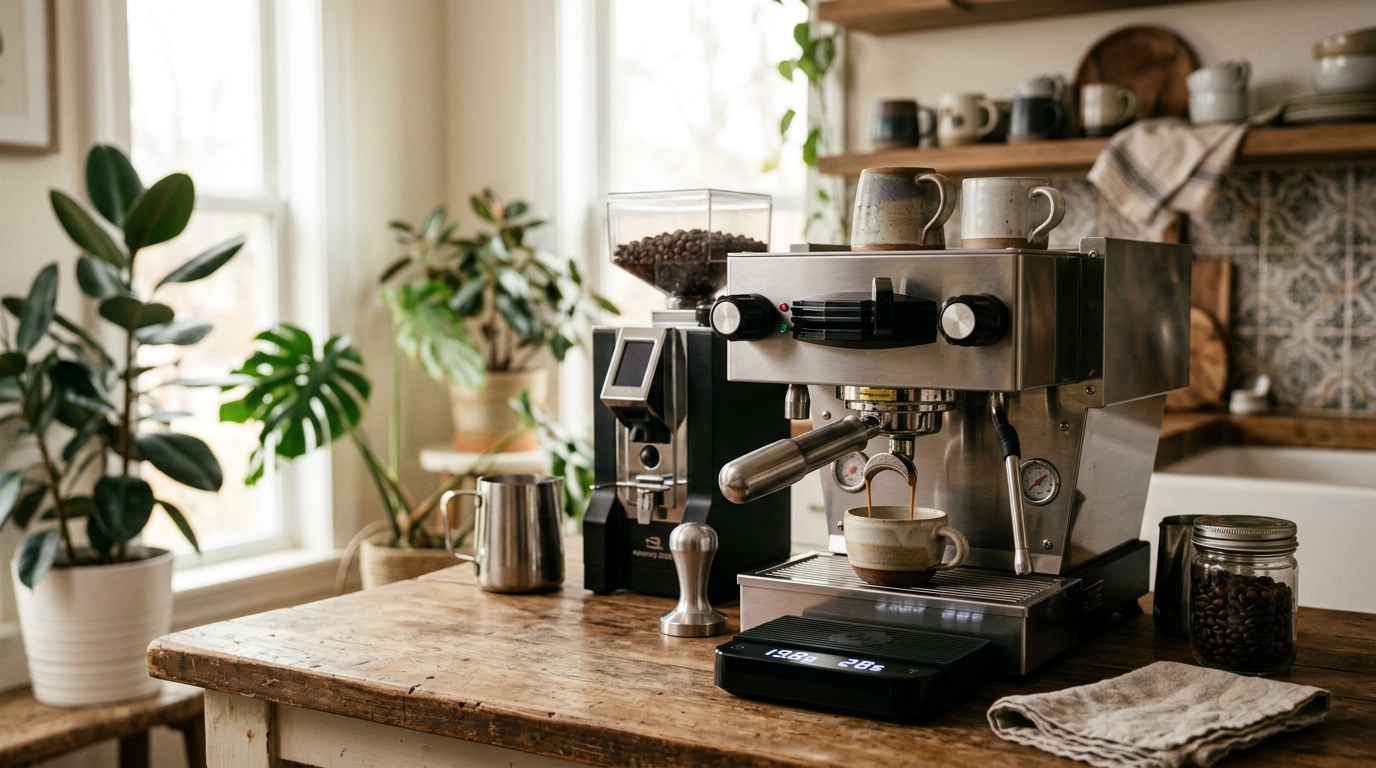
Most home baristas improve their espresso shots faster by adding a scale than by upgrading any other piece of equipment. The reason is straightforward: ratios drive extraction quality more reliably than any intuitive timing approach. A scale turns the abstract instruction “use 18 grams of coffee and pull a 36g shot” into a repeatable measurement you can track, adjust, and compare shot to shot. Without one, you are guessing at input dose, estimating output by volume, and troubleshooting blind. With one, you have data. This guide covers the five espresso scales worth buying, from $65 to $230, with no filler picks.
What separates a good espresso scale from a bad one
Resolution and response time
Espresso scales are sold with two precision numbers that are often conflated. Resolution is the smallest increment the scale can display — 0.1g for most espresso scales, 0.01g for a few premium models. Response time is how quickly the scale updates its reading after a change in weight.
For espresso, resolution at 0.1g is sufficient. Your espresso output changes in increments of 0.1g or more during a 25–35 second pull, and the variables affecting extraction quality — grind size, distribution uniformity, water temperature — all operate at a scale larger than 0.1g output precision can detect. Spending extra for 0.01g resolution is not an investment in shot quality.
Response time is the critical specification. A slow scale — one that takes 1.5–2 seconds to register a weight change — cannot provide useful feedback during an espresso pull. The shot is already past the point where the measurement applies. Fast scales update every 0.3–0.5 seconds, which is fast enough to watch the output climb in real time and stop the shot at your target weight. All five scales in this guide update at approximately 0.7 seconds or better.
Physical dimensions: fitting the drip tray
This is the specification that eliminates more scales than any other. An espresso machine’s drip tray is typically 120–135mm wide and 90–110mm deep, with 20–30mm of height clearance between the tray surface and the portafilter spout. A kitchen food scale — even one with a timer — usually measures 175–200mm wide and 30–40mm tall. It does not fit.
The Acaia Lunar was designed specifically for this constraint: 25mm tall and 115mm × 115mm footprint. The Timemore Black Mirror and Brewista Smart Scale II are also under 30mm tall with footprints that fit most residential espresso machine drip trays. Measure your drip tray clearance before purchasing anything not explicitly designed for espresso use.
Timer and auto-start
An espresso timer that starts automatically when the shot begins is a significant quality-of-life feature. On scales with auto-start — detecting weight change when espresso first hits the cup — you do not need to tap a timer button while managing the portafilter, cup positioning, and machine controls simultaneously. Every scale in this guide includes a manual timer. Auto-start is available on the Timemore Black Mirror and the Acaia scales.
Quick comparison
| Product | Best for | Rating | Notes | |
|---|---|---|---|---|
| Acaia Pearl | best smart scale for home baristas | ★★★★★ | 0.1g. Bluetooth. App with flow rate. ~0.5s response. ~$220. | Check price |
| Acaia Lunar | best scale designed for espresso drip trays | ★★★★★ | 0.1g. 25mm tall. Bluetooth. Rechargeable. ~$230. | Check price |
| Timemore Black Mirror Basic+ | best value espresso scale | ★★★★★ | 0.1g. Timer with auto-start. No Bluetooth. ~$65. | Check price |
| Brewista Smart Scale II | best waterproof espresso scale | ★★★★★ | 0.1g. IPX6 waterproof. Bluetooth. Timer. ~$90. | Check price |
| Felicita Arc | best mid-range Bluetooth scale | ★★★★★ | 0.1g. Bluetooth. Rechargeable. Slim profile. ~$110. | Check price |
The picks
Best overall: Acaia Pearl
Best for home baristas who want the full data picture on every shot and pour
Acaia Pearl
The Acaia Pearl is the scale that set the current benchmark for specialty coffee use and has not been displaced since. Bluetooth connectivity pairs with the Acaia app to display flow rate in real time during extraction — not just cumulative weight, but the rate at which espresso is flowing into the cup in grams per second. That single display has diagnostic value that exceeds what most home baristas expect: a shot that flows fast early and slows suddenly shows a different grind problem than one that flows at a constant rate throughout. The Pearl's response time is 0.3–0.5 seconds — fast enough to be genuinely useful during a 25-second pull. It charges via USB-C, holds a charge for weeks of daily use, and has a flat, easily cleaned stainless surface. At 133mm × 133mm and 29mm tall, it fits most residential machine drip trays without issues. The app logging feature lets you record target ratios, actual results, and shot notes over time — the coffee equivalent of a training log. For home baristas who want to develop espresso skill systematically rather than through repeated guessing: the Pearl's data feedback loop is the highest-value tool in the toolkit.
★★★★★ 4.8 · 4,800 reviews
Check current price on Amazon→Pros
- Real-time flow rate display in the app — shows extraction rate per second, not just cumulative weight
- Sub-0.5-second response time keeps pace with espresso pulls without lagging behind the shot
- USB-C rechargeable with multi-week battery life under daily home use
- App logging tracks ratios, results, and shot notes — useful for systematic dialing-in over time
- Acaia app is mature, actively maintained, and well-documented by the home barista community
Cons
- ~$220 — the app features are genuinely useful, but the price is hard to justify if you will not engage with them
- 133mm × 133mm footprint is slightly large for some narrow drip trays — measure before purchasing
- Bluetooth pairing occasionally drops on some Android devices; iOS is consistently more reliable
- If espresso is your primary use, the Lunar is the better form factor at the same price tier
Best for espresso specifically: Acaia Lunar
Best for home baristas whose primary use is espresso and who need a scale engineered for drip tray placement
Acaia Lunar
The Lunar is what happens when you engineer a scale from the drip tray constraint outward instead of shrinking a general-purpose scale to fit. At 25mm tall and 115mm × 115mm footprint, it slides under the portafilter spout on virtually any residential espresso machine without clearance modification. The electronics inside are identical to the Pearl: same Bluetooth chipset, same Acaia app connectivity, same flow rate display, same sub-0.5-second response time. The functional difference is form factor. Where the Pearl is designed to work well for espresso alongside pourover and other brew methods, the Lunar exists only to solve the espresso drip tray problem — and it solves it better than any other scale available. The stainless steel platform has a slightly textured surface that grips cups without letting them slide during extraction. USB-C charging. The same app logging as the Pearl. If you use a machine where the drip tray-to-portafilter clearance is tight, or if you have struggled with other scales not fitting cleanly, the Lunar is the correct buy regardless of the ~$10–20 premium over the Pearl.
★★★★★ 4.8 · 3,100 reviews
Check current price on Amazon→Pros
- 25mm profile fits under portafilter spouts on virtually all residential espresso machines without modification
- Same Acaia app electronics as the Pearl — flow rate, logging, and all smart features in a purpose-built espresso form factor
- Textured stainless platform grips cups during extraction and resists sliding under pump vibration
- USB-C rechargeable with the same multi-week battery life as the Pearl under daily home use
- Designed specifically for espresso — not a general coffee scale that happens to fit, but an espresso-first product
Cons
- ~$230 — nearly the same price as the Pearl with fewer use cases if you also do pourover or batch brew
- Slightly smaller platform than the Pearl means larger cups or travel mugs feel less stable on the surface
- Bluetooth and app required to access flow rate display — the scale alone shows only weight and time
- Overkill for home baristas who just want a timer and ratio control without the full data layer
Best value: Timemore Black Mirror Basic+
Best for home baristas who want correct specs at the lowest possible price, without Bluetooth
Timemore Black Mirror Basic+
Timemore made the Black Mirror series to address a specific gap: the absence of a well-built coffee scale under $80 with a fast response time and a proper timer. The Basic+ delivers exactly that. Resolution is 0.1g. Response time is approximately 0.5–0.7 seconds — slower than the Acaia by a small margin, fast enough to use comfortably during a 25-second pull. The timer has an auto-start mode that begins counting when it detects weight on the platform, which eliminates the manual start problem for espresso. There is no Bluetooth, no app, no flow rate display. This is not a missing feature — it is a deliberate simplification that reduces the price to ~$65 and removes complexity from a morning workflow that benefits from not involving a phone. The Black Mirror charges via USB-C and holds battery for weeks. Footprint is 130mm × 98mm at 30mm tall — it fits most drip trays with modest clearance. The matte black aluminum surface is easy to wipe clean and resists coffee staining. For a barista who uses ratios, wants a timer, and has no interest in data logging: this is the scale to buy first.
★★★★★ 4.6 · 7,200 reviews
Check current price on Amazon→Pros
- 0.1g resolution and ~0.5–0.7 second response time at ~$65 — correct specs at the lowest price in this guide
- Timer with auto-start mode eliminates the need for manual timer tapping during shot initiation
- No app or Bluetooth — simplified workflow that does not require a phone for basic ratio and timing function
- USB-C rechargeable with weeks of battery life under daily home use
- Matte aluminum surface resists staining and wipes clean easily after spills
Cons
- No flow rate display — response time is fast enough to track cumulative weight in real time, but no per-second rate data
- 130mm × 98mm footprint at 30mm tall requires measuring drip tray clearance before purchasing
- No Bluetooth means no shot logging and no integration with other smart home espresso tools
- Auto-start mode occasionally triggers on machine vibration rather than shot impact; manual timer mode is more reliable on machines with strong pump vibration
Best waterproof: Brewista Smart Scale II
Best for home baristas who want Bluetooth and waterproofing at a mid-range price
Brewista Smart Scale II
Brewista built the Smart Scale II with one specification the Acaia scales lack: IPX6 water resistance. That rating means it survives direct water jets — not just coffee drips, but an accidental full-pressure rinse under the sink without damage. For a scale that lives on a machine drip tray where backflushing and machine cleaning produce standing water, IPX6 is a meaningful durability improvement. The Smart Scale II also has Bluetooth connectivity with a companion app that provides timer functions and basic session logging, though the app is less refined than Acaia's. Response time is approximately 0.5 seconds at 0.1g resolution. Footprint at 120mm × 100mm and 25mm tall is one of the most compact in the mid-range category. Battery charges via USB-C. The primary trade-off relative to the Acaia Lunar at a similar price point is app sophistication: Brewista's app covers the basics without the flow rate analytics the Acaia app provides. For home baristas who prioritize durability and waterproofing over data depth, and who want Bluetooth without paying Acaia prices: the Smart Scale II earns its place.
★★★★★ 4.5 · 1,800 reviews
Check current price on Amazon→Pros
- IPX6 waterproof — survives full rinse under running water, not just splash or drip resistance
- 0.1g resolution with ~0.5 second response time — competitive precision at mid-range pricing
- Compact 120mm × 100mm footprint at 25mm tall fits most drip trays including tight clearance configurations
- Bluetooth with companion app for timer control and basic shot logging
- USB-C rechargeable with consistent battery performance under daily home use volumes
Cons
- Companion app is functional but less polished than Acaia — no real-time flow rate display
- ~$90 puts it within range of the Acaia Lunar, where app quality is significantly better
- Bluetooth range is shorter than Acaia; operates best with phone nearby rather than across the kitchen
- Less community documentation than Acaia; troubleshooting requires more independent research
Best mid-range Bluetooth: Felicita Arc
Best for home baristas who want Bluetooth and a slim profile without paying Acaia prices
Felicita Arc
The Felicita Arc occupies the middle ground between the Timemore Black Mirror Basic+ and the Acaia ecosystem. At ~$110, it adds Bluetooth and a rechargeable lithium battery to a 0.1g, fast-response platform in a profile slim enough for drip tray placement. The Felicita companion app covers the core functions: timer, weight display, auto-tare, and basic session logging. The Arc's build uses aluminum casing and a minimal aesthetic that holds up to daily espresso use without staining. Response time is approximately 0.5 seconds. The footprint fits most residential espresso machine drip trays. Where the Arc sits clearly behind the Acaia Lunar is app depth: no real-time flow rate display, simpler logging interface, and a slower app update cadence. Where it earns its place: for home baristas who want Bluetooth ratio tracking without the $230 Acaia price and who do not need the full Pearl or Lunar data layer, the Arc hits a genuine price-to-performance point that neither the Timemore nor the Acaia quite occupies.
★★★★★ 4.6 · 950 reviews
Check current price on Amazon→Pros
- Bluetooth with companion app at ~$110 — the clearest mid-range option between Timemore and Acaia
- 0.1g resolution with ~0.5 second response time on a slim profile that fits espresso drip trays
- Rechargeable lithium battery via USB-C with multi-week life under daily home use
- Clean aluminum build with minimal aesthetic; holds up without staining under regular coffee exposure
- Auto-tare and timer functions work reliably without the app for core espresso workflow
Cons
- Companion app lacks real-time flow rate — Bluetooth connects but does not add the diagnostic layer the Acaia provides
- ~$110 is close enough to the Acaia Lunar price that the value argument requires honest comparison
- Less widely stocked than Timemore or Acaia; availability varies by region and retailer
- App update cadence is slower than Acaia; feature requests and bug fixes may wait longer
What to skip
General kitchen scales. A kitchen food scale may show 0.1g resolution and cost $15. The disqualifying specification is response time: most kitchen scales update every 1.5–3 seconds. At that speed, you cannot watch an espresso shot in real time — the shot ends before the scale finishes registering the output. Add a physical footprint of 175–200mm wide and 35–50mm tall, and it will not fit on the drip tray regardless of resolution. Kitchen scales work for weighing coffee dose before grinding; they do not work for weighing espresso output during extraction.
Scales with 1g resolution. Some budget coffee scales display weight in 1g increments. That works for filter coffee and drip, where a 1g error in a 30g dose is acceptable. For espresso, your total output is 30–40g — a 1g error on a 36g target is a 2.8% measurement error that translates to meaningful ratio drift and inconsistent results shot to shot. Espresso requires 0.1g resolution.
Scales taller than 35mm. Portable kitchen scales and some compact food scales sit 35–45mm tall. Combined with the height of a cup, total height from drip tray surface to the top of the cup often exceeds the clearance between the drip tray and the portafilter spout. The scale either does not fit under the portafilter, or you must remove the drip tray and improvise a placement that makes weighing the output impractical. Buy a scale engineered for this constraint or measure clearance carefully before purchasing.
Scales with non-rechargeable AA batteries. Some espresso-marketed scales use AA or AAA batteries rather than a rechargeable lithium cell. The scale will reach zero charge on an unexpected morning when the batteries die mid-session. All five scales in this guide use rechargeable lithium cells via USB-C — the correct power architecture for a tool you use every day.
FAQ
Frequently asked questions
What ratio should I use for espresso?
Do I need Bluetooth on my espresso scale?
What size scale fits on an espresso machine drip tray?
Should I weigh the input dose, the output shot, or both?
Can I use a pourover scale for espresso?
How do I stop a shot at the right weight when the scale has response lag?
Bottom line
Best overall: Acaia Pearl — Bluetooth, real-time flow rate, fast response, and a mature app at $220. Best for espresso specifically: Acaia Lunar — same Pearl electronics in a 25mm profile engineered for drip tray clearance at $230. Best value: Timemore Black Mirror Basic+ — correct specs, timer with auto-start, no unnecessary complexity at $65. Best waterproof: Brewista Smart Scale II — IPX6 waterproofing and Bluetooth at $90. Best mid-range Bluetooth: Felicita Arc — the step between Timemore and Acaia at $110 for those who want app connectivity without the full Acaia commitment.
For the rest of your puck preparation workflow, see the best espresso tampers guide covering calibrated and uncalibrated picks from $25 to $115. For a complete list of accessories worth owning at each setup tier, the best espresso accessories guide covers WDT tools, knock boxes, and more. For the grinder that limits shot quality more than any scale can fix, see the best espresso grinders guide. And for a walkthrough of how these tools fit together in a full home setup, see the home espresso setup guide.