guides
Why Espresso Tastes Bitter: Causes and Fixes
Bitter espresso usually means over-extraction, wrong grind, or stale beans. Learn how to diagnose and fix every cause of bitter espresso at home.
 Elena Marchetti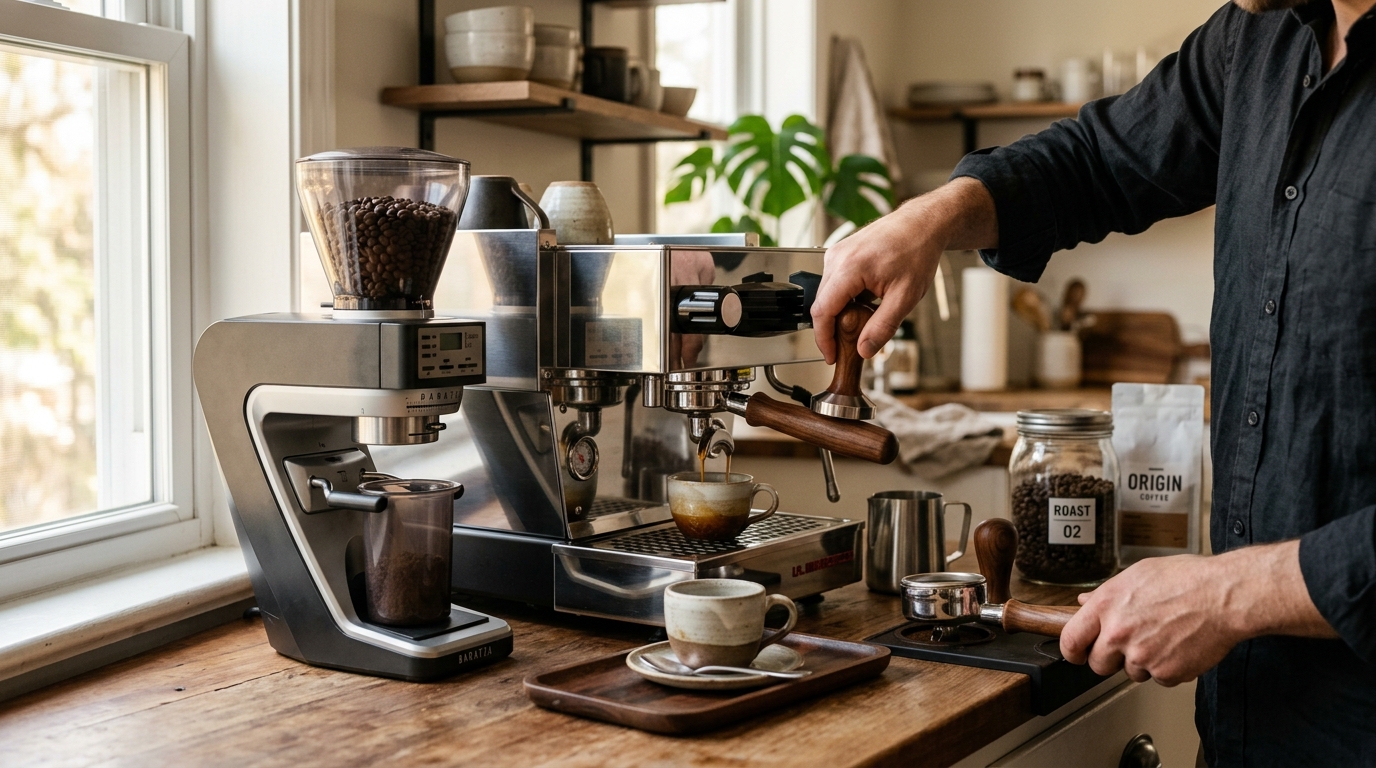
Bitter espresso almost always means over-extraction: the shot ran too slowly and water pulled out the harsh compounds that develop last. The most common causes are a grind that is too fine, water temperature that is too high, a dark roast requiring coarser settings, or beans that are past their prime. Grind one click coarser and clean the machine before adjusting anything else.
What causes bitter espresso?
Bitterness in espresso comes directly from over-extraction. Hot water in contact with ground coffee dissolves compounds in stages: the bright acids and fruity notes extract early, the sweetness and body extract in the middle, and the harsh phenolic compounds come last. When the shot runs too long — or conditions make extraction happen too fast — those harsh compounds reach the cup in concentrations that dominate everything else.
There are five root causes, and most bitter espresso traces back to one or two of them working together:
- Grind too fine — creates high puck resistance, slows water flow, extends extraction into bitter territory
- Water temperature too high — accelerates extraction of all compounds including harsh bitter ones
- Dark roast beans — have more bitter compounds and extract faster than medium or light roasts
- Stale beans — natural sweetness fades with age, leaving bitterness more exposed
- Dirty machine — coffee oil residue and scale cause temperature spikes and off-flavors that read as bitterness
Identify which of these applies to your situation and you can fix most bitter espresso in 3-5 shots.
Is your espresso over-extracted?
The fastest way to diagnose over-extraction is to record three numbers during your next pull: dose (grams of ground coffee), yield (grams of espresso collected), and time (seconds from pump start to stopping the shot).
For a standard 1:2 ratio — 18g of coffee yielding 36g of espresso — the target window is 25-30 seconds. Shots outside this range almost always taste off.
| Product | Best for | Rating | Notes | |
|---|---|---|---|---|
| Shot under 22 seconds | Diagnosis | — | Grind too coarse — water moves through with little resistance. Taste is sour and thin, not bitter. | — |
| Shot 22-30 seconds | Target zone | — | Correct extraction window. If still bitter, check roast level, bean age, or temperature instead of grind. | — |
| Shot 30-35 seconds | Diagnosis | — | Slightly over-extracted. Taste will lean bitter. Grind one click coarser and re-pull to confirm. | — |
| Shot over 35 seconds | Diagnosis | — | Clearly over-extracted. Harsh and bitter throughout. Go several clicks coarser and check puck prep. | — |
| Machine chokes — no flow | Diagnosis | — | Grind far too fine. Go 5-10 clicks coarser immediately and verify dose is correct for basket size. | — |
If the shot runs over 32 seconds, grind is almost certainly the problem. If the shot time is in range but the espresso still tastes harsh, read on — the issue is roast level, bean age, temperature, or machine cleanliness.
Grind size and bitterness
The grind setting is the primary lever for controlling extraction time and the single most common cause of bitter espresso. A grind that is too fine creates a dense, high-resistance puck. Water moves through slowly, spends too long in contact with the grounds, and dissolves the astringent compounds that extract last.
How to fix it: Go one click coarser on the grinder, pull a shot, and record the new extraction time. Most burr grinders shift extraction time by 3-5 seconds per click at the fine end of the range. Repeat one click at a time until the shot lands in the 25-30 second window, then taste from there.
Do not change both grind and dose at the same time. Change one variable per shot so you know exactly which adjustment produced which result.
If you recently changed anything — a new bag of beans, a switch from medium to dark roast, a different basket, or a grinder cleaning — any of these can shift the optimal grind setting by several clicks and cause sudden bitterness where there was none before. Start a fresh dial-in from a coarser baseline.
The fundamental difference between a blade grinder and a burr grinder matters here. Blade grinders pulverize coffee into a mix of fine powder and coarse chunks — the fines over-extract and taste bitter while the coarse pieces stay under-extracted. The result is shots that taste both bitter and sour simultaneously, and no grind setting fixes it because every grind produces the same uneven distribution. A burr grinder produces uniform particles across a consistent size, which is why grind adjustments actually work.
Best for entry-level grind precision that eliminates blade-grinder bitterness
Baratza Encore Conical Burr Grinder
The Baratza Encore is the most-recommended entry-level burr grinder for home espresso. Its 40mm conical burrs produce far more uniform particle distribution than any blade grinder, which directly reduces over-extraction and bitterness. The 40 click-stop settings give meaningful one-click-at-a-time control. If bitter shots are tracing back to uneven grind, upgrading from a blade grinder to the Encore is the single highest-impact fix available.
★★★★★ 4.5 · 8,200 reviews
Check current price on Amazon→How roast level affects bitterness
Dark roasts are fundamentally different from medium or light roasts at the cellular level. High roasting temperatures break down complex sugars, create more bitter phenolic compounds, and make the bean cell walls more porous. Water moves through dark-roasted grounds faster and the harsh compounds dissolve with less resistance.
The practical consequence: dark roast requires a significantly coarser grind setting than medium or light roast from the same machine. Moving from a medium to a dark roast without adjusting the grinder is a reliable way to produce over-extracted, bitter espresso even though the grind setting was correct the day before.
Dark roast grind adjustment: Go coarser — sometimes 8-12 clicks on a stepped burr grinder, or a meaningful turn on a stepless. Pull a shot and check time. Dark roast at a 1:2 ratio in 25-30 seconds will taste smoother and less harsh than the same ratio at 35 seconds.
Dark roasts also benefit from slightly lower brew temperature. The range of 90-92°C (194-198°F) works better for most dark roasts compared to 93-96°C (199-205°F), which is more appropriate for light or medium roasts. If your machine has PID temperature control, try dropping 2-3°C when pulling dark roast and see if bitterness decreases at the same extraction time.
Temperature as a cause of bitterness
Water temperature is the second-largest extraction lever after grind. Brew too hot and the harsh, astringent compounds that normally extract last come out too quickly and in too high a concentration. The shot may hit the correct time window of 25-30 seconds but still taste bitter because temperature accelerated the wrong compounds.
Signs that temperature is the issue:
- Shot time is correct (25-30 seconds) but taste is harsh and astringent
- Problem appeared after a longer warm-up period than usual
- Machine has been running for 30+ minutes before pulling
Temperature fixes:
On single-boiler machines like the Gaggia Classic Pro or Rancilio Silvia, the grouphead runs slightly hot immediately after the heating element cycles on. The thermostat light turning off does not mean the water reaching the puck is at target temperature — it means the boiler hit setpoint. Wait 30-60 seconds after the light turns off, then pull the shot.
A cooling flush drops group temperature quickly: insert the portafilter, run 2-3 seconds of water through without coffee, remove and dry the basket, dose normally, then pull. This technique is especially useful on machines without temperature control and on hot days when ambient temperature is high.
On machines with PID temperature control (Breville Barista Express, Breville Barista Pro, Lelit machines), try dropping the set temperature by 2°C if bitterness persists at correct extraction times. Confirm the machine is fully heat-soaked — at least 15-20 minutes from cold start — before concluding temperature is wrong.
Are your beans past their peak?
Fresh espresso beans contain CO2 from the roasting process and a full complement of aromatic oils. These compounds provide the natural sweetness that balances bitterness in a well-extracted shot. As beans age, CO2 escapes and oils oxidize. The result: bitterness that was previously balanced by sweetness becomes more prominent, and no amount of grind adjustment compensates for lost sweetness.
Target: Beans 7-21 days off roast for espresso. This window gives enough time for initial degassing while preserving the oils and sweetness that balance extraction.
Signs of stale beans causing bitterness:
- Very thin crema or no crema despite correct extraction time
- Shot tastes flat and harsh with no brightness, sweetness, or complexity
- Bitterness appeared gradually over 2-3 weeks as you worked through a bag
- Beans do not have a roast date printed on the bag (a common sign of supermarket beans with no freshness tracking)
The fix is fresh beans stored properly. Whole beans in an airtight container away from light, heat, and moisture hold at peak quality for 3-4 weeks from roast date. A vacuum-seal canister extends that window meaningfully by removing the oxygen that drives oxidation.
Best for extending bean freshness to preserve natural sweetness
Fellow Atmos Vacuum Coffee Canister
The Fellow Atmos removes oxygen from the canister with a twist-top vacuum pump, which slows oxidation and preserves the natural sweetness that balances bitterness in espresso. Beans stored in an Atmos stay at peak quality noticeably longer compared to a standard resealable bag. If bitter shots are tracking with older beans and you go through coffee slowly, an Atmos extends useful life by 1-2 extra weeks.
★★★★★ 4.6 · 5,100 reviews
Check current price on Amazon→A dirty machine causes chronic bitterness
Coffee oil accumulates in the grouphead, shower screen, portafilter basket, and gasket with every shot. At espresso temperatures, old oil goes rancid quickly — it adds a harsh, acrid bitterness to every pull regardless of grind, roast, or technique. A machine that has not been cleaned in weeks or months cannot produce a clean, sweet shot no matter how carefully you dial in.
Scale buildup in the boiler is a separate issue that causes temperature instability. A scaled boiler delivers water at inconsistent temperatures, which produces inconsistent extraction that trends toward over-extraction and bitterness in unpredictable ways.
If you are unsure when the machine was last cleaned, clean it before making any other adjustment. A thorough clean takes less time than a dial-in session and solves a problem that no grind adjustment can fix.
Best for removing coffee oil residue that causes persistent bitter shots
Puly Caff Plus Espresso Machine Cleaner
Coffee oil builds up in the grouphead and portafilter basket with every single shot. Old oil adds harsh bitterness to every pull regardless of grind setting. Puly Caff Plus dissolves oil residue in one backflush cycle on machines with a 3-way solenoid valve — Breville, Rancilio, La Marzocca, and Rocket models all qualify. Weekly backflushing is the most overlooked fix for espresso that tastes chronically bitter with no obvious cause.
★★★★★ 4.8 · 3,900 reviews
Check current price on Amazon→How to fix bitter espresso: step-by-step
Work through these steps in order. Change one thing at a time and pull a test shot after each change before moving to the next step.
- Record your baseline numbers. Pull one shot with current settings and note dose, yield, and extraction time. You need a starting point.
- Check extraction time. If the shot ran over 32 seconds, grind one click coarser and pull again. Repeat until the shot hits 25-30 seconds.
- If time is in range but taste is still bitter, check roast level. If you are pulling dark roast, go coarser and drop temperature 2-3°C. Dark roast is the most common reason for correct-time but still-bitter shots.
- Check bean age. If the bag has been open more than 3 weeks or has no roast date, buy a fresh bag before diagnosing further. Stale beans cause bitterness that technique cannot fix.
- Check machine warmup. Confirm the machine has been running 15-20 minutes before pulling. Run a blank shot with no coffee through the group, wait 2 minutes, then pull your test shot.
- Run a cooling flush if temperature might be high. Two to three seconds of water through the group before pulling drops grouphead temperature noticeably on single-boiler machines.
- Clean the shower screen and backflush. Soak the shower screen in hot water for 10 minutes and run a backflush cycle with a cleaning tablet. Pull one shot after cleaning and note whether bitterness decreases.
- Descale if overdue. If the machine has not been descaled in 2-3 months (or longer), run a full descale cycle before drawing conclusions about extraction.
FAQ
Frequently asked questions
Why does my espresso still taste bitter when extraction time is correct?
Can dark roast espresso ever taste less bitter?
Why did my espresso suddenly get more bitter when I switched bags?
Does a blade grinder cause bitter espresso?
Is bitter espresso a sign of a broken machine?
How often should I clean my espresso machine to prevent bitterness?
Bottom line
Bitter espresso is almost always fixable. Start with grind — go one click coarser if the shot ran over 32 seconds. If time is in range, look at roast level, bean age, and temperature before touching the grinder. A dirty machine is a wildcard that mimics every other problem, so clean it before drawing conclusions. Work through one variable at a time, record your numbers, and most bitter espresso resolves in a single dialing-in session.
For the complete extraction framework: espresso shot troubleshooting guide. For grind adjustment technique: espresso grind size guide. For keeping the machine clean and performing at its best: how to clean your espresso machine and how to descale your espresso machine.