guides
Best Starbucks Beans for Espresso (2026 Guide)
Which Starbucks coffee beans pull the best espresso shot? Espresso Roast vs Blonde vs Verona — flavor, extraction tips, and grind settings compared.
 Elena Marchetti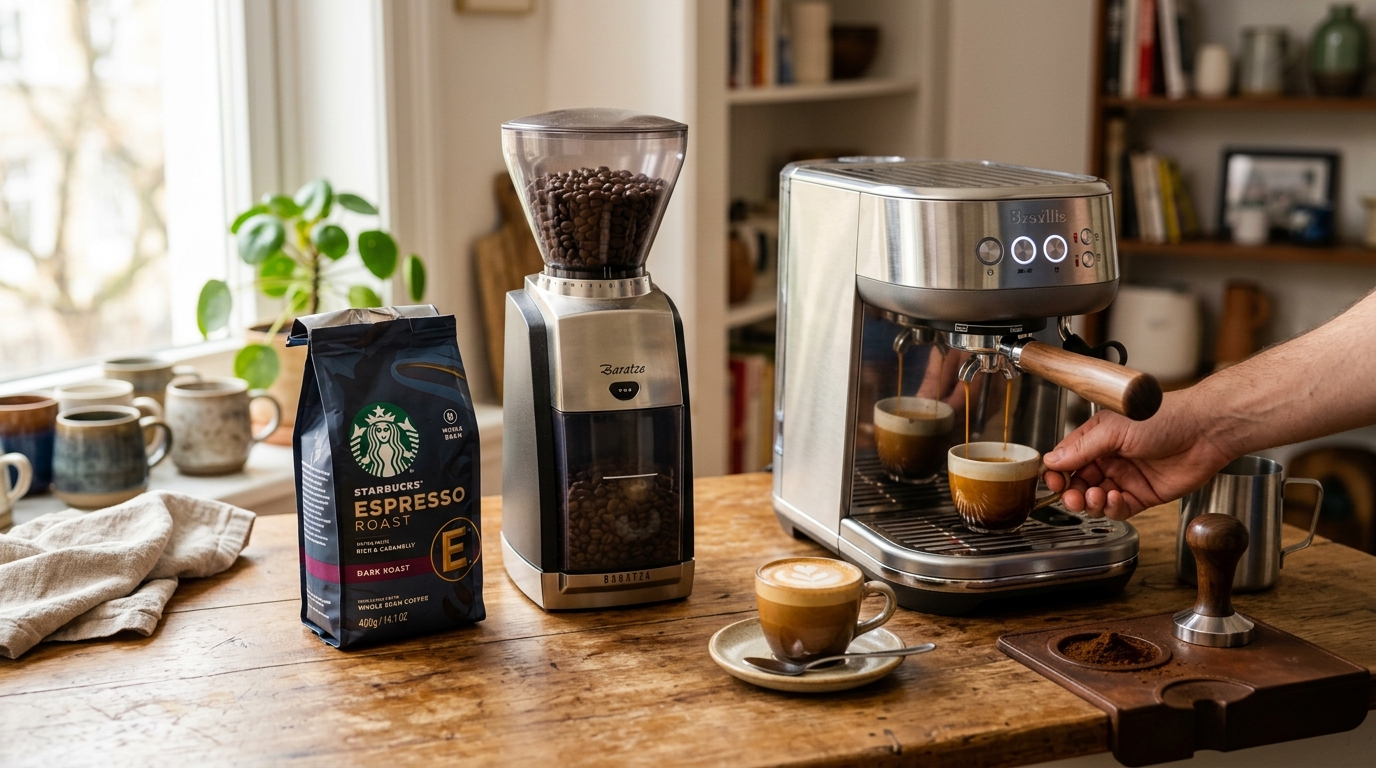
The best Starbucks bean for espresso is the Starbucks Espresso Roast — a dark blend built specifically for espresso that pulls consistent shots with low acidity, thick crema, and a caramelized sweetness. For a less bitter cup, the Starbucks Blonde Espresso Roast is the clear runner-up: lighter body, more sweetness, and noticeably better performance in oat-milk lattes and cortados.
Which Starbucks coffee beans work for espresso?
Starbucks sells several whole-bean and ground coffees. Not all of them are suitable for espresso. The key variable is roast level: espresso machines pull a highly concentrated extraction through a dense puck, which works best with beans developed enough to resist over-extraction bitterness while delivering the body and crema that define an espresso shot.
Starbucks organizes its coffees by roast level into three tiers — Blonde (light), Medium, and Dark — and labels certain products as purpose-built for espresso. Their espresso-specific line (Espresso Roast and Blonde Espresso Roast) is blended and roasted to pull cleanly on commercial and home espresso machines. Their non-espresso lines (Pike Place, Veranda Blend, Sumatra) are optimized for drip or pour-over and may produce thinner, less satisfying results in an espresso machine, though medium and dark offerings can still work.
Here is the practical hierarchy for home espresso use:
- Starbucks Espresso Roast — best for traditional espresso
- Starbucks Blonde Espresso Roast — best for lighter shots and oat-milk drinks
- Starbucks Caffe Verona — best for milk-heavy drinks, strong chocolatey notes
- Starbucks Sumatra — works for espresso, earthy and full-bodied
- Starbucks Pike Place — serviceable but not optimized for espresso
Quick comparison
| Product | Best for | Rating | Notes | |
|---|---|---|---|---|
| Starbucks Espresso Roast | Traditional espresso shots and classic milk drinks | ★★★★★ | Dark roast. Low acidity. Thick crema. The reference standard for Starbucks espresso. | Check price |
| Starbucks Blonde Espresso Roast | Lighter shots, oat milk lattes, flat whites | ★★★★★ | Light-medium roast. More sweetness and brightness. Less bitterness. Popular at Starbucks stores. | Check price |
| Starbucks Caffe Verona | Lattes, cappuccinos, mochas | ★★★★★ | Dark blend. Extra chocolate notes. Slightly sweeter finish than Espresso Roast. | Check price |
| Starbucks Sumatra | Earthy, full-bodied espresso for black-coffee drinkers | ★★★★★ | Dark single-origin. Earthy and herbal profile. Works for espresso but divides opinion on flavor. | Check price |
| Starbucks Pike Place Roast | Drip coffee; acceptable espresso in a pinch | ★★★★☆ | Medium roast designed for drip. Produces espresso without strong crema. Not recommended for espresso-first setups. | Check price |
Starbucks Espresso Roast: the classic choice
Starbucks Espresso Roast is the dark blend the company sells in its cafes worldwide for pulling espresso shots. It is the reference point for what a Starbucks-style espresso should taste like — and it transfers well to home machines.
The roast is dark by any standard. The beans are nearly black, oil-shiny, and have the low density that characterizes extended dark roasting. In the espresso machine, this produces a shot with low acidity, rich caramelized bitterness, and a thick, persistent crema. The flavor profile leans toward dark chocolate, brown sugar, and a faint smokiness — classic Italian-style espresso.
Extraction notes: Because these beans are dark and brittle, they grind easily and produce fine particles quickly. This means you may need to set your grinder slightly coarser than you would for a lighter specialty bean to avoid a choked puck or excessively bitter shot. Aim for a pull time of 25-30 seconds for a double shot at standard 9-bar pressure. Water temperature of 91-93°C (195-200°F) is ideal — higher temperatures amplify bitterness in dark roasts.
In milk drinks: Espresso Roast excels in lattes, cappuccinos, and flat whites. The bold, low-acid flavor cuts through steamed dairy cleanly, and the caramelized sweetness complements whole milk especially well. For oat milk, the roast is strong enough to show through but slightly overpowering compared to the Blonde roast.
Freshness caveat: At most retail stores and on Amazon, Starbucks Espresso Roast has a roast date that may be several months old. For espresso specifically, fresher beans produce more CO2 and therefore better crema. Subscribe-and-Save on Amazon tends to have faster turnover than store inventory.
Best for classic dark espresso shots and all milk-based drinks
Starbucks Espresso Roast Whole Bean Coffee
The original Starbucks espresso blend — a dark, low-acidity roast designed specifically for espresso machines. Pulls consistent shots with rich caramelized flavor, thick crema, and the bold profile that holds up through steamed whole milk or oat milk. Available in 1 lb and 2.5 lb bags. The 2.5 lb bag offers the best per-ounce value for daily espresso drinkers.
★★★★★ 4.7 · 24,600 reviews
Check current price on Amazon→Starbucks Blonde Espresso Roast: lighter shots, sweeter results
Starbucks introduced Blonde Espresso in 2018 as an alternative to their standard dark espresso for customers who found the original too intense. It has since become one of their most popular espresso options in stores — and it works just as well at home.
Blonde Espresso Roast is a light-to-medium roast, notably lighter than the standard Espresso Roast. The beans are tan-brown rather than near-black, with a dry surface (no oil migration). In the espresso machine, this produces a shot that is brighter, sweeter, and less bitter than the dark roast — closer in style to a well-pulled medium-roast specialty espresso than to a traditional Italian dark roast.
Flavor profile: The shot has lemon citrus acidity, a subtle grain sweetness, and a clean finish. It is noticeably less smoky and less bitter than Espresso Roast. Blind tasters who dislike “coffee bitterness” typically prefer Blonde.
Extraction notes: Blonde Espresso Roast is denser than the dark roast, which means it requires a slightly finer grind and slightly higher water temperature (93-95°C / 200-203°F) for full extraction. At lower temperatures or with too coarse a grind, shots can taste thin and sour. Start with a standard dark-roast grind setting and adjust 1 click finer, then dial from there.
Best use case: Oat milk lattes. The brighter, sweeter espresso profile is an excellent match for the mild sweetness of oat milk — better, in most people’s opinion, than the more intense Espresso Roast in the same drink. If you primarily drink oat-milk lattes or flats at Starbucks stores and want to replicate that at home, Blonde Espresso Roast is the pick.
Best for sweeter, less bitter espresso shots and oat-milk lattes
Starbucks Blonde Espresso Roast Whole Bean Coffee
Starbucks lighter espresso blend — a medium roast with citrus brightness, grain sweetness, and significantly less bitterness than the standard dark Espresso Roast. The go-to choice for oat-milk lattes and drinkers who find dark espresso too intense. Requires slightly finer grinding and higher extraction temperature than the dark roast. Available in 1 lb bags.
★★★★★ 4.6 · 11,400 reviews
Check current price on Amazon→Starbucks Caffe Verona: for milk drinks and mochas
Caffe Verona is one of the oldest Starbucks blends and a cult favorite among espresso drinkers who want more chocolate character than the standard Espresso Roast delivers. It is technically a “dark roast” brewing coffee, not a labeled espresso roast, but it pulls beautifully in an espresso machine.
The flavor profile is dark chocolate, dried cherry, and brown sugar — a richer, more dessert-forward profile than Espresso Roast’s caramelized bitterness. In a latte or mocha, Caffe Verona adds a depth of chocolate that complements both dairy and dairy-free milks extremely well.
Best pairing: Mochas and chocolate-based milk drinks. If you add cocoa powder or chocolate syrup to your espresso drinks, Caffe Verona amplifies rather than fights that flavor. For a straight espresso shot, it is bolder and more polarizing than Espresso Roast — some people prefer it, others find it too much.
Extraction notes: Verona is a dark, brittle roast like Espresso Roast. Use the same extraction parameters — 91-93°C, standard grind for dark beans, 25-30 second pull — and adjust coarser if shots taste bitter.
Best for dark espresso with pronounced chocolate notes, lattes, cappuccinos, mochas
Starbucks Caffe Verona Dark Roast Whole Bean Coffee
One of the richest, most chocolatey Starbucks blends — a dark roast with dried cherry and dark chocolate notes that excel in milk-based espresso drinks. Not labeled as an espresso roast but performs well in espresso machines. Available in 1 lb and 2.5 lb bags. The best Starbucks pick for mochas and chocolate-forward lattes.
★★★★★ 4.7 · 9,900 reviews
Check current price on Amazon→How to dial in Starbucks beans on your espresso machine
Getting a great shot from Starbucks beans is straightforward once you understand how dark-roast beans behave differently from lighter specialty beans.
-
Start coarser than you think. Dark roasts (Espresso Roast, Caffe Verona, Sumatra) are brittle and produce more fine particles than lighter beans at the same grind setting. If you set your grinder the same way you would for a specialty medium roast, the puck may be over-compacted and slow the shot to a trickle. Start 1-2 clicks coarser than your medium-roast setting.
-
Use standard 9-bar pressure. Starbucks espresso blends are developed for commercial machines operating at 9 bars. There is no need to adjust pressure. If your machine has a pressure gauge, aim for 9 bars at peak flow.
-
Target 25-30 seconds for a double shot. Measure your dose (typically 18g for a double), start your timer when flow begins, and aim for the shot to complete in 25-30 seconds. A shot finishing in under 20 seconds is too coarse; over 35 seconds is too fine.
-
Lower your water temperature for dark roasts. Most home machines default to 93-94°C. Dark Starbucks beans extract better at 91-93°C — the lower temperature suppresses the bitter, ashy notes that over-extraction pulls from dark roast beans. If your machine allows temperature adjustment, try 92°C as a starting point.
-
For Blonde Espresso, go the opposite direction. Lighter beans need more heat for full extraction. Set water temperature to 93-95°C and grind 1 click finer than your dark-roast setting. Expect the shot to taste thin and sour if underextracted — adjust finer until sweetness appears in the cup.
-
Flush your machine between grind setting changes. If switching between a Starbucks dark and Blonde Espresso, purge 2-3 seconds of water before the next shot to clear any retained grounds from the previous grind.
-
Use a scale. Weigh your dose and your yield. A standard double shot is 18g in, 36g out. Starbucks dark beans lose more mass in roasting, so an 18g measured dose is a good starting point. Adjust dose weight up or down by 0.5g at a time if taste suggests over- or under-extraction.
Starbucks beans vs specialty roasters
Starbucks beans are a solid, accessible option — but it is worth understanding what you gain and give up compared to specialty coffee.
What Starbucks does well: Consistency, availability, and reliability. Starbucks uses the same blends globally with minimal batch-to-batch variation. If you travel frequently or live somewhere with limited specialty coffee access, Starbucks beans ensure you always have a known-quantity espresso coffee on hand. They extract predictably, pair well with milk, and produce crema reliably.
The key trade-off is freshness. Specialty roasters like Onyx, Counter Culture, or Stumptown ship beans within days of roasting. At peak freshness (4-14 days off roast), the CO2 produced during degassing creates lively, complex crema and enhances flavor. Starbucks beans at most retail locations are 4-8 months from roast date by the time you buy them. Crema will still form — dark beans naturally produce more crema due to their oil content — but the cup will not have the complexity that a freshly roasted bean delivers.
Price: Starbucks beans at major retailers run approximately $13-18 per 12 oz, or $20-24 for a 2.5 lb bag. Quality specialty roasters charge $18-32 for a 12 oz bag but ship it 1-3 days off roast. If you drink one double shot per day, a 12 oz bag lasts roughly 10 days — which makes specialty subscription pricing comparable to Starbucks retail pricing.
For convenience-first households and beginners still dialing in technique, Starbucks beans are a smart choice. For anyone who has already dialed in their machine and wants to push the quality ceiling, specialty beans make a meaningful difference.
FAQ
Frequently asked questions
Which Starbucks coffee is best for espresso machines?
Can I use Starbucks Pike Place in an espresso machine?
What is the difference between Starbucks Espresso Roast and Blonde Espresso?
Are Starbucks beans fresh enough for good espresso crema?
What grind size should I use for Starbucks Espresso Roast?
Bottom line
For home espresso, Starbucks Espresso Roast is the best Starbucks option: purpose-built for espresso extraction, widely available, consistent, and reliable in milk drinks. Blonde Espresso Roast is the best pick for anyone who finds dark espresso too bitter or primarily makes oat-milk lattes. Caffe Verona is worth trying if you want deeper chocolate notes in milk-based drinks.
The main compromise with Starbucks beans is freshness — retail bags are rarely close to the roast date, which limits crema quality and complexity compared to specialty roasters. For a meaningful step up in cup quality, consider transitioning to a specialty subscription once your espresso technique is dialed in.
For more on finding the right espresso beans: best espresso beans for home machines, light roast vs dark roast for espresso, single-origin vs blend for espresso, how to choose espresso beans, and how to store coffee beans to preserve freshness.