guides
How to Store Coffee Beans for Maximum Freshness
The right container, location, and timeline for keeping coffee beans fresh — plus whether freezing actually helps or hurts your espresso.
 Elena Marchetti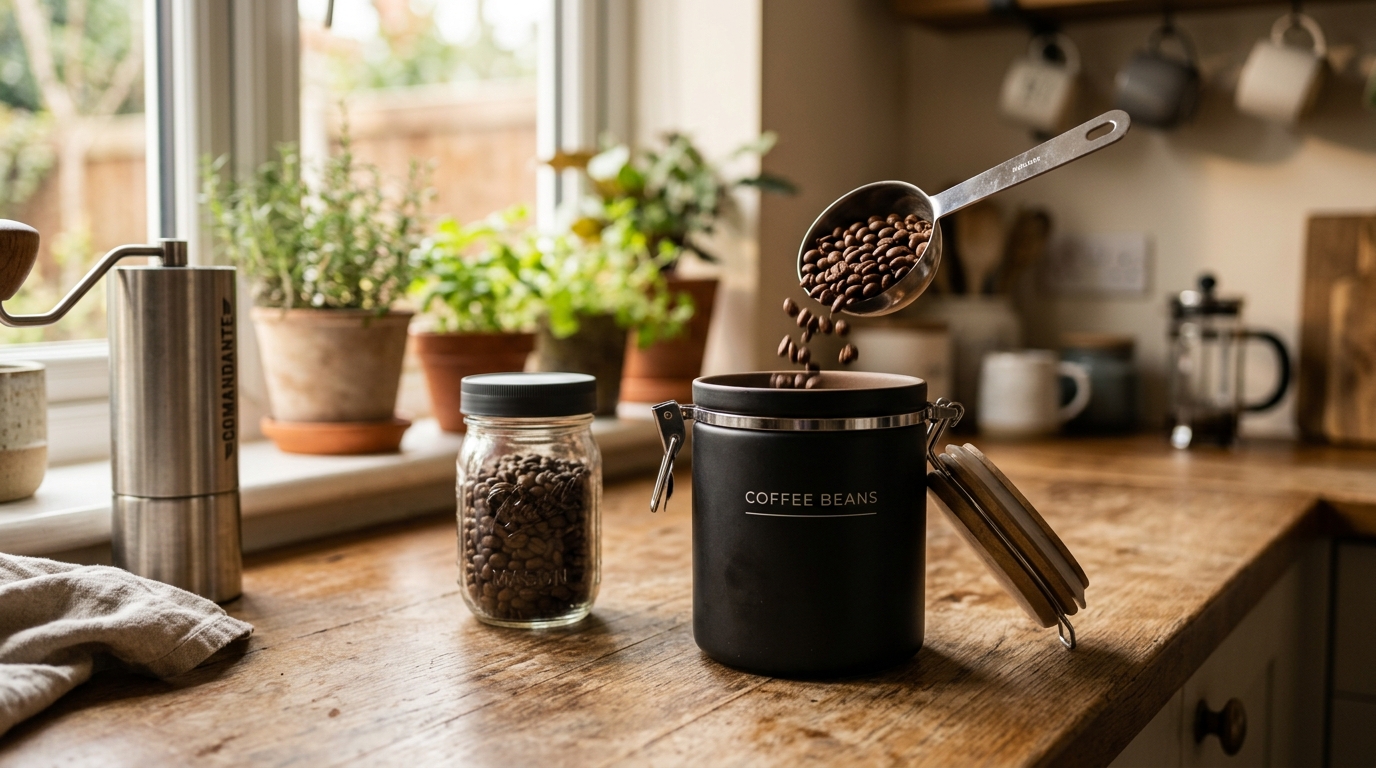
Store coffee beans in an opaque, airtight container at room temperature — not a clear glass jar on the counter, not the refrigerator. A vacuum canister like the Fellow Atmos or Airscape keeps beans at peak flavor for 3-4 weeks after opening. Buy in quantities you can use within two weeks for the best results.
Why storage matters more than most people realize
Coffee beans are not shelf-stable. They are a perishable agricultural product that begins degrading the moment roasting ends. Roasting drives out moisture and generates CO2, which slowly off-gasses from the bean over the following days and weeks. During this window — roughly 4-14 days after roast for espresso — beans are at their flavor peak.
After that peak, oxidation, moisture absorption, and exposure to light and heat progressively flatten the flavor. The oils responsible for aroma and sweetness go rancid. The complex acids that produce brightness and fruit notes break down. By the time most grocery-store beans reach the shelf, they may already be past their best.
Good storage does not stop this process. It slows it. The difference between beans stored in a clear glass jar on a sunny counter versus beans in an opaque vacuum canister in a dark cabinet can be a week or more of peak flavor — which on a $20-25 bag of specialty beans is a meaningful difference.
The four enemies of fresh coffee
Every storage decision comes down to protecting beans from four specific things:
1. Oxygen is the primary culprit. When coffee oils contact oxygen, they oxidize and go stale — the same process that turns butter rancid. CO2 from freshly roasted beans actually helps protect them during the first few days by displacing oxygen in the bag, which is why specialty roasters seal bags with one-way CO2 valves. Once beans are exposed to open air, oxidation accelerates dramatically.
2. Light, especially UV light, breaks down coffee oils through photodegradation. A clear jar of beans sitting near a window will go stale faster than sealed beans in a dark drawer. The best canisters are fully opaque or heavily tinted.
3. Heat accelerates every chemical reaction that degrades coffee flavor. Above roughly 70°F (21°C), oxidation, off-gassing, and rancidification all happen faster. This rules out storage above the espresso machine and anywhere near the stove.
4. Moisture is absorbed by coffee beans and triggers staleness faster than almost anything else. This is also why the refrigerator is a poor choice — moisture cycling in and out as you open and close the fridge door does more harm than any temperature benefit.
Step 1: Choose the right container
The container choice matters more than any other storage variable. Here is how common options compare:
| Product | Best for | Rating | Notes | |
|---|---|---|---|---|
| Vacuum canister (Fellow Atmos, Airscape) | Everyday home storage | ★★★★★ | Removes oxygen; opaque or dark; best option for 2-4 week freshness | — |
| Original roaster bag (sealed and clipped) | First 1-7 days after opening | ★★★★☆ | Great if the bag has a one-way CO2 valve; roll and clip the top tightly | — |
| CO2-valve airtight canister | Heavy users who buy large bags | ★★★★☆ | Lets CO2 out without letting outside air in; good for fresh beans off-gassing | — |
| Opaque ceramic or metal canister (non-vacuum) | Short-term use under 1 week | ★★★☆☆ | Blocks light but not truly airtight; acceptable for very fresh beans used quickly | — |
| Clear glass jar | Display only | ★★☆☆☆ | Allows light penetration; loses freshness noticeably faster than opaque containers | — |
| Refrigerator in any container | Not recommended | ★☆☆☆☆ | Moisture cycling and food odor absorption degrade beans regardless of container quality | — |
The Fellow Atmos and Airscape are the containers most used by specialty coffee enthusiasts for good reason: both actively remove oxygen rather than just sealing it out.
Best for everyday espresso use — the cleanest vacuum-seal canister on the counter
Fellow Atmos Vacuum Canister
The Fellow Atmos uses a twist-to-vacuum mechanism that pulls oxygen out of the canister before you set it down. The matte finish blocks light completely. Available in 0.4L (small bag), 0.7L (standard 250g bag), and 1.2L (large bag). Holds a tight seal for weeks. Worth the price if you are buying specialty beans at $18-25 per bag.
★★★★★ 4.7 · 5,200 reviews
Check prices on Amazon→Best for anyone who wants a simple push-down seal that is fast and foolproof
Airscape Coffee Canister
The Airscape inner lid pushes down and locks to force oxygen out of the headspace above the beans. The outer lid adds a second barrier. Made from stainless steel with a matte finish; available in sizes from 4 oz to 64 oz. Less expensive than the Fellow Atmos and nearly as effective — the push-and-lock mechanism works well every time.
★★★★★ 4.6 · 8,900 reviews
Check prices on Amazon→Step 2: Pick the right location
Once you have a container that removes or excludes oxygen and blocks light, location comes down to the remaining two enemies: heat and moisture.
The ideal spot: A closed cabinet or pantry away from the stove, dishwasher, and any window. Temperature should be stable and consistently below 70°F (21°C). Most kitchen pantries and closed cabinet shelves work well.
Not above or near the espresso machine. Heat and steam generated during machine warm-up cycles raise the temperature of anything nearby. Even beans inside a good canister stored above the machine can lose flavor faster due to repeated heat exposure.
Not near the window. Even inside an opaque canister, a spot near a window cycles between hot and cool repeatedly throughout the day, stressing beans more than consistent cool storage.
Not in the fridge. Despite the intuition that cold preserves things, coffee beans are porous and hygroscopic. They absorb moisture from the refrigerator environment, pick up odor molecules from other foods, and suffer condensation damage when brought out into warmer air. The result is coffee that tastes flat and slightly off — often confused with poor brewing technique.
Step 3: Buy in the right quantities
No container, however good, compensates for buying more beans than you can use while they are fresh. The most common coffee storage mistake is purchasing a large bag and expecting the canister to save it for months.
A practical guide to how much to buy:
- Pull 1-2 shots per day: a 250g bag (about 14-16 doses at 18g per shot) lasts 10-15 days. Buy fresh every 2 weeks.
- Pull 3-4 shots per day: a 250g bag lasts about a week. You can buy 500g bags and use them within 2-3 weeks with no meaningful quality loss.
- Avoid buying 1kg bags unless you make 5 or more drinks per day. Even excellent storage will not save a kilogram of beans for 8-10 weeks at good quality.
Look for a roast date on the bag, not just an expiration date. Specialty roasters almost always print the roast date. For espresso, aim to use beans between 4 and 21 days after roast. Within this window, CO2 is still present and extraction is predictable. Outside this window — either too fresh or too stale — shots behave erratically and taste flat regardless of technique.
Should you freeze coffee beans?
Freezing is more nuanced than the debates online suggest. Done correctly, it works. Done incorrectly, it can ruin beans faster than room-temperature storage.
When freezing makes sense: You have more beans than you can use in the next 3-4 weeks, or you want to stockpile a limited-edition roast. Freezing slows oxidation and off-gassing so dramatically that beans frozen at their peak can remain very close to peak quality for 2-3 months.
The single non-negotiable rule: portion first, freeze once. Before freezing, divide beans into individual airtight portions — vacuum-sealed bags or small airtight containers, each holding enough for one or two days of use. Freeze immediately after portioning. When you need a portion, take it out and let it come fully to room temperature while still sealed (this prevents condensation from forming on the beans). Then open and use within a week. Never put beans back in the freezer.
What goes wrong: Most people freeze beans in the original bag, open and close the freezer bag repeatedly to scoop out daily doses, and wonder why the beans taste off. Repeated freeze-thaw cycles cause moisture damage, and each time a cold bag is opened in warmer air, condensation forms on the beans. The result is flat, damaged beans that extract poorly regardless of grind setting.
Freezing is a logistics tool, not a flavor enhancer. Beans at 4-14 days post-roast stored at room temperature in an Airscape will taste better than the same beans frozen at roast day and thawed weeks later.
How long do coffee beans stay fresh?
Realistic freshness windows under proper storage:
- Unopened specialty bag (sealed, CO2 valve): 6-12 months before meaningfully stale; peak flavor is within 4-6 weeks of roast
- Opened bag in an opaque airtight vacuum canister: 3-4 weeks at good quality; 5-6 weeks at acceptable but diminished quality
- Opened bag stored loosely or in a non-airtight container: 1-2 weeks before noticeable staleness
- Pre-ground coffee in an airtight container: about 1 week at reasonable quality; flat and unremarkable after 2 weeks
- Pre-ground coffee in open air: noticeable flavor loss within a few hours; perceptibly stale within 24 hours
- Frozen whole beans (properly portioned, airtight): 2-3 months with minimal quality loss
The pattern is clear: grind as close to brewing as possible, buy in quantities you use within 2-3 weeks, and eliminate exposure to oxygen, light, heat, and moisture between sessions.
What about pre-ground coffee?
Pre-ground coffee has a vastly larger surface area than whole beans, which means oxidation happens proportionally faster. The aroma compounds released by grinding begin dissipating within minutes. For espresso in particular — which depends on a precise grind size dialed to a specific machine and basket — pre-ground creates two simultaneous problems: staleness and the inability to adjust grind.
If convenience is the priority, a super-automatic espresso machine that grinds fresh on demand is a better solution than buying pre-ground. Investing in a decent burr grinder and buying whole beans pays off every morning in shot quality that pre-ground cannot match.
For drip coffee and AeroPress, pre-ground is more forgiving — the coarser grind and shorter brew time are less sensitive to minor staleness. But even there, whole beans ground fresh taste better.
FAQ
Frequently asked questions
Is it okay to store coffee beans in the original bag?
Can I store coffee beans in the freezer long-term?
Why do my beans taste stale after two weeks even in an airtight container?
Does the one-way valve on a specialty coffee bag actually matter?
What is the best way to store beans if I travel frequently and leave gaps?
Should I store coffee in a dark cabinet or is an opaque canister enough?
Bottom line
Store coffee beans in an opaque, airtight container at room temperature — a Fellow Atmos or Airscape are the two strongest practical choices. Keep the container in a dark cabinet away from heat and moisture. Buy in 2-week quantities rather than bulk. For longer storage, freeze in airtight single-dose portions and let each one thaw fully before opening. The roast date matters more than any container: start with fresh beans and good storage becomes easy to maintain.
For more: the best espresso beans to buy this year, how grind size affects extraction flavor, how to pull a perfect espresso shot, and the best espresso grinders for home use.