guides
Ristretto vs Espresso: Key Differences Explained
Ristretto vs espresso: same dose, less water. Learn how the ratio shift changes flavor, caffeine, and which shot belongs in your favorite drinks.
 Elena Marchetti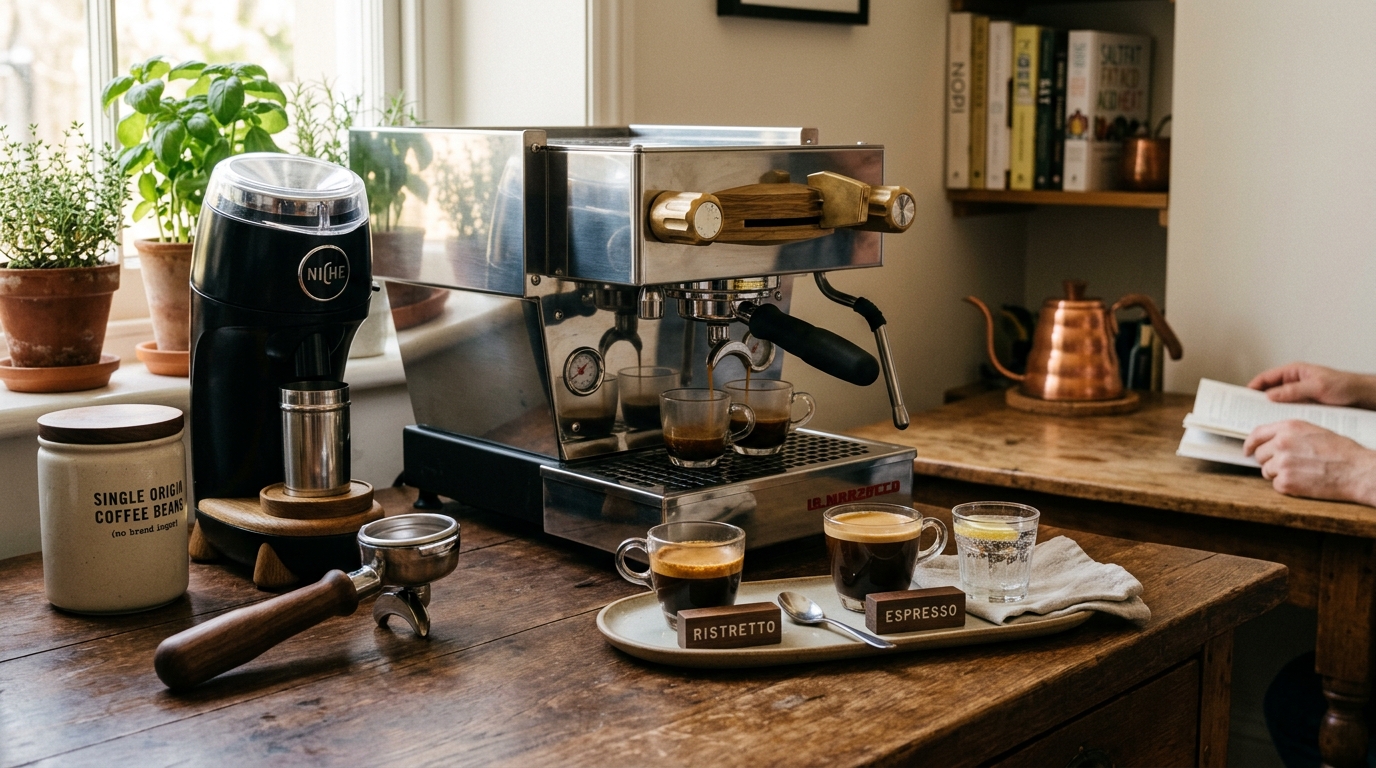
A ristretto uses the same coffee dose as a standard espresso but stops extraction at a 1:1 output ratio — 18g in, 18g out in 15-20 seconds — versus the espresso standard of 1:2. The result is a sweeter, more concentrated shot with less bitterness, preferred by many specialty cafes for milk drinks.
What is the actual difference between a ristretto and an espresso?
Both drinks start from an identical position: same dose of finely ground coffee, same portafilter basket, same pump pressure — typically 18g of grounds at 9 bar. The only variable is how much water passes through the puck before you stop the shot.
A standard espresso targets a 1:2 brew ratio: 18g of coffee in, 36g of liquid espresso out, in approximately 25-30 seconds. This is the benchmark that nearly every specialty cafe and roaster refers to when they talk about pulling espresso, and it is the ratio that most espresso recipes are calibrated around.
A ristretto targets a 1:1 brew ratio: 18g of coffee in, 18g of liquid out, stopping extraction at roughly 15-20 seconds. The word ristretto is Italian for “restricted” — the water volume is restricted, not the coffee dose. You are pulling the same amount of coffee through a shorter extraction window, which concentrates the early-stage compounds and stops before the later, harsher ones dissolve.
A lungo — Italian for “long” — is the third member of this family. It uses the same dose but pushes through more water, typically yielding 54-72g of output in 35-45 seconds. Lungo shots are thinner, more bitter, and contain more caffeine than either ristretto or espresso.
The brew ratio is the single variable that determines the flavor, concentration, bitterness, and behavior of the shot in a milk drink. Everything else stays the same.
Side-by-side comparison
| Product | Best for | Rating | Notes | |
|---|---|---|---|---|
| Brew ratio | Ristretto: 1:1 (18g dose, 18g output) | — | Espresso: 1:2 (18g dose, 36g output) | — |
| Extraction time | Ristretto: 15-20 seconds | — | Espresso: 25-30 seconds | — |
| Volume per shot | Ristretto: approximately 18ml per single | — | Espresso: approximately 36ml per single — twice the volume | — |
| Flavor profile | Ristretto: sweeter, more concentrated, thicker body | — | Espresso: balanced bitterness, brightness, and acidity | — |
| Bitterness | Ristretto: noticeably lower — bitter compounds extract late in the shot | — | Espresso: moderate bitterness from full-length extraction | — |
| Caffeine per shot | Espresso: slightly more caffeine due to longer extraction time | — | Ristretto: marginally less caffeine despite higher concentration | — |
| Use in milk drinks | Ristretto: preferred in flat whites and lattes for its sweetness | — | Espresso: works well in all milk drinks; slightly more bitter base | — |
| Grind adjustment | Ristretto: grind slightly finer to slow the shorter pull | — | Espresso: standard grind tuned for 1:2 ratio at 25-30 seconds | — |
How the shorter pull changes flavor
Espresso extraction is not uniform across the 25-30 second shot. The compounds that dissolve into the water shift significantly as time progresses, which is why the ratio matters so much.
In the first 15-20 seconds, the high-solubility aromatic acids and fruity esters dissolve into the water first. These are responsible for sweetness, floral notes, fruit character, and a syrupy body. This is sometimes called the heart of the shot — maximum aroma, sweetest flavor, most intense concentration.
From 20-30 seconds, extraction shifts toward bitter and astringent compounds: chlorogenic acids, harsh phenols, and tannins. In a well-extracted standard espresso, these add structure and complexity — pleasant bitterness that balances sweetness, similar to high-quality dark chocolate. In an over-extracted or poorly dialed shot, they become harsh and unpleasant.
A ristretto stops before those bitter compounds dominate. The result is a shot that typically tastes:
- Sweeter and more syrupy — the sweetness of the early extraction is not diluted by the later, more bitter extraction phase
- Thicker in body — more dissolved solids per unit of water, creating a denser mouthfeel
- Less bitter — the chlorogenic acids that extract heavily in the final 10+ seconds are largely absent
- More aromatic — volatile aromatic compounds are concentrated rather than diluted by additional water
A standard espresso balances all extraction phases. The bitterness from the final seconds adds complexity and length when extraction is clean. Neither style is objectively better — the ristretto delivers a sweeter, more intense experience, while the espresso delivers a more balanced, layered one.
Does ristretto have more or less caffeine?
This surprises most home baristas: a ristretto contains slightly less caffeine than a standard espresso from the same dose, despite being more concentrated in almost every other way.
Caffeine dissolves into water relatively slowly compared to aromatic compounds. Extraction curves show that caffeine continues increasing in the shot output throughout the full 25-30 second espresso pull. The first 15-20 seconds extract the majority of aromatic compounds and a smaller portion of the available caffeine. The final 10-15 seconds extract less flavor but continue adding caffeine to the output.
In practical terms, the difference is small — a ristretto might yield 60-70mg of caffeine versus 70-80mg in a standard espresso from the same 18g dose. Neither number is large enough to matter for most drinkers. If caffeine content is your primary concern, a lungo (long pull) delivers the most caffeine of the three shot styles from a single dose.
The bottom line: if someone tells you ristretto is “stronger” in caffeine because it is more concentrated, they are measuring concentration correctly but misidentifying which compound makes it stronger. Ristretto is stronger in dissolved aromatic solids; espresso is stronger in caffeine.
When to pull ristretto instead of espresso
In milk-based drinks, ristretto is almost always a better choice. The concentrated sweetness holds up through steamed milk more effectively than a standard espresso. A flat white made with two ristretto shots has a more pronounced, sweeter coffee character than one made with standard espresso doubles. Many specialty cafes default to ristretto-ratio shots for lattes, flat whites, and cortados.
For black shots, the choice is personal preference. If your standard espresso tastes slightly too bitter or harsh, pulling shorter — moving toward a 1:1 ratio — is the first adjustment worth trying before changing beans or grind size. If you prefer espresso with more volume, brightness, and structural bitterness, the standard 1:2 pull is likely the right choice.
With lighter roasts, ristretto can be a useful tool. Light roast coffees extract quickly and can cross into bitterness fast. A short pull preserves the delicate fruity and floral notes that make light roasts interesting without pushing the shot into over-extraction. Many specialty roasters explicitly recommend ristretto ratios on their single-origin espresso offerings.
With darker roasts, the difference matters less. Dark roast espressos are more forgiving across extraction ratios because the roasting process has already caramelized or oxidized many of the more delicate compounds. Both 1:1 and 1:2 pulls from a dark roast taste dark and chocolatey — the ristretto slightly sweeter, the espresso slightly more bitter — but the gap is smaller than with lighter coffees.
How to pull a ristretto at home
Pulling a ristretto is straightforward if you are already pulling consistent espresso. The main changes are the output target and a small grind adjustment:
1. Set your scale to stop at your target ristretto yield. For an 18g dose, target 18g of output. For a 20g dose, target 20g. A precision scale is non-negotiable for ristretto work — the shots are small enough that a 3-4g error represents a significant percentage of total output and will produce noticeably different results.
2. Grind slightly finer than your standard espresso setting. Because less water passes through the same puck, you need slightly more flow resistance to achieve proper extraction in the shorter time window. Start by adjusting one click or notch finer than your standard espresso grind. If the shot stalls completely or tastes over-extracted and harsh, back off slightly.
3. Use the same dose as your standard espresso. Do not reduce the coffee. A common mistake is assuming ristretto means less coffee — it means less water. Reducing the dose instead of the output produces a thin, under-extracted shot.
4. Start the shot and stop at your yield target. If your machine allows programming shot volumes, you can set a shorter volumetric output. If you are stopping manually, watch the scale readout and stop the shot promptly when you hit your target weight. Some machines with lever-style preinfusion allow a natural cutoff.
5. Taste and adjust. A correctly pulled ristretto tastes sweet, intense, and syrupy with minimal harsh bitterness. If it tastes sour or thin, grind finer or let the shot extend to 20 seconds. If it tastes bitter despite the shorter pull, grind slightly coarser — you may be over-extracting the early compounds.
A gram-accurate espresso scale is the most important tool for ristretto consistency. Even a well-dialed machine can drift several grams across short shots, and on an 18g output target, a 4g variance changes the brew ratio from 1:1 to 1:1.2 — a meaningful difference in flavor.
Best for accurate ristretto and espresso yield tracking on any machine
Timemore Black Mirror Nano Espresso Scale
The Timemore Black Mirror Nano is an ultra-thin, heat-resistant espresso scale with 0.1g resolution and a built-in shot timer. At roughly 7mm tall, it fits under most portafilters without blocking flow. The auto-flow mode starts timing when water is detected and pauses when flow stops, eliminating manual timing errors. For ristretto work where hitting 18g versus 22g is the difference between a good shot and a wasted puck, this scale removes the guesswork. Charges via USB-C and battery lasts several weeks of daily use.
★★★★★ 4.6 · 3,200 reviews
Check current price on Amazon→Ristretto in superautomatic and pod machines
Many superautomatic espresso machines — particularly Jura, DeLonghi Magnifica, and Philips LatteGo units — include a ristretto setting alongside standard espresso. This is a genuine feature, not just a marketing label. These machines vary the water volume delivered to the puck, producing a shorter-ratio shot with noticeably different flavor character.
If your superautomatic offers a ristretto option, try it specifically for milk drinks. The concentrated sweetness will come through in a latte or cappuccino more effectively than the same machine’s standard espresso setting. Most superautomatic owners who switch to ristretto for their morning lattes do not switch back.
Nespresso applies similar logic. On the Original Line, the 25ml espresso setting and 40ml lungo setting approximate ristretto and standard espresso ratios respectively — the 25ml setting produces a sweeter, more concentrated shot that performs better in a small flat white or cortado. On the Vertuo Line, the espresso and double espresso sizes sit closer to a ristretto ratio by design.
What to skip
Avoid chasing ristretto ratios on pressurized portafilter basket machines. Entry-level machines from Breville, DeLonghi, and similar brands often ship with pressurized (dual-wall) baskets. These baskets create back-pressure artificially to simulate crema regardless of grind size or dose. Adjusting the output ratio on these machines mostly changes how much water runs through without shifting flavor the way a genuine single-wall extraction does. Upgrade to a single-wall basket before worrying about brew ratios.
Do not use a coarse espresso grind for ristretto work. A coarse grind plus a short pull produces an under-extracted, thin, and sour shot. Dial in a clean standard espresso at 1:2 first, then experiment with ristretto ratios from that baseline. Ristretto is a refinement on top of a working espresso workflow, not an alternative to dialing in properly.
FAQ
Frequently asked questions
What is the ratio for a ristretto?
Does ristretto taste stronger than espresso?
Does ristretto have more caffeine than espresso?
How do you grind for a ristretto?
Are flat whites made with ristretto shots?
Can I pull a ristretto on any espresso machine?
Bottom line
A ristretto and an espresso share everything — same dose, same pressure, same machine — and diverge only in how much water passes through the puck. That one variable shifts the flavor from balanced and complex (espresso) to concentrated, sweet, and low-bitterness (ristretto). Neither is objectively better. Standard espresso is the reference point for a reason; ristretto is the adjustment to make when you want a sweeter shot or a milk drink where coffee sweetness needs to hold its own against dairy.
The practical skill is hitting your target ratio consistently every morning. A 0.1g precision scale removes the guesswork and makes ristretto repeatable.
For more on pulling great shots: how to pull a perfect espresso shot, espresso grind size guide, how to dial in espresso, and espresso shot troubleshooting.