guides
How to Make Vietnamese Iced Coffee
Learn to make Vietnamese iced coffee (ca phe sua da) at home with a phin filter, condensed milk, and the right dark roast coffee beans.
 Elena Marchetti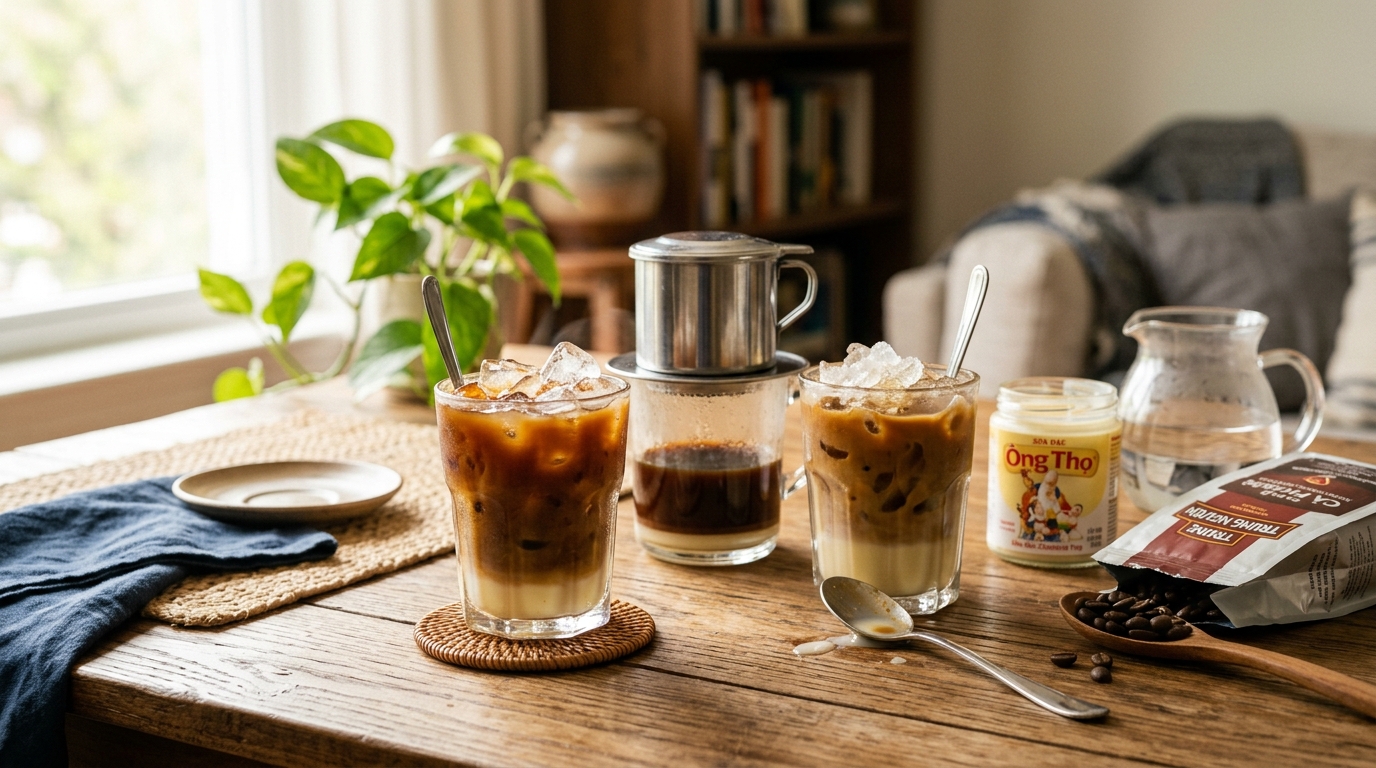
Vietnamese iced coffee is straightforward: add 2 tablespoons of sweetened condensed milk to a glass of ice, set a phin filter on top, add 15-18g of dark-roast ground coffee, and let it drip for 5-7 minutes. The result is strong, sweet, and deeply satisfying — one of the best cold coffee drinks you can make at home.
What is Vietnamese iced coffee?
Cà phê sữa đá — literally “iced milk coffee” in Vietnamese — is the national coffee drink of Vietnam. It is brewed strong through a metal phin filter directly over a glass of ice and sweetened condensed milk. The condensed milk does two jobs: it sweetens the drink and adds a richness that regular milk cannot replicate, because most of its water has been removed and it carries a high concentration of sugar and milk fat.
The drink arrived in Vietnam during the French colonial period, when fresh dairy was scarce and sweetened condensed milk was the practical substitute. The phin filter followed the same logic: simple, durable, and effective without electricity. Decades later, it has become one of the most recognizable coffee preparations in the world.
The flavor is distinctive — very strong coffee intensity, intense sweetness from the condensed milk, and a slightly bitter, earthy finish from the dark-roast robusta-forward beans traditionally used. Over ice, the combination is more refreshing than it sounds. The bitterness and strength are exactly what make it work.
What you need
Equipment
A phin filter. A stainless steel drip chamber with a removable gravity press disk, a grounds chamber, a perforated base plate that rests on the glass rim, and a lid that doubles as a drip catcher. They cost $6-12 and last indefinitely. Any size from 5 oz to 8 oz capacity works for a single serving. The 8 oz phin brews slightly faster and is more forgiving for beginners.
Best for authentic Vietnamese drip coffee at home
Trung Nguyen Stainless Steel Phin Filter
Trung Nguyen makes the phin filter that Vietnamese households actually use. The stainless steel construction is heavy enough to sit stable on any glass rim, and the gravity press plate fits snugly without requiring adjustment. At around $8 for a single-serve 6 oz model, it is the most used and most recommended phin on Amazon — a lifetime purchase that requires no replacement parts.
★★★★★ 4.6 · 3,800 reviews
Check current price on Amazon→A glass or mug that fits the phin. The phin base plate needs to rest on the rim without falling in. Most standard 12-16 oz glasses and mugs work. Measure the inner diameter of your glass rim and buy a phin whose base plate is slightly wider.
Near-boiling water. 195-205°F works well. A standard kettle is fine; a gooseneck kettle gives you more control over the small pour quantities involved.
A scale or measuring spoons. Coffee-to-water ratio matters more with a phin because you are brewing a small, concentrated volume. A 1:7 ratio — about 15-18g of ground coffee to 110-120ml of water — is a reliable starting point.
Ingredients
Coffee. Traditional Vietnamese coffee uses robusta-dominant blends, which are higher in caffeine and more bitter than arabica. Vietnamese brands like Trung Nguyen and Nguyen Coffee Supply are the most authentic options. If you prefer arabica, use a dark French or Italian roast — lighter roasts produce thin, acidic results through a phin.
Sweetened condensed milk. Two tablespoons is the standard starting point; adjust to taste. Eagle Brand and Longevity are the most widely available. Do not substitute evaporated milk (it has no added sugar) — the sweetness and body from condensed milk are structural to the drink, not optional.
Ice. Fill the glass to the top. The hot brewed coffee drips directly onto the ice; the ice is what chills it. Use plenty and replenish if the brew runs long.
How to make Vietnamese iced coffee: step by step
Step 1: Add condensed milk to the glass
Spoon 1.5-2 tablespoons (about 20-25g) of sweetened condensed milk into the bottom of your glass. You can go up to 3 tablespoons if you prefer a sweeter drink — that is the standard in many Vietnamese cafes, where the coffee is brewed even stronger to match.
Step 2: Fill the glass with ice
Pack ice to about 1 inch below the rim. Leave a small amount of space for the brewed coffee. Clear ice melts more slowly and keeps the drink cold longer, but standard cube or crescent ice works perfectly.
Step 3: Set the phin base plate on the glass rim
Place the phin base plate on the rim of the glass. It should rest securely without rocking. If the base plate falls into the glass, the opening is too wide and you need a larger phin or a narrower glass.
Step 4: Add coffee and seat the gravity disk
Add 2-3 tablespoons (15-18g) of ground coffee to the phin chamber. Tap lightly to level the grounds, then set the gravity press disk on top. Do not press down hard — just let it rest. The disk is designed to apply gentle, even pressure as the grounds swell during brewing. Pressing hard restricts flow and causes over-extraction.
Step 5: Bloom the grounds
Add about 15-20ml (1 tablespoon) of near-boiling water over the press disk and watch for drips through the bottom within 10-15 seconds. If nothing comes through after 30 seconds, the grind is too fine — stop and regrind coarser before your next brew. Let the bloom sit for 30 seconds. The CO2 released during this step improves extraction and reduces grassy, sour notes that skipping the bloom can produce.
Step 6: Fill the phin with hot water
Add the remaining hot water slowly — about 90-100ml — until the chamber is nearly full. Place the lid on top with the concave side facing up to catch any overflow drips. The coffee should begin dripping within a few seconds. A steady drip of roughly 2-3 drops per second is the target flow rate.
Step 7: Wait 5-7 minutes
The brew time for a properly set-up phin is 5-7 minutes. Faster than 4 minutes means the grind is too coarse and the coffee will taste weak. Slower than 8 minutes means the grind is too fine and the coffee will be over-extracted and bitter, with muddy sediment in the glass. The lid keeps the brew temperature up — leave it in place during this step.
Step 8: Remove the phin and stir
Once dripping stops, lift the phin off the glass and set it on a small dish (the phin is still very hot). Stir the glass vigorously with a long spoon for 15-20 seconds. This integrates the condensed milk sitting at the bottom with the hot brewed coffee and the ice. An unstirred glass has a layer of sweet milk at the bottom and bitter concentrated coffee on top — always stir before drinking.
Step 9: Taste and adjust
Take a sip and note what to adjust next time. Too sweet: use less condensed milk. Not sweet enough: add more now. Too bitter: grind slightly coarser or use a little less coffee. Too weak: add another 2-3g of coffee or grind slightly finer. The phin is one of the most adjustable brewing methods you will encounter.
Which coffee works best in a phin?
| Product | Best for | Rating | Notes | |
|---|---|---|---|---|
| Trung Nguyen Creative 1 | Traditional Vietnamese flavor | ★★★★★ | Robusta-dominant blend with chocolate and caramel notes; the classic choice, widely available and affordable | Check price |
| Nguyen Coffee Supply Truegrit | Single-origin robusta | ★★★★☆ | Pure Vietnamese robusta, bold and earthy; fresh-roasted and ships directly — strong community following | Check price |
| Cafe Du Monde Coffee Chicory | Chicory-forward bittersweet profile | ★★★★☆ | Not Vietnamese but widely used as a substitute; chicory adds bitterness and body that mimics robusta well | Check price |
| Death Wish Coffee Dark Roast | High-caffeine arabica alternative | ★★★☆☆ | Bold enough for a phin but tastes different from traditional ca phe — bitter without the robusta earthiness | Check price |
Grind size for a phin: medium-coarse — coarser than espresso, slightly finer than a standard pour-over. If you use a burr grinder, aim for roughly 600-700 microns. Pre-ground Vietnamese coffee is usually already at the right particle size. Avoid blade grinders, which produce inconsistent particles that lead to channeling and uneven extraction in the phin.
Best for single-origin Vietnamese robusta for the phin
Nguyen Coffee Supply Truegrit Robusta
Nguyen Coffee Supply sources directly from Vietnamese farmers and roasts in Brooklyn. Truegrit is their 100% robusta — bold, earthy, and slightly chocolatey in a way that arabica dark roasts do not fully replicate. If you want the authentic ca phe sua da experience from a specialty-grade brand rather than a supermarket blend, this is the cleanest option available on Amazon.
★★★★★ 4.5 · 890 reviews
Check current price on Amazon→Variations worth trying
Cà phê đen đá (iced black coffee)
The same phin brew with no condensed milk — just ice in a glass and hot water through the phin. The result is intensely strong black iced coffee. Some people add a small amount of simple syrup or rock sugar to balance the bitterness. This version shows you the raw character of your beans better than any other preparation.
Cà phê trứng (egg coffee)
A Hanoi specialty. The brewed coffee is topped with a thick whipped mixture of egg yolks, sweetened condensed milk, and sometimes vanilla, creating a custard-like foam that floats on top. It is usually served warm but works over ice with a longer brew and a chilled egg cream. The combination tastes much better than it sounds.
Coconut iced coffee
Brew the phin normally over ice and skip the condensed milk. Instead, stir in 2-3 tablespoons of coconut cream (the thick solid from a can of coconut milk) and a teaspoon of sweetened condensed milk. This has become popular in Vietnamese specialty cafes and pairs especially well with a slightly lighter dark roast.
Cold concentrate for batch brewing
Brew three phins back to back directly into an ice-filled jar, allow to cool, and refrigerate the concentrate for up to 3 days. When ready to drink, combine 3-4 oz of concentrate with ice and condensed milk. This is more efficient for daily use than brewing one cup at a time.
Troubleshooting your phin
Water drips through before I finish filling it. The grind is too coarse, or the press disk is not seated properly. Grind finer on your next brew or press the disk down with slightly more pressure.
Nothing is dripping through at all. The grind is too fine. Lift the press disk to relieve pressure temporarily and see if flow starts. On your next brew, coarsen the grind setting.
The coffee tastes sour or grassy. Under-extraction from too coarse a grind or water that was not hot enough. Use water just off the boil and grind slightly finer.
The coffee is bitter with a muddy sediment. Over-extraction from too fine a grind. Coarsen the grind by one or two steps on your next brew.
The phin keeps falling into the glass. The glass opening is wider than the phin base plate. Use a mug with a narrower rim or buy a larger-diameter phin.
The brew is taking more than 10 minutes. The press disk may be pressed down too hard, compressing the bed. Lift the disk, stir the surface grounds gently with a toothpick or spoon, and reseat the disk with less downward force.
FAQ
Frequently asked questions
Can I make Vietnamese iced coffee without a phin filter?
What is the caffeine content of Vietnamese iced coffee?
Can I make Vietnamese iced coffee without condensed milk?
How do I clean a phin filter?
Can I brew Vietnamese coffee ahead of time and refrigerate it?
Bottom line
Vietnamese iced coffee is one of the best-value coffee drinks you can make at home. The phin filter costs around $8 and lasts for years; the only variables are coffee, condensed milk, and water. Use a robusta-forward dark roast or a dark arabica, two tablespoons of sweetened condensed milk over plenty of ice, a medium-coarse grind, near-boiling water, and 5-7 minutes of patience. Stir well after removing the phin, taste, and adjust the condensed milk and grind size over the next few brews until it matches exactly what you want.
For more: how to make cold brew espresso, how to store coffee beans, best espresso beans, and robusta vs arabica for espresso.