guides
Espresso Flow Profiling Guide: Unlock Better Shots
Learn how flow profiling works, which machines support it, and which pressure profiles suit light versus dark roast espresso.
 Elena Marchetti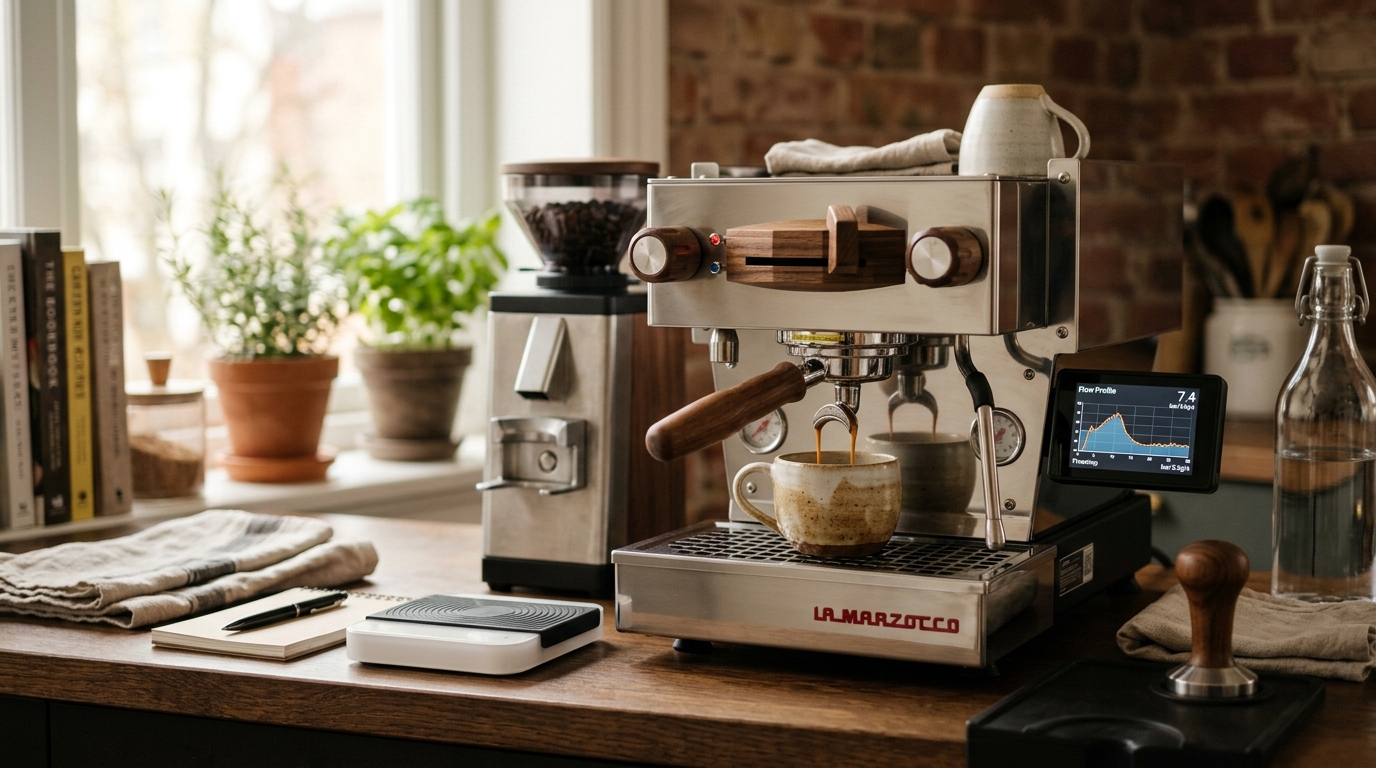
Flow profiling means adjusting water pressure or flow rate during extraction instead of holding a constant 9 bar. For most home baristas, the single biggest gain is pre-infusion: soaking the puck at 2–4 bar for 5–10 seconds before ramping to full pressure. This reduces channeling, improves extraction uniformity, and is achievable on many machines at any price point.
What is flow profiling in espresso?
Standard espresso machine pumps deliver water at a constant 9 bar of pressure from the moment you engage the pump to the moment you stop the shot. That fixed ramp became the industry standard because it is simple, consistent, and produces good espresso with commercial blends roasted for that extraction style.
Flow profiling — also called pressure profiling — changes that picture. Instead of a flat, constant pressure, the machine applies different amounts of pressure at different points in the extraction: low at the start to gently saturate the puck, higher during the extraction body, sometimes declining at the end. Some machines control pressure directly; others control flow rate (the volume of water per second), which achieves the same effect through a different mechanism.
The result, done well, is more even extraction and greater control over flavor. Done poorly or carelessly, it is just a different way to pull an inconsistent shot.
Why does adjusting pressure during extraction matter?
Espresso pucks are not uniform. Even after careful distribution and tamping, the compressed grounds contain small differences in density, small channels where water can slip through faster, and a dry outer surface that absorbs the first burst of water unevenly.
A sudden 9 bar hit can blast water through the weakest path in the puck — a channel — before the rest of the grounds even get wet. Once a channel forms, it widens as extraction progresses, sending most water through a narrow tunnel and leaving the rest of the puck under-extracted. The result is a shot that pulls fast, tastes sour and thin, and wastes most of the flavor in the portafilter.
Pre-infusion counteracts this by saturating the puck slowly. Water enters at low pressure (2–4 bar), moves through the dry grounds without enough force to blast a channel, and fully wets the entire puck before higher pressure kicks in. When full pressure arrives, the puck is uniformly wet, more resistant to channeling, and ready to extract evenly.
Beyond pre-infusion, full pressure profiling lets advanced users shape the entire extraction curve: a gentle ramp up, a peak at full pressure, then a declining tail at the end that prevents bitterness from compounds that extract last.
Pre-infusion vs. full flow profiling: what is the difference?
| Product | Best for | Rating | Notes | |
|---|---|---|---|---|
| Flat 9 bar | Dark roasts and commercial blends | — | Traditional. Simple and repeatable. Works well with blends designed for this profile. No extra machine features needed. | — |
| Pre-infusion (2-4 bar, 5-10 sec) | Most roast levels, reducing channeling | — | Best entry point. Reduces puck disturbance, improves uniformity. Available on many mid-range machines. | — |
| Ramp up (4 to 9 bar over 10 sec) | Medium and medium-light roasts | — | Gentle puck saturation. Smooths the leading edge of extraction without full profiling complexity. | — |
| Declining pressure (9 to 6 bar) | Light roasts and high-clarity shots | — | Starts at full pressure then decreases. Pulls flavor fast then eases off to prevent bitterness. | — |
| Full custom curve | Advanced users with Decent DE1 or lever machines | — | Complete control over every stage. Set a unique curve per bean. High learning curve; high reward potential. | — |
Most home baristas will see the biggest real-world improvement from adding pre-infusion alone, even without a dedicated profiling machine. Machines like the Breville Dual Boiler have a programmable pre-infusion setting built in. That single change — a 5-second low-pressure pre-soak before full pressure — can cut channeling and improve cup clarity noticeably without requiring a $3,000 profiling machine.
Full custom profiling with a machine like the Decent DE1 lets you adjust the entire pressure or flow curve, draw it on a screen, save profiles per bean, and track the result over time. It is powerful and genuinely useful for enthusiasts who want to optimize each bean they buy — but it is a much bigger investment in both money and learning time.
Which profile type should you use for your roast?
Roast level is the clearest guide for choosing a starting profile:
Dark roasts and blends: Flat 9 bar or a short 3-second pre-infusion at 4 bar. Dark beans extract quickly. Prolonged pre-infusion or declining pressure profiles often produce flat, over-extracted results with dark roasts. The traditional flat 9 bar works well here because commercial blends were designed for it.
Medium roasts: Pre-infusion at 3–4 bar for 5–8 seconds, then ramp to 9 bar. The most forgiving roast level for profiling. Medium beans have enough sweetness and structure to benefit from slower saturation without being as delicate as light roasts.
Light roasts and naturals: Longer pre-infusion (8–15 seconds at 2–3 bar) followed by a ramp to 8–9 bar, then optionally declining to 6 bar at the end. Light roasts are dense and extract slowly — they need more time to wet fully, and a lower peak pressure prevents high-acidity compounds from dominating the cup. This is where profiling earns its reputation; a well-designed light roast profile genuinely sounds and tastes different from a flat 9 bar shot on the same beans.
What machines support flow profiling?
There are three tiers of profiling capability:
Pre-infusion only: Many machines in the $500–$1,200 range include programmable pre-infusion. The Breville Dual Boiler lets you set a pre-infusion pressure and duration. The ECM Classika and Profitec Pro 300 have a mechanical pre-infusion valve. These machines give you the biggest slice of the profiling benefit at a fraction of the cost of a dedicated profiling machine.
Pressure profiling via retrofit: E61 group head machines (La Marzocco Linea Mini, ECM Synchronika, Rocket Appartamento) can add pressure profiling via a flow control device — a retrofit paddle or needle valve that restricts water flow. These turn existing E61 machines into capable profiling setups without buying a new machine.
Full flow profiling: The Decent Espresso DE1 is the reference machine. It uses a software-controlled pump that can execute any pressure or flow profile you program, display the result in real time on a tablet screen, and save profiles per bean origin. Flair lever machines (the 58x and 58 Pro) provide manual pressure control through the lever itself.
How to set up your first flow profile: step by step
This guide assumes a machine with at least programmable pre-infusion. Steps 1–4 apply to any machine; Steps 5–7 apply to full profiling setups.
-
Dial in your grind first. Flow profiling does not replace grind dial-in. Pull a standard flat 9 bar shot and get the grind timing in the 25–30 second window before adding any profile. This establishes the baseline you will compare against.
-
Add a 5-second pre-infusion at your machine’s minimum pressure. On the Breville Dual Boiler, set pre-infusion to 5 seconds and pressure to the lowest available setting (usually 3–4 bar). Pull the same shot and compare: note channeling behavior, total shot time, and taste.
-
Adjust grind for the new profile. Pre-infusion extends total shot time. If your shot ran 28 seconds with flat 9 bar, expect 32–36 seconds with 5 seconds of pre-infusion added. You may need to grind slightly coarser to compensate and keep the extraction body in the right window.
-
Taste the difference. A good pre-infusion shot should taste cleaner than your flat 9 bar baseline — more distinct flavor notes, less harsh bitterness, better balance on acidity. If it tastes flat or muddy, the pre-infusion is too long.
-
(Full profiling only) Set a peak pressure. On the Decent DE1 or similar, set peak pressure to 8.5 bar for medium roasts, or 7.5–8 bar for light roasts. Reducing peak pressure below 9 bar slows extraction slightly and reduces harsh extraction at the end of the shot.
-
(Full profiling only) Try a declining tail. After the peak pressure phase, program a decline from full pressure to 6–7 bar over the last 10 seconds of extraction. This extends shot time without over-extracting the late-stage compounds that contribute bitterness.
-
Save the profile. Once you find a combination that works for a particular bean, save it with the bean name and roast date. Refine it as the bag ages — beans change between week 1 and week 3 post-roast, and a small pressure adjustment compensates for that shift.
Recommended flow profiling machines
Best for serious enthusiasts who want full shot control
Decent Espresso DE1PRO
The DE1PRO is the benchmark for home flow profiling. A software-controlled pump executes any pressure or flow curve you draw on a tablet interface, displays the extraction in real time, and saves profiles per bean. At around \$2,000-2,500, it is a major investment — but for baristas who want to explore every dimension of a bean, nothing else comes close at the home scale.
★★★★★ 4.8 · 620 reviews
Check current price on Amazon→Best for home baristas wanting pre-infusion without a dedicated profiling machine
Breville Dual Boiler (BDB)
The Breville Dual Boiler offers programmable pre-infusion time and pressure alongside a PID-controlled dual boiler — all for around \$1,200-1,500. Pre-infusion is set via the onboard display. It is not a full profiling machine, but the pre-infusion setting alone delivers a noticeable improvement on medium and light roasts, making the BDB one of the best-value machines for baristas stepping into profiling territory.
★★★★★ 4.6 · 3,100 reviews
Check current price on Amazon→Best for manual lever control and tactile profiling without electronics
Flair 58x Espresso Maker
The Flair 58x is a manual lever machine with a built-in pressure gauge and a standard 58mm portafilter. Profiling is done by hand: control the lever position to vary pressure throughout the shot. This tactile approach teaches you what pressure changes feel and taste like in a way that button-based profiling does not. Around \$500-600, it is the most affordable path to genuine full-profile espresso.
★★★★★ 4.5 · 890 reviews
Check current price on Amazon→Common flow profiling mistakes
Profiling before dialing in grind. Pre-infusion adds time to shots. If you set up a profile without first establishing a grind baseline, you cannot isolate what the profile is doing versus what the grind is doing. Grind comes first, always.
Pre-infusion too long with dark roasts. A 15-second pre-infusion on a dark roast produces a flat, over-extracted, muddy shot. Dark roasts extract fast by nature; slowing the start compounds that over-extraction. Keep pre-infusion under 5 seconds for dark roasts, or skip it entirely and use flat 9 bar.
Changing multiple profile parameters at once. Profiling has the same rule as grind adjustment: change one thing at a time. Adding pre-infusion, reducing peak pressure, and adding a declining tail simultaneously makes it impossible to know which change improved or hurt the shot.
Expecting profiling to rescue bad puck prep. Pre-infusion reduces channeling from slightly uneven prep. It cannot fix a severely channeled puck caused by clumps, an untamped ring, or a basket gap. Profiling amplifies technique; it does not replace it.
Ignoring bean age during profiling. A profile dialed in on fresh beans (7 days off roast) needs adjustment as the beans age past 3 weeks. Older beans are more porous and extract faster — what required 8 seconds of pre-infusion at week 1 might need only 5 seconds at week 4.
FAQ
Frequently asked questions
What is flow profiling in espresso?
Does flow profiling make espresso taste better?
Can I do flow profiling on a standard espresso machine?
What is the best pressure profile for light roast espresso?
How does pre-infusion reduce channeling?
Is the Decent Espresso DE1 worth the price?
Bottom line
Flow profiling is not magic — but it is a genuine lever for improving shot quality, particularly with light roasts and high-quality single-origin beans. Start with pre-infusion. A 5-to-8-second pre-soak at low pressure on a machine that supports it produces a measurable improvement in most setups at zero extra cost. From there, full pressure profiling is the logical next step for baristas who want deeper control and are willing to invest in a dedicated machine.
For the foundational technique that profiling builds on: how to pull a perfect espresso shot. For the grind adjustment that has to come before profiling: espresso grind size guide. For machines that support pre-infusion at every budget: best espresso machines under 2000. For a complete shot troubleshooting framework: espresso shot troubleshooting.