guides
Espresso Roast Levels Guide
How light, medium, and dark roast affect espresso flavor, temperature, and brew ratio — so you can pull better shots with any bean.
 Elena Marchetti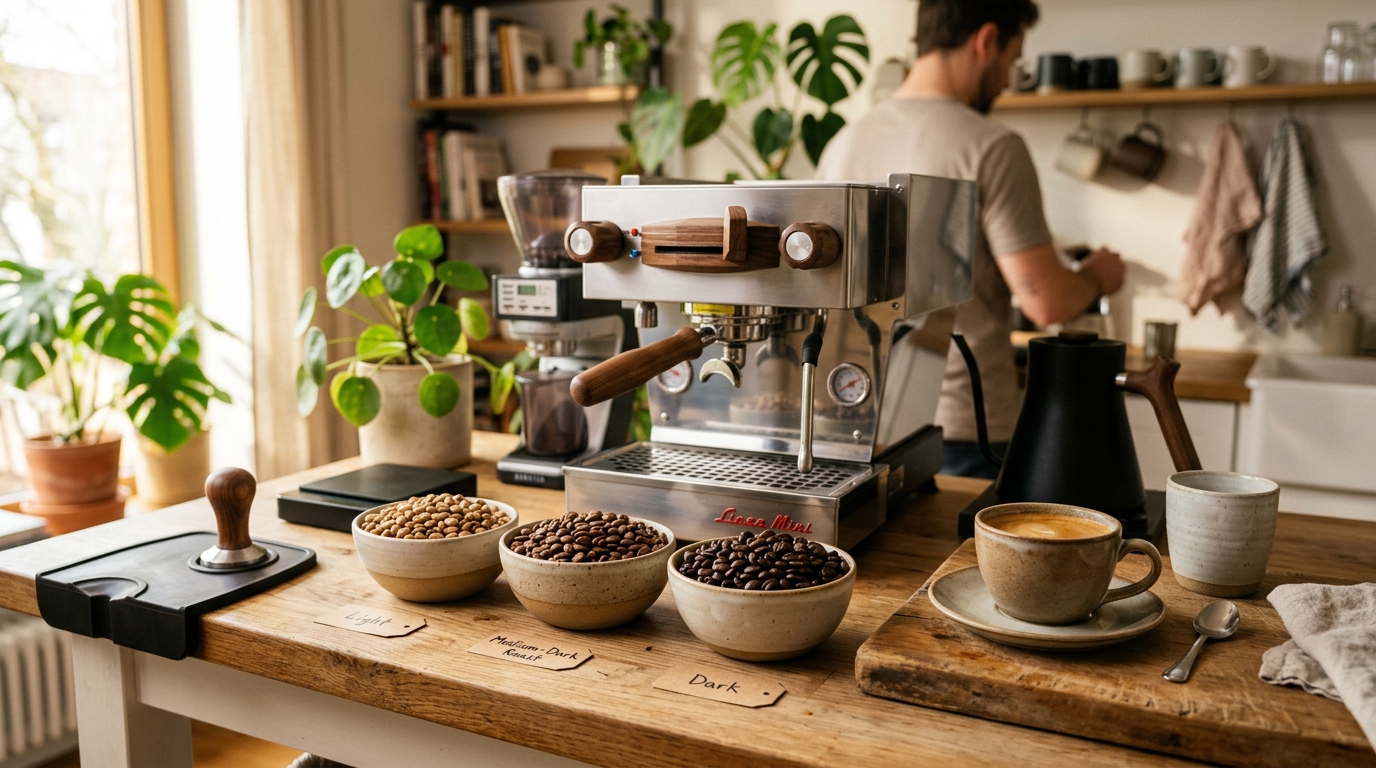
For espresso, medium roast is the most forgiving starting point — it hits the 18-22% extraction range at a standard 1:2 brew ratio and 90-93°C with minimal adjustment. Light roasts need higher temperatures (93-96°C) and longer ratios (1:2.5 to 1:3) to develop fully. Dark roasts extract fast and need lower temperatures (88-91°C) or a tighter yield to stay out of bitterness.
What does roast level mean for espresso?
Roasting transforms green coffee by driving off moisture, developing sugars through the Maillard reaction and caramelization, and creating the soluble compounds that dissolve into your espresso. The longer and hotter the roast, the more these compounds develop — and the more cell structure breaks down, making grounds easier to extract.
Roast level affects espresso in three key ways:
- Extraction speed: darker beans extract faster because the porous cell structure has more fractures and soluble compounds sit closer to the surface. Light roasts are denser and more resistant, requiring more time and temperature to reach proper extraction.
- Flavor compounds: light roasts preserve more of the bean’s original character — fruit acids, florals, and regional terroir. Dark roasts replace those with roast-derived compounds — chocolate, caramel, smoke, and bitterness. Medium roasts balance both.
- Optimal recipe: each roast level has a different sweet spot for temperature, brew ratio, and shot time. A recipe dialed in for dark roast will under-extract a light roast, and a light roast recipe risks over-extracting a dark one.
How is roast level measured?
The Agtron scale measures roast color numerically. High numbers (85+) indicate very light roasts; low numbers (25-40) indicate very dark. Most coffee sold as “espresso roast” falls between 45-65 — a medium to medium-dark profile. This context is useful because “light” and “dark” mean different things to different roasters, and Agtron scores give you a consistent reference point.
Light roast espresso
Light roast espresso is challenging but rewarding when done well. The beans are dense, extraction resistance is high, and the flavor window is narrow.
Flavor profile: bright fruit acids, floral notes, tea-like clarity, minimal body. Ethiopian and Kenyan single origins, Panama geishas, and similar high-altitude coffees express dramatically at light roast. There is essentially no roast-derived bitterness — the challenge is developing enough sweetness to balance the fruit acids.
Why it is hard to pull: the same acids that give light roast its character taste sharp and sour when the shot under-extracts. You need to push harder than you would with medium roast — higher temperature, longer ratio, and a finer grind — to coax out the sweetness that balances those acids.
Recipe starting point for light roast espresso:
- Temperature: 93–96°C (199–204°F)
- Brew ratio: 1:2.5 to 1:3 (18g dose producing 45–54g output)
- Shot time: 28–35 seconds
- Grind: finer than your medium roast baseline
Rest time matters most with light roast: fresh light roast (1–6 days post-roast) is high in CO2 and channels easily, producing inconsistent shots regardless of recipe. Let light roast beans rest at least 7–14 days after roast before pulling espresso.
Medium roast espresso
Medium roast is where most espresso recipes originate — it is the benchmark the Specialty Coffee Association uses for its extraction charts, and the default profile for most home espresso machine manufacturers.
Flavor profile: balanced sweetness, moderate body, and a blend of origin character and roast development. Notes of caramel, nuts, milk chocolate, and mild fruit acidity are common. Medium roast pulls well as straight espresso and as the base for milk drinks — it has enough intensity without being harsh.
Why it works well: medium roast beans extract smoothly across a wider range of temperatures and ratios than light or dark. Small errors in grind, ratio, or temperature are less punishing. If you are new to home espresso or switching machines, starting with medium roast will let you learn technique without fighting bean characteristics at the same time.
Recipe starting point for medium roast espresso:
- Temperature: 90–93°C (194–200°F)
- Brew ratio: 1:2 (18g dose producing 36g output)
- Shot time: 25–30 seconds
- Grind: your machine’s baseline setting
Dark roast espresso
Dark roasts have a long history in espresso — Italian-style blends traditionally target Agtron scores in the 25–40 range, producing dense, syrupy, low-acid shots associated with traditional espresso bars in Naples and Rome.
Flavor profile: bittersweet chocolate, caramel, smoke, and roasted nuts. Body is heavy. Acidity is low. Origin character is largely replaced by roast character. Dark roast espresso works exceptionally well in milk drinks — the intensity cuts through dairy in lattes and cappuccinos without disappearing.
Why it needs a lighter touch: dark roast beans are porous and highly soluble. They give up their soluble compounds quickly, and over-extraction happens faster than with lighter roasts. Bitterness spikes sharply when the ratio runs long or temperature climbs above 92–93°C.
Recipe starting point for dark roast espresso:
- Temperature: 88–91°C (190–196°F)
- Brew ratio: 1:1.5 to 1:2 (18g dose producing 27–36g output)
- Shot time: 20–25 seconds
- Grind: slightly coarser than your medium roast setting
Roast level comparison
| Product | Best for | Rating | Notes | |
|---|---|---|---|---|
| Light Roast | Fruit-forward and floral espresso | — | High density, extraction-resistant. Needs 93-96C, 1:2.5 to 1:3 ratio, finer grind, longer shot time. Rewards patience; reveals terroir and origin character clearly. | — |
| Medium Roast | Balanced everyday espresso | — | The SCA baseline. Pulls well at 90-93C and 1:2 ratio in 25-30 seconds. Balanced sweetness, body, and acidity. Most forgiving and easiest to dial in. | — |
| Dark Roast | Concentrated, low-acid espresso and milk drinks | — | Highly soluble, extracts fast. Best at 88-91C and 1:1.5 to 1:2 ratio in 20-25 seconds. Rich chocolate and caramel; requires care to avoid harsh bitterness. | — |
How to adjust your espresso technique when switching roast levels
Re-dialing when you change roast levels is not optional — the recipes are genuinely different. The fastest path is to move one variable at a time and taste after each change.
Moving from medium to light roast
- Raise temperature by 2–3°C as your first move. Light beans need more heat to extract at the same rate.
- Extend the yield from 36g to 42–48g (a 1:2.3 to 1:2.7 ratio) while keeping dose the same.
- Taste: if the shot is still sour and thin, extend the ratio toward 1:3 and go finer on the grind.
- Be patient with fresh beans: if roasted within the last week, rest them 7–14 days before pulling espresso. CO2 outgassing causes channeling and sour shots that are recipe problems by appearance but rest problems in reality.
Moving from medium to dark roast
- Lower temperature by 2–3°C before touching anything else. This alone eliminates much of the harshness dark roast produces at standard temps.
- Shorten the yield from 36g to 27–30g (a 1:1.5 to 1:1.7 ratio) to limit bitterness from over-extraction.
- Taste: if still bitter, coarsen the grind slightly or drop yield further. If the shot tastes flat or thin, extend by 3–4g.
- Do not tamp harder to compensate — dark roast pucks compress easily and channeling creates uneven extraction that tastes both sour and bitter simultaneously.
Does roast level affect lattes and cappuccinos?
Yes, significantly. Milk dilutes and sweetens the espresso base, so roast level affects whether the espresso still comes through. Dark roast espresso is traditionally preferred for milk drinks because its intensity and roast-forward bitterness cut through dairy without disappearing. Light roast espresso in a latte can taste muted or watery unless you pull a high-concentration ristretto-style shot.
A practical guideline: for straight shots and milk drinks at specialty cafes, light to medium roast. For home lattes and cappuccinos on a single-boiler machine without precise temperature control, medium to dark roast will give you more consistent results.
Choosing espresso beans at each roast level
Best for clarity-focused espresso with fruit and floral notes
Single Origin Light Roast Espresso Beans
Single origin light roast beans — especially Ethiopian or Kenyan naturals — showcase what light roast espresso can achieve. Expect bright citrus, berry, or jasmine notes when pulled at 93-95C with a 1:2.5 ratio. Best for home baristas willing to invest time in dial-in and who want to explore origin character rather than a reliable daily driver.
★★★★★ 4.5 · 1,200 reviews
Check current price on Amazon→Best for balanced everyday espresso without the difficulty of light roast
Medium Roast Espresso Blend
A quality medium roast espresso blend is the most practical everyday choice for home espresso. Look for blends that list a roast date (not just a best-by date) and target Agtron scores around 55-65. Caramel, nuts, and mild fruit work well as straight espresso and as a base for milk drinks without demanding precision dialing.
★★★★★ 4.6 · 3,800 reviews
Check current price on Amazon→Best for traditional espresso and milk-based drinks on any home machine
Italian-Style Dark Roast Espresso Beans
Italian-style dark roast espresso beans are designed for traditional low-acid, high-body shots at 88-91C and a 1:1.5 to 1:2 ratio. Widely available, very consistent batch to batch, and well suited to semi-automatic machines without temperature control. A reliable choice for latte and cappuccino drinkers who want intensity without brightness.
★★★★★ 4.7 · 5,200 reviews
Check current price on Amazon→Common roast level mistakes
Using a dark roast recipe on light beans. The 27-second shot that works with a medium-dark blend will under-extract a light roast and taste sour. Light roasts need longer shot time, higher temperature, or a longer ratio — usually all three.
Pulling dark roast at too high a temperature. Temperature above 92°C with dark roast accelerates extraction of bitter phenolic compounds. If your machine has temperature adjustment, drop it to 88–90°C before changing anything else.
Not accounting for rest time. Fresh light roast beans (1–6 days post-roast) are saturated with CO2, channel easily, and produce inconsistent shots. Letting beans rest 7–14 days stabilizes extraction dramatically. Fresh dark roast is less sensitive to this, but still benefits from 3–7 days of rest.
Expecting the same dose volume across roast levels. Dark roast beans are less dense — 18g of dark roast occupies more basket volume than 18g of light roast. Some baskets need a slightly reduced dose (16–17g) with very dark roast to avoid overfilling and puck integrity problems.
Buying “espresso roast” assuming it means dark. The term has no regulated definition. Some roasters use it for dark blends; others use it for any beans they recommend pulling as espresso, including medium and light roasts. Look at the tasting notes and roast date, not the label.
FAQ
Frequently asked questions
What roast level is best for espresso?
Can you use light roast for espresso?
Does dark roast espresso have more caffeine?
Why does my light roast espresso taste sour?
Should I change grind size when switching roast levels?
What is the difference between espresso roast and regular roast?
Bottom line
Roast level is one of the highest-impact variables in espresso — it shifts the entire recipe, not just one dial. Medium roast is the most forgiving starting point: pull 18g to 36g at 90–93°C in 25–30 seconds and you will land in range. Light roasts need higher temperatures and longer ratios; dark roasts need a lighter touch on temperature and yield. When you switch roast levels, plan to re-dial from scratch rather than applying one-click adjustments to your existing recipe.
For complete dial-in steps: how to dial in espresso. For how roast affects grind: espresso grind size guide. For a deeper light vs. dark comparison: light roast vs dark roast for espresso. For fixing shots after a roast switch: espresso shot troubleshooting.