roundups
Best Lever Espresso Machines in 2026
Best lever espresso machines: Flair 58+, Cafelat Robot, Flair PRO 2, La Pavoni Europiccola, and Picopresso compared with honest trade-offs.
 Elena Marchetti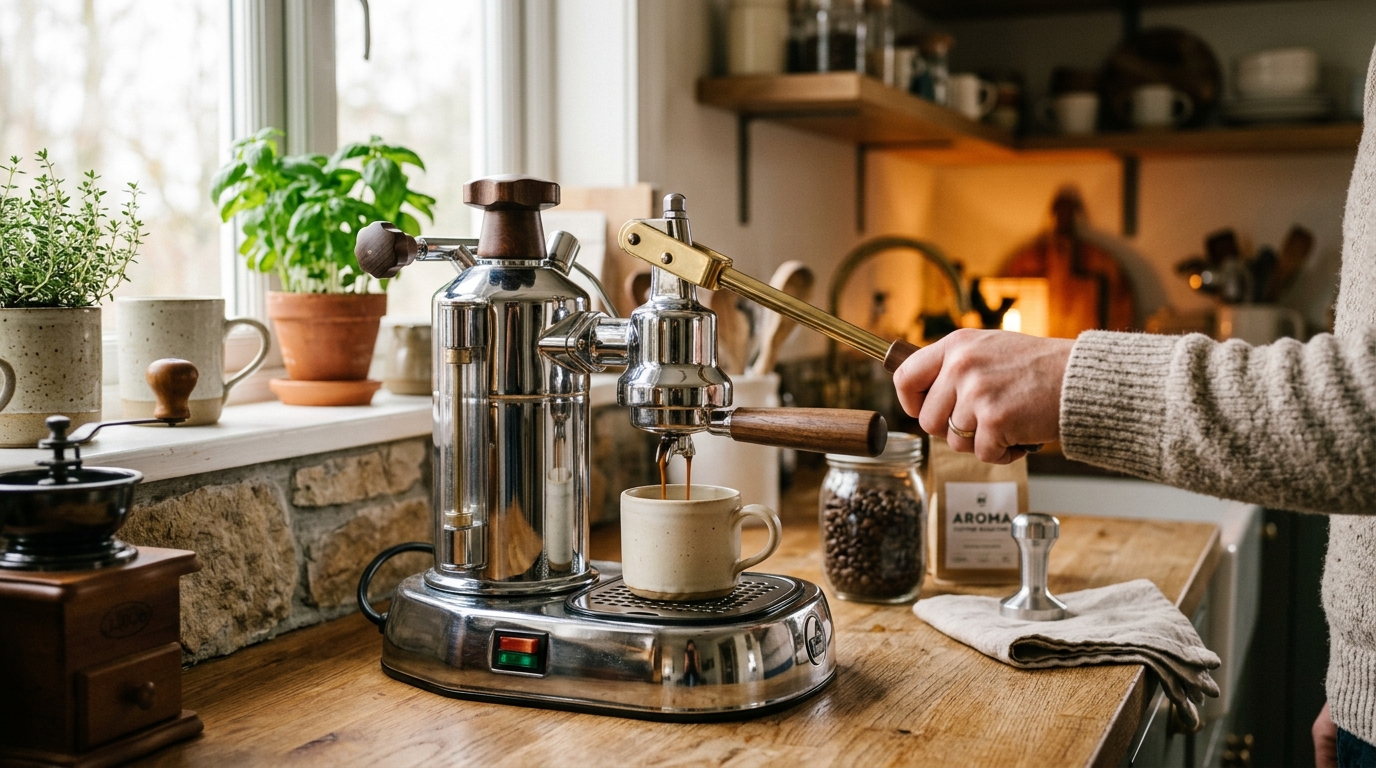
The Flair 58+ is the best lever espresso machine for home baristas — 58mm commercial portafilter, integrated pressure gauge, and full manual pressure control at around $350. For the most compact all-metal build, the Cafelat Robot Barista at $300 is the runner-up. Both deliver espresso quality that surpasses most pump machines at twice the price.
Why lever espresso machines deserve serious attention
Lever espresso machines represent the original and purest form of espresso preparation. Before electric pumps entered the picture, every espresso pulled in a cafe came from a lever — a skilled barista controlling pressure with their body weight and arm strength, reading the resistance of the puck through the lever itself and adjusting in real time. That manual feedback loop is not nostalgia. It is the genuine advantage lever machines retain over pump machines today.
You feel the puck. A pump machine applies fixed pressure and you have no direct information about what is happening inside the portafilter. A lever machine transmits real resistance back to your hands — you can feel when a puck channels, when the grind is too fine (resistance before you reach full pressure), or too coarse (the lever moves freely with little resistance). This tactile feedback, once developed, accelerates espresso technique faster than any gadget attached to a pump machine.
No pump noise. Lever machines have no vibrating pump. The only sounds are the hiss of steam, the drip of espresso into the cup, and the lever return spring if your machine has one. In open-plan homes where an espresso machine wakes everyone, or in apartments with thin walls, a lever machine is genuinely and meaningfully quieter than the vibration pump alternatives.
True pressure profiling, built in. Flow control and pressure profiling accessories for pump machines cost $200 to $500 and require machine modification. On a direct-pull lever machine, the profiling is the operation itself. You begin with gentle pressure during pre-infusion, ramp to full pressure through the shot body, and deliberately trail off at the end. No electronics, no valves, no wiring — the lever is the profiling device.
Long service life. Lever machines have dramatically fewer moving parts than pump machines. No pump to burn out, no solenoid valve to fail, no electronic board to replace when it corrodes. A Flair 58+ has no electrical components at all. A La Pavoni Europiccola has one heating element and a boiler. Both are repairable indefinitely with simple tools and widely available parts.
Direct-pull vs spring lever: which type fits your workflow?
The core technical divide in lever machines is between direct-pull and spring lever designs.
Direct-pull levers (Flair 58+, Cafelat Robot, Flair PRO 2) require you to manually apply and maintain pressure throughout the shot. You control exactly how much pressure, how fast the ramp, and how long each phase lasts. The shot profile is entirely determined by your technique. This is the format with the steepest initial learning curve and the highest ceiling for skilled baristas. Most home lever enthusiasts choose direct-pull machines.
Spring lever machines (La Pavoni Europiccola, Olympia Cremina) use a compressed spring that automatically pushes water through the puck at a relatively consistent pressure. You compress the spring by pulling the lever down, then release it — the spring does the work. The pressure profile is a natural spring curve that starts high and tapers through the shot. This format is more forgiving of technique variation and easier to repeat, but offers less manual control than a direct-pull machine. The La Pavoni also uses a boiler for heat rather than a separate kettle, which adds steam capability but also adds temperature management complexity.
For most home baristas starting with levers, a direct-pull machine is the better choice: more transparent technique feedback, lower price point, no boiler management required, and better community resources for dialing in.
Quick comparison
| Product | Best for | Rating | Notes | |
|---|---|---|---|---|
| Flair 58+ | best overall direct-pull lever under $400 | ★★★★★ | 58mm portafilter. Pressure gauge. Stainless steel. Full shot control. ~$350. | Check price |
| Cafelat Robot Barista | best compact all-metal lever with pressure gauge | ★★★★★ | All-metal build. Pressure gauge. 58mm compatible. Compact footprint. ~$300. | Check price |
| Flair PRO 2 | best entry-level direct-pull lever under $250 | ★★★★★ | 58mm portafilter. Detachable design. Pressure gauge add-on. Portable. ~$230. | Check price |
| La Pavoni Europiccola | best spring lever classic with integrated boiler | ★★★★☆ | Spring lever. Integrated boiler. Steam wand. Italian-made. ~$700. | Check price |
| Wacaco Picopresso | best portable lever for travel and outdoor use | ★★★★☆ | Ultra-compact. 58mm compatible basket. No electricity. Under $100. | Check price |
The picks
Best overall lever espresso machine: Flair 58+
Best for home baristas who want genuine manual pressure control, a 58mm commercial portafilter, and the highest shot quality ceiling in a direct-pull lever
Flair 58+ Espresso Maker
The Flair 58+ is the clearest expression of what a home lever machine can be when designed by people who take espresso seriously. A 58mm commercial portafilter means you use IMS, VST, and Pesado baskets — the same as every Italian prosumer pump machine — with no proprietary accessories and no compromises on basket quality. The integrated pressure gauge reads out in real time as you apply pressure: you can see when you hit 9 bar, how fast you ramped, and how pressure behaves through the back half of the shot. The stainless steel build is substantial and easy to clean. The leveling feet and spring-loaded lever return make operation smoother than earlier Flair models. Heat your brew head and portafilter with the supplied kettle adapter or an inline thermometer for precise temperature control. At around $350, the Flair 58+ competes with pump machines at $800 to $1,000 on shot quality — and wins in experienced hands.
★★★★★ 4.8 · 2,100 reviews
Check current price on Amazon→Pros
- 58mm commercial portafilter opens the full IMS, VST, and Pesado basket ecosystem from day one
- Integrated pressure gauge provides real-time feedback on your pressure curve through every shot
- Full manual pressure control — pre-infusion duration, peak pressure, and decline are entirely under your hands
- No electricity required for brewing — only a kettle for hot water, no heating element to fail
- Stainless steel construction with build quality designed for decades of daily use
Cons
- Requires pre-heating the brew head with hot water before each shot — adds 60 to 90 seconds to the workflow
- No integrated boiler means relying on a separate kettle and thermometer for temperature control
- Direct-pull technique takes several weeks to develop consistent pressure profiles
- No steam wand — a separate milk frother is needed for latte and cappuccino preparation
Best compact lever with pressure gauge: Cafelat Robot Barista
Best for espresso drinkers who want the most compact all-metal lever machine with a built-in pressure gauge in a highly portable form factor
Cafelat Robot Barista
The Cafelat Robot Barista is a design achievement: a fully functional direct-pull lever machine with an integrated pressure gauge in a footprint smaller than most grinders. The stainless steel arms and aluminium body are built to last — there are no plastic components anywhere in the pressure path. The 58mm portafilter basket accepts standard aftermarket baskets, meaning you are not locked into the Cafelat ecosystem once you buy in. The Barista edition adds the pressure gauge over the standard Robot, and that gauge feedback is essential for developing consistent technique — it is the version worth buying. Operation is direct: pour near-boiling water into the brew chamber, lock in the portafilter, and apply pressure through the lever arms. The compact footprint allows it to pack into a bag for travel without disassembly. A large Reddit and YouTube community has produced detailed technique guides, basket recommendations, and temperature management approaches that make the learning curve navigable from day one.
★★★★★ 4.7 · 1,650 reviews
Check current price on Amazon→Pros
- All-metal construction with stainless steel arms and aluminium body — no plastic in the pressure path
- Integrated pressure gauge on the Barista edition provides real-time feedback without a separate accessory
- Most compact lever machine at this quality level — fits in a bag for travel without disassembly
- Large and active community with detailed technique guides, basket recommendations, and temperature resources
- 58mm compatible baskets — standard aftermarket baskets fit directly and improve performance immediately
Cons
- Smaller brew chamber volume than the Flair 58+ — large ratio or lungo shots may require multiple water pours
- No integrated brew head thermometer — a separate temperature measurement device is needed for precise control
- Lever arm angle at full compression is less ergonomic for shorter users compared to the Flair design
- Pricier than the Flair PRO 2 for equivalent direct-pull functionality at entry level
Best entry-level lever: Flair PRO 2
Best for baristas starting with lever espresso who want a 58mm direct-pull machine at the most accessible price with room to grow
Flair PRO 2 Espresso Maker
The Flair PRO 2 is the most practical starting point for a home barista who wants to learn lever espresso before paying the Flair 58+ premium. The 58mm portafilter accepts the same aftermarket baskets as the 58+, which means any technique or basket upgrade discovered later transfers directly. The detachable design packs flat for travel and storage. A pressure gauge is available as a separate add-on for the PRO 2 — buying it bundled is strongly recommended, as the gauge transforms the learning process by giving you the visual reference for what different pressures feel like before technique memory fully develops. Build quality uses more plastic components than the 58+ or Cafelat Robot, but the pressure path and brewing mechanics are sound. At around $230, the PRO 2 is the right answer for anyone testing lever espresso before committing to the full 58+ investment.
★★★★★ 4.5 · 3,200 reviews
Check current price on Amazon→Pros
- 58mm commercial portafilter — same basket compatibility as the Flair 58+ and every Italian prosumer machine
- Detachable design stores flat and packs for travel — the most portable lever at this quality level
- Lowest-cost entry into genuine direct-pull lever espresso with full 58mm basket compatibility
- Pressure gauge add-on available — the bundled gauge version is strongly recommended for beginners
- Large and supportive owner community with detailed technique guides across Reddit and YouTube
Cons
- More plastic components than the Flair 58+ or Cafelat Robot — noticeably less premium in hand
- Pressure gauge not included by default — the base version ships without real-time feedback
- Pre-heating requirement same as the 58+ — hot water flush of the brew head before each shot
- Smaller brew chamber than the 58+ limits dose size for high-ratio extraction
Best spring lever classic: La Pavoni Europiccola
Best for enthusiasts who want the classic spring lever experience with an integrated boiler, steam wand, and iconic Italian design built since 1961
La Pavoni Europiccola Espresso Machine
The La Pavoni Europiccola is the machine that brought lever espresso into the home kitchen in 1961 and has been in continuous production ever since. The design is immediately recognizable: a small chrome boiler on a chrome base, a vertical lever, and a portafilter that accepts standard 51mm baskets. The spring lever mechanism compresses when you pull the lever down and releases to push water through the puck at a natural pressure curve — high at the start, tapering through the shot. The integrated boiler heats water for both espresso and the steam wand in a single chamber, meaning steam is always available immediately after a shot without a mode switch. Milk drinks are straightforward. The learning curve on the Europiccola centers on temperature management: timing the pull relative to boiler pressure, managing the single-group boiler volume, and developing a feel for when the machine is ready. Italian-made in Milan by La Pavoni with replacement parts available globally for indefinite service — this machine rewards patience with extraordinary espresso quality in experienced hands.
★★★★☆ 4.4 · 980 reviews
Check current price on Amazon→Pros
- Spring lever mechanism delivers a natural pressure curve without requiring manual pressure technique from the barista
- Integrated boiler provides both espresso brewing and steam for milk drinks from a single machine
- Italian-made in Milan since 1961 — replacement parts available globally for indefinite service
- Iconic design that has not changed substantively in 65 years — visually distinctive on any counter
- Steam wand ready immediately after pulling a shot with no mode switch or temperature recovery wait
Cons
- Boiler temperature management requires technique — pulling at the wrong boiler pressure produces poor shots
- Single group and small boiler volume limits sessions to one or two drinks before a recovery wait is needed
- Significantly more expensive than direct-pull levers at around $700 for the Europiccola
- No pressure gauge — feedback on extraction comes entirely from visual observation of the shot
Best portable lever: Wacaco Picopresso
Best for travelers and outdoor enthusiasts who want genuine espresso-quality extraction in a device that fits in a jacket pocket
Wacaco Picopresso
The Wacaco Picopresso is not a toy or a novelty. It is a genuinely engineered manual espresso device that achieves true espresso extraction — 9 bar pressure, 58mm compatible basket, real crema — in a device small enough for a jacket pocket. The 58mm basket compatibility is the most important technical decision Wacaco made with this design: you use the same basket diameter as a commercial machine, which means grind consistency and dose weight are the same variables you dial in at home. Take a pre-ground dose in a small container, add hot water from any thermos or kettle, and pull a shot that holds its own next to a pump machine. For camping, hotel rooms, office use, or international travel where poor coffee is not acceptable, the Picopresso is the answer. At under $100, it is also the most accessible entry point to understanding lever technique and manual espresso before investing in a full counter machine.
★★★★☆ 4.3 · 4,800 reviews
Check current price on Amazon→Pros
- 58mm compatible basket — the same diameter as commercial and prosumer machines, no proprietary ecosystem
- True 9 bar extraction with genuine crema — real espresso quality in a pocket-sized form factor
- Pocket-sized for travel — the most portable true espresso device available at any price point
- Under $100 entry point to manual espresso technique before committing to a counter machine investment
- No electricity required — works anywhere with hot water and a fine grind
Cons
- Small basket volume limits dose to around 8 to 10 grams — shorter shots only, no large-ratio options
- No pressure gauge and no feedback on pressure during extraction — technique relies entirely on feel
- Plastic construction throughout — durable for travel but not the build quality of the Flair or Cafelat
- Manual pressure requires practice — expect a steep learning curve for the first several shots
What to skip
Cheap lever-styled machines with electric pumps inside. Several machines are styled to look like vintage lever machines — chrome finish, a lever handle, a prominent group head — but use an internal electric pump rather than lever pressure. These are electric machines wearing lever aesthetics. They produce fixed-pressure pump espresso with no technique feedback whatsoever. The manual lever is purely decorative. If the product listing does not explicitly describe a manual lever mechanism or spring lever, assume it is a standard electric pump machine.
The original Flair Classic and Flair Signature. These earlier Flair models use a smaller 49mm or 54mm portafilter that is not compatible with the standard 58mm commercial basket ecosystem. The PRO 2 and 58+ both use 58mm, which opens the full IMS, VST, and aftermarket basket library. The small portafilter size limits dose and restricts your ability to upgrade baskets as technique develops. For the same or slightly more money, start with a 58mm machine.
La Pavoni Stradivari or Esperta models for beginners. These are La Pavoni machines with larger boilers and higher capacity for extended sessions, but also significantly higher prices and more complex temperature management. The Europiccola is already demanding for baristas new to spring levers — start there and move up only after maxing out its capacity through genuine daily use.
Budget hand-pressure devices without a standard basket. Devices like early Aeropress-style espresso attachments and pressurized pod levers use pressurized baskets that do not produce true espresso. True espresso requires a fine grind in a standard filter basket at genuine 9 bar pressure. If the device does not take a standard basket and genuinely fine ground coffee, it does not produce real espresso regardless of what the marketing copy claims.
FAQ
Frequently asked questions
Are lever espresso machines harder to use than pump machines?
Can you make milk drinks on a lever machine?
What grinder should I pair with a lever machine?
How much pressure should I apply when pulling a lever shot?
Is the Flair 58+ worth the upgrade over the Flair PRO 2?
Do lever espresso machines require descaling?
Bottom line
Best overall: Flair 58+ — direct-pull lever with a 58mm commercial portafilter, integrated pressure gauge, and manual shot control that surpasses pump machines at twice the price in experienced hands. Best compact: Cafelat Robot Barista — all-metal construction, built-in pressure gauge, and a footprint smaller than most grinders. Best entry point: Flair PRO 2 — the lowest-cost path into genuine direct-pull lever espresso with full 58mm basket compatibility. Best spring lever: La Pavoni Europiccola — the original home espresso lever machine, Italian-made since 1961, with integrated steam and a natural pressure curve that automates the hardest part of lever technique. Best for travel: Wacaco Picopresso — pocket-sized, genuine 9 bar extraction, 58mm compatible basket, under $100.
Pair any lever machine here with a quality grinder — see our espresso grind size guide for detailed grind recommendations by roast level and dose. For a full overview of home espresso machine types across all formats and budgets, the best home espresso machines guide covers every tier. For diagnosing shots that pull too fast or too slow on any machine type, the espresso shot troubleshooting guide covers extraction diagnosis in full. The single boiler vs dual boiler espresso guide explains the pump machine architecture for direct comparison against levers.