roundups
Best Espresso Subscription Boxes 2026
The best espresso subscription boxes for 2026: Trade Coffee, Atlas Coffee Club, Onyx, and MistoBox compared by variety, roast quality, and value.
 Elena Marchetti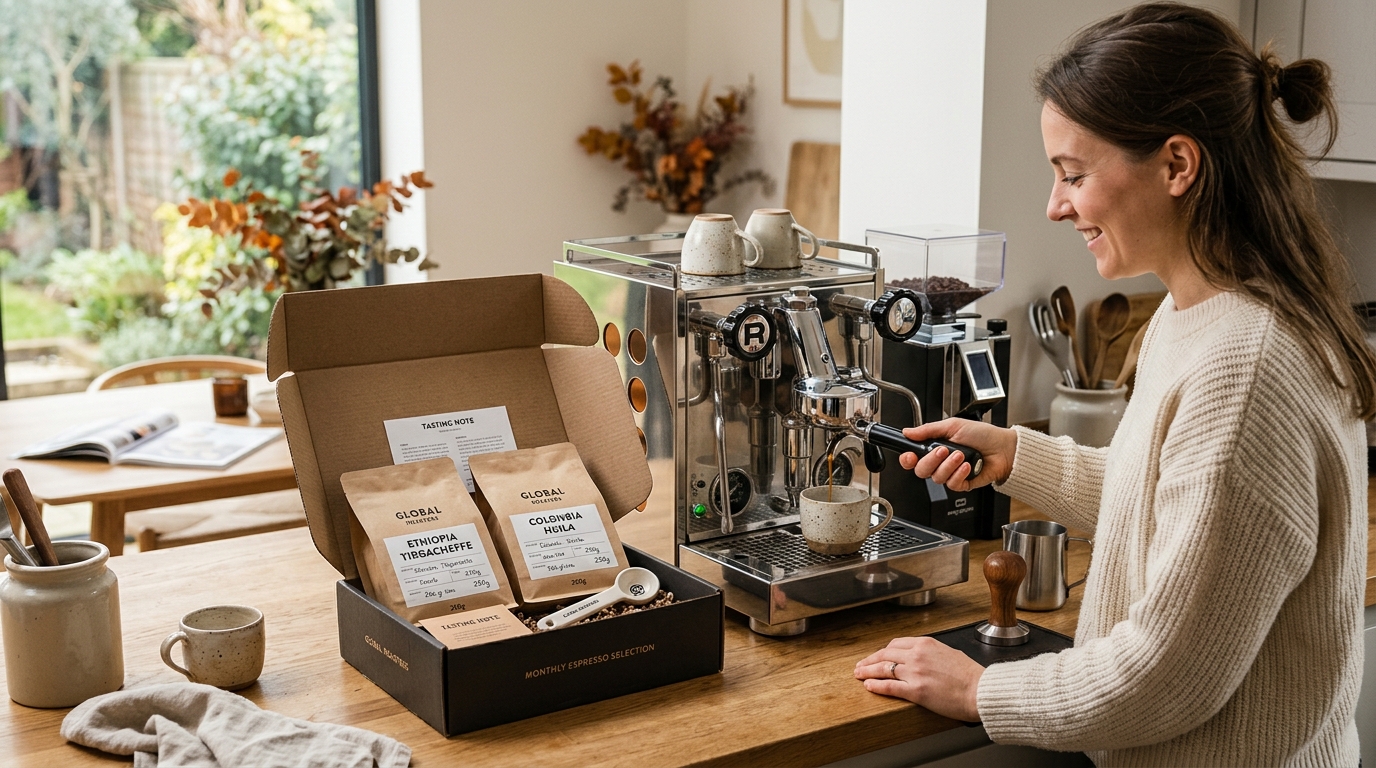
The best espresso subscription overall is Trade Coffee — its matching algorithm sources from 400-plus roasters and routes beans specifically profiled for 9-bar extraction based on your machine type and taste preferences, with flexible biweekly delivery. For single-origin exploration with country-by-country variety, Atlas Coffee Club is the most distinctive alternative.
Why espresso subscriptions require a different evaluation than drip coffee subscriptions
Espresso extraction amplifies roast freshness and profiling differences
A standard drip coffee subscription can succeed with a wide range of roast levels and freshness windows — medium roasts from the last four weeks produce acceptable results in a drip brewer. Espresso extraction at 9 bars of pressure is far less forgiving. Under-extracted shots from stale or overly fresh beans produce sour, thin results; over-extracted shots from improperly profiled beans produce harsh, astringent bitterness.
Specialty espresso subscriptions that ship beans roasted within the past week, rested to the 7-14 day post-roast window optimal for espresso CO2 degassing, and profiled for 9-bar extraction produce meaningfully better results than generic coffee subscriptions that ship from standing inventory. The distinction is worth paying for if espresso is your primary brew method.
Single-origin versus blend changes how often you need to redial
Espresso blends are formulated to be forgiving across dose, grind, and temperature variations — blend components are selected to produce a predictable extraction window. A well-designed espresso blend from any reputable subscription will extract reasonably well with the settings that worked for your previous order.
Single-origin espresso coffees, which represent the premium tier at most subscription services, require a fresh dial-in with each new bag. A Guatemalan Huehuetenango and a Kenyan Kiambu have different optimal extraction parameters — different grind fineness, different dose, sometimes different temperature. Atlas Coffee Club and Onyx single-origin deliveries produce outstanding shots when properly dialed, but the expectation matters: plan 3-5 shots to find the extraction window on each new coffee before pulling for enjoyment.
What makes an espresso subscription worth keeping
Roast-to-ship interval: The best subscriptions ship within 48-72 hours of roasting. Trade Coffee, Onyx, and MistoBox all commit to ship timing relative to roast date. Subscriptions that do not disclose roast date are shipping from inventory and may arrive with 2-4 weeks of post-roast age already spent before they reach your door.
Espresso-specific profiling: A subscription that sources or roasts specifically for espresso will recommend extraction parameters on the bag or the accompanying card. Subscriptions that ship the same coffee to drip and espresso customers have not profiled for espresso — the results are workable but not optimized.
Delivery frequency matching use rate: A 12oz bag at one to two drinks daily lasts 10-14 days. Biweekly delivery schedules match this consumption rate; monthly delivery sends 12oz at once, requiring proper bean storage and accepting that the second half of the batch is past its prime extraction window by the time you reach it. Most subscriptions allow frequency adjustment — set it to match your actual consumption.
Feedback and replacement loops: Trade Coffee and MistoBox allow you to rate each coffee and adjust future recommendations. This feedback loop improves match quality over multiple deliveries in ways that one-time purchases cannot replicate.
Quick comparison
| Product | Best for | Rating | Notes | |
|---|---|---|---|---|
| Trade Coffee | best overall | ★★★★★ | Matching algorithm across 400-plus roasters. Biweekly or monthly. 12oz from $14-22 per bag with free shipping. | Check price |
| Atlas Coffee Club | best for origin exploration | ★★★★★ | Single-origin from 50-plus countries. Educational cards and tasting notes per shipment. ~$15-20 per bag. | Check price |
| Onyx Coffee Lab | best single-roaster specialty | ★★★★★ | Award-winning Arkansas roastery. Espresso blends and single-origins shipped within 48h of roast. ~$18-25 per bag. | Check price |
| Angels Cup | best for discovery and blind tasting | ★★★★★ | Blind tasting format with 4 coffees per box and app-based tasting notes. ~$35-45 per box. | Check price |
| MistoBox | best curated variety | ★★★★★ | Coffee concierge curates from 55-plus roasters. Flexible frequency and bag size. ~$13-18 per bag. | Check price |
The picks
Best overall: Trade Coffee
Best for home espresso brewers who want algorithmically matched specialty coffees from the widest roaster network
Trade Coffee Subscription
Trade Coffee curates a network of over 400 specialty roasters across the United States and matches your espresso machine type, roast level preference, flavor profile, and origin curiosity to beans sourced from the roasters best positioned to produce them. The matching starts with a short quiz — machine type, flavor preference (fruit-forward, chocolate-rich, nutty-sweet), roast level, and origin curiosity. The algorithm selects a starting recommendation, and you rate each delivery to progressively refine the match. Trade espresso-specific deliveries route toward roasters that profile for 9-bar extraction — medium-light through medium-dark roasts rather than drip-optimized light roasts. Frequency options run from weekly through monthly; biweekly at 12oz matches the consumption rate of a household making one to two espresso drinks daily. Bag cost varies by roaster and origin, typically $14-22 per 12oz bag with free shipping. The network breadth means subscribers rarely receive the same coffee twice, which suits adventurous home baristas more than those wanting a single go-to espresso profile delivered consistently.
★★★★★ 4.8 · 14,200 reviews
Check current price on Amazon→Pros
- Largest roaster network in the subscription category — over 400 specialty roasters means sustained variety across many shipments without repetition
- Matching algorithm learns from delivery ratings and progressively narrows toward personal taste preferences across brew method, roast level, and flavor profile
- Espresso-specific routing sends beans profiled for 9-bar extraction rather than generic drip coffee sent to all subscribers regardless of brew method
- Flexible delivery frequency from weekly to monthly; bag size options allow adjustment to actual consumption rate without accumulating stale inventory
- Customer service replaces unsatisfactory deliveries — roasters on the Trade platform are vetted for consistency, and Trade mediates when a shipment does not meet expectations
Cons
- Variety-first model means no single go-to espresso blend — subscribers who want the same consistent profile delivered repeatedly are better served by a direct subscription to one roaster
- Roaster quality within the network varies somewhat; the first 2-3 deliveries are effectively calibration shipments before the algorithm refines itself to your preferences
- Price premium over buying direct from roasters — Trade adds a curation layer that costs $2-4 per bag compared to purchasing the same coffee directly from the sourcing roaster
- The onboarding quiz does not capture all espresso preferences — grind setting, water hardness, and milk-versus-black preference are not factors in the initial matching
Best for origin exploration: Atlas Coffee Club
Best for home baristas who want to explore single-origin coffees from around the world with educational context each shipment
Atlas Coffee Club Subscription
Atlas Coffee Club structures each shipment as an origin exploration: one single-origin coffee from a specific country, estate, or cooperative, accompanied by a tasting card, postcard from the origin country, and a QR code linking to detailed information about the farm, processing method, and regional flavor characteristics. Origins rotate through the Atlas sourcing network — Ethiopia, Guatemala, Colombia, Rwanda, Honduras, Papua New Guinea, and others — with a different country featured each month. For espresso, Atlas ships whole bean with explicit extraction guidance on the card covering recommended grind settings and dose for espresso use. Single-origin espresso extraction requires more dialing than blends — a washed Ethiopian Yirgacheffe behaves very differently from a natural-processed Brazilian at the same grind setting — but the Atlas cards provide enough context to start the dial-in correctly. Pricing is competitive at $15-20 per 12oz bag including shipping. Atlas also offers gift subscriptions in 3, 6, and 12-month increments with distinctive packaging, making it the most popular espresso gift recommendation in the category.
★★★★★ 4.7 · 8,900 reviews
Check current price on Amazon→Pros
- Origin-specific educational cards with farm information, altitude, variety, and extraction guidance tailored to the specific coffee in each shipment
- Widest origin variety in the subscription category — rotates through 50-plus sourcing countries, ensuring sustained novelty across monthly shipments
- Explicit espresso extraction guidance on the tasting card provides a starting point for dial-in with each new single-origin coffee
- Gift subscription options in 3, 6, and 12-month increments with attractive packaging — the strongest gift-giving option in the espresso subscription category
- Competitive pricing at $15-20 per bag with free shipping; cost per serving is lower than comparable single-origin coffees purchased from specialty roasters
Cons
- Single-origin focus requires fresh dial-in with each new coffee — not suitable for home baristas who want a consistent, familiar espresso profile without adjustment
- Atlas sources broadly rather than deeply within a roaster network — quality is consistently good but does not reach the peak specialty level of dedicated single-roaster subscriptions like Onyx
- Monthly cadence only; no biweekly or weekly frequency option — a monthly 12oz bag will be partially past its peak by the end of the month for low-volume households
- Espresso-specific profiling is advisory rather than roasted-for-espresso; some Atlas coffees ship at the same roast level sent to filter coffee subscribers
Best single-roaster specialty: Onyx Coffee Lab
Best for espresso enthusiasts who want award-winning specialty coffee from a single consistently excellent roastery
Onyx Coffee Lab Subscription
Onyx Coffee Lab, based in Rogers, Arkansas, is consistently ranked among the top specialty roasters in North America and has placed multiple times at the United States Barista Championship and the Good Food Awards. Their subscription ships roasts from the Onyx portfolio — including the flagship Geometry espresso blend, various single-origin espresso offerings, and seasonal limited releases — directly to subscribers within 48 hours of roasting. The Geometry blend is the Onyx flagship espresso: a Brazilian and Guatemalan blend developed specifically for 9-bar extraction producing chocolate, almond, and subtle citrus notes at a medium-light roast level appropriate for both milk-based drinks and straight shots. Single-origin options from the Onyx subscription rotate through their current direct-trade sourcing relationships — Ethiopia, Colombia, Peru, Kenya — with explicit espresso extraction parameters provided for each coffee. Subscribers can choose specific coffees or allow Onyx to select the current featured offering. Unlike multi-roaster curation services, Onyx quality is consistent because it comes from a single team with a singular approach to sourcing and roasting — less variety than a network service, but the most reliably excellent espresso in the subscription category.
★★★★★ 4.9 · 5,600 reviews
Check current price on Amazon→Pros
- Consistently top-ranked specialty roastery in the United States — competition placements and industry recognition reflect roast quality that multi-roaster networks cannot guarantee uniformly
- Ships within 48 hours of roasting to subscribers — arrival timing typically hits the optimal 7-14 day post-roast espresso extraction window without any planning on the subscriber end
- Geometry espresso blend is specifically formulated for 9-bar extraction — reliable extraction window, tolerant of reasonable dose and grind variation, excellent in milk-based drinks and straight shots
- Single-origin espresso options include explicit extraction parameters from Onyx baristas who have dialed in each coffee on commercial espresso equipment before shipping
- Direct-trade sourcing relationships provide the most transparency in the category about farm conditions, processing method, and producer compensation per pound
Cons
- Single-roaster model limits variety to the Onyx portfolio only — subscribers seeking exploration across many roasters will exhaust the rotation faster than with a network service
- Premium pricing reflects quality: Onyx subscriptions run $18-25 per 12oz bag, the highest base price in this comparison
- Limited machine-type personalization — Onyx ships the same coffees to all espresso subscribers regardless of machine type or individual taste preference
- Waitlists for limited seasonal releases — the highest-demand single-origins sell through before many subscribers can access them, even on active subscriptions
Best for discovery and blind tasting: Angels Cup
Best for home baristas who want a structured tasting experience across four different coffees per shipment to develop palate quickly
Angels Cup Coffee Subscription
Angels Cup takes a structurally different approach from other subscriptions: each box ships four sample-size coffees (roughly 1.5oz each) in unlabeled bags alongside a sealed envelope containing the tasting notes. The premise is blind tasting — brew and evaluate each sample before opening the envelope to compare your assessments against the roaster notes. An accompanying app tracks your tasting history, favorite coffees, and note patterns over time. For espresso specifically, Angels Cup offers an espresso-focused tier with coffees sourced and curated for 9-bar extraction rather than the default filter-focused tier. At $35-45 per box, the per-serving cost is higher than full-bag subscriptions, but the format delivers value for those who find tasting and learning as important as drinking. The blind format reduces the staleness risk since small sample sizes are consumed quickly after arrival. Angels Cup sources from rotating specialty roasters rather than maintaining its own roasting operation — quality varies by roaster, and the blind format treats variety as a feature of the experience rather than an inconsistency to manage.
★★★★★ 4.6 · 4,100 reviews
Check current price on Amazon→Pros
- Four coffees per shipment allows sensory comparison across origins and roast levels in the same week — the fastest palate development format in the subscription category
- Blind tasting format with app tracking builds genuine flavor assessment skills rather than just delivering fresh coffee passively
- Sample sizes eliminate staleness risk — 1.5oz samples are consumed within days of arrival rather than lingering through the bag-end staleness typical of 12oz monthly subscriptions
- Espresso-specific tier sources coffees profiled for 9-bar extraction rather than sending the same coffees to all brewing method subscribers
- App tasting history creates a personal flavor preference record useful for future espresso bean purchasing decisions beyond the subscription
Cons
- Per-serving cost is the highest in this comparison — $35-45 for four 1.5oz samples works out to roughly $3-5 per shot, more than twice the cost of full-bag alternatives
- Sample sizes are too small to dial in espresso properly — 1.5oz at home grinder waste rates leaves only 4-6 actual shots per sample, limiting extraction experimentation
- Blind tasting requires genuine engagement to deliver value — subscribers who treat it as a regular coffee delivery service rather than a structured tasting exercise overpay for the format
- Quality consistency depends on the rotating roasters sourced for each box — roaster curation is less transparent than multi-roaster network services with published roaster directories
Best curated variety: MistoBox
Best for home espresso brewers who want human-curated selections across a large roaster catalog with concierge adjustments
MistoBox Coffee Subscription
MistoBox positions itself as a coffee concierge service: rather than a pure algorithm or a single-roaster direct subscription, MistoBox assigns a human coffee guide who curates selections from a catalog of 600-plus coffees across 55-plus roasters based on your taste profile and machine type. The catalog breadth — the largest in the subscription category by roaster count — means subscribers who rate coffees and interact with their guide can access specialty roasters that do not appear in other curation services. For espresso, MistoBox collects machine type and roast level preference at signup and routes accordingly. The concierge element is the differentiator: subscribers can message their guide to request a specific origin, flavor profile, or roaster type and receive a personalized selection next shipment rather than waiting for the algorithm to converge. Pricing is the most competitive in the category at $13-18 per 12oz bag with free shipping. The catalog rotation across 55-plus roasters provides comparable variety to Trade Coffee at a lower average price point; the tradeoff is that MistoBox sources from some lower-profile roasters where Trade skews toward better-known specialty names.
★★★★★ 4.7 · 6,300 reviews
Check current price on Amazon→Pros
- Largest roaster catalog in the comparison at 600-plus coffees from 55-plus roasters — more breadth than any competitor for subscribers who want extended exploration without repetition
- Human concierge element allows direct requests for specific origins, flavor profiles, or roasters not available through algorithmic matching alone
- Most competitive pricing in the category at $13-18 per bag with free shipping — accessible entry point for home baristas evaluating specialty subscriptions for the first time
- Flexible delivery intervals from weekly to monthly and bag sizes from 8oz to 16oz — the most granular frequency and size customization of any subscription reviewed here
- Rating system feeds both algorithm and human guide — the combination of machine learning and human curation produces faster preference convergence than algorithm-only services
Cons
- Concierge quality depends on guide responsiveness — some subscribers report slow response times from guides during high-volume periods
- Catalog includes roasters of varying prominence — some MistoBox sources are smaller regional roasters with less consistency than the named specialty roasters Trade Coffee focuses on
- Website and app interface is less polished than Trade Coffee or Atlas Coffee Club — functional but less streamlined for browsing catalog options independently
- Espresso-specific profiling is machine-type-based rather than extraction-parameter-based — a step behind Onyx and Trade for subscribers who want roast notes specifically calibrated for espresso
What to skip
Generic grocery store coffee subscriptions. Store-brand subscription programs ship from inventory rather than roasting to order. Beans arrive with roast dates weeks in the past, missing the optimal extraction window for espresso before they are even delivered. The price difference between a grocery subscription and a specialty service is $5-10 per bag — a small premium for meaningfully fresher beans.
Auto-refill programs from non-specialty roasters. Convenience brands offering subscribe-and-save at $8-12 per bag are appealing on price but ship beans roasted months prior, over-roasted to mask defects and extend shelf life, and profiled for drip extraction tolerance rather than espresso. The espresso results are consistently poor regardless of grinder quality.
Subscriptions that pre-grind for espresso. Pre-ground espresso loses ideal extraction characteristics within hours of grinding. The convenience of pre-ground does not outweigh the extraction quality loss — if a home grinder is not available, a same-week purchase from a local specialty roaster with in-store grinding beats a pre-ground subscription on freshness at any delivery interval.
Gift subscriptions to espresso beginners without machine context. A specialty single-origin subscription arriving at the home of someone with a basic machine and no experience dialing in produces frustration rather than enjoyment. Match the subscription tier to the recipient — Trade Coffee with its flavor quiz and machine-type matching handles beginners more gracefully than a single-origin rotation requiring regular dial-in adjustments.
FAQ
Frequently asked questions
What is the difference between an espresso subscription and a regular coffee subscription?
How often should my espresso subscription deliver?
Is whole bean or pre-ground better for an espresso subscription?
How do I adjust my espresso grinder for a new subscription coffee?
Are espresso subscriptions worth it compared to buying from a local roaster?
Can I pause or skip deliveries in an espresso subscription?
Bottom line
Best overall: Trade Coffee — widest roaster network, machine-type and taste-profile matching, and a feedback loop that improves with each delivery at $14-22 per bag. Best for origin exploration: Atlas Coffee Club — country-by-country single-origin rotation with educational cards and gift-ready packaging at $15-20 per bag. Best single-roaster quality: Onyx Coffee Lab — award-winning Arkansas roastery shipping within 48 hours of roast for those who want consistently excellent espresso without origin variety. Best tasting experience: Angels Cup — four blind-tasting samples per box for rapid palate development at $35-45 per shipment. Best curated value: MistoBox — human concierge curation from the largest catalog at the most competitive pricing of $13-18 per bag.
For the beans behind these subscriptions purchased without a commitment, see the best espresso beans roundup covering top picks available as one-time purchases. To keep subscription beans at peak freshness between deliveries, see how to store coffee beans for container and environment recommendations. For the grinder needed to get the most from specialty subscription deliveries, see best espresso grinders and the complete home espresso setup guide.