roundups
Best Espresso Accessories 2026 (Tampers, Scales, WDT, Baskets)
Essential espresso accessories: scales, tampers, WDT tools, IMS and VST precision baskets, naked portafilters, knock boxes. What helps and what is fluff.
 Elena Marchetti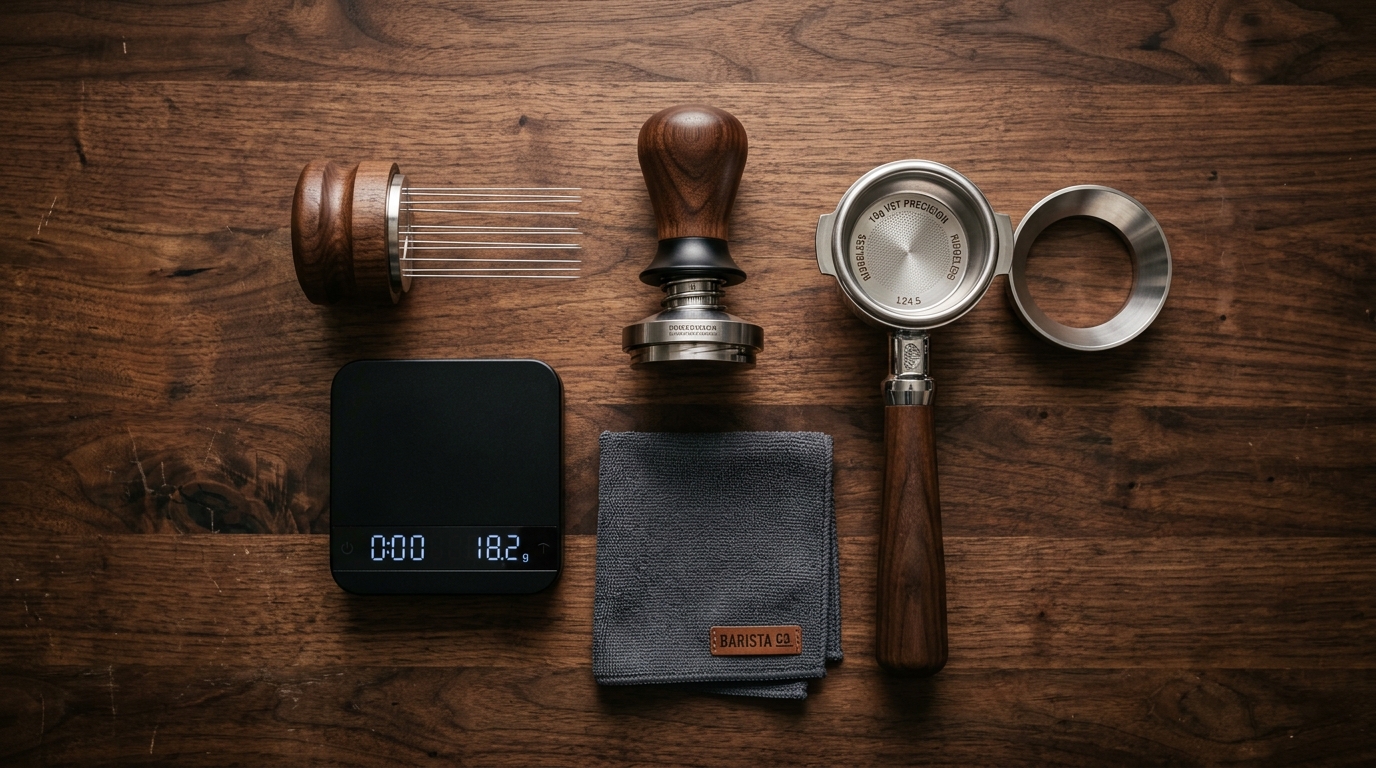
A great espresso machine and a great grinder do most of the work. The accessories ecosystem fills in the last 10-15% of consistency: scales for repeatable doses, distribution tools for even extraction, precision baskets that fix the cheap stamped baskets most machines ship with. Some accessories are genuinely transformative (a $20 WDT tool can rescue a $400 machine). Others are pure fluff. This guide separates the two.
Tier 1: accessories that change shot quality
These are the four accessories where the cost-to-quality ratio is highest. If you already own a machine and grinder and are wondering what to add, start here.
- Scale with 0.1g resolution and a fast refresh rate
- WDT tool for distributing coffee grounds in the basket
- Precision basket to replace the stamped one your machine shipped with
- Calibrated tamper sized correctly for your basket
Tier 2: useful, not transformative
- Knock box (any 20 dollar option works)
- Tamping mat (silicone, prevents counter damage)
- Group-head cleaning brush
- Backflush detergent (Cafiza)
- Milk pitcher in your preferred size
Tier 3: fluff (skip)
- 200 dollar precision tampers (the cheap ones tamp the same coffee)
- Decorative knock boxes
- Tamping stations with built-in levelers
- Branded cloths and bar mats
- Coffee storage canisters with vacuum seals (whole beans degas; sealed bags work fine)
Quick comparison
| Product | Best for | Rating | Notes | |
|---|---|---|---|---|
| Timemore Black Mirror Nano (scale) | best value espresso scale; 0.1g resolution, fast refresh | ★★★★★ | $70-90. Auto-tare, USB-C. Fits under portafilter. | Check price |
| Acaia Lunar (scale) | pro standard; auto-tare, app integration, lifetime durability | ★★★★★ | $250-280. Industry default in specialty cafes. | Check price |
| Normcore 58.5mm Tamper | best budget precision tamper; calibrated spring | ★★★★★ | $30-45. Fits 58mm baskets snugly. Spring-loaded. | Check price |
| WDT Tool (any brand) | distribution; eliminates clumps before tamping | ★★★★★ | $10-25. DIY version with acupuncture needles works. | Check price |
| IMS Precision Basket | best precision basket; laser-drilled holes | ★★★★★ | $20-30. Replaces stamped basket. 18-20g doses. | Check price |
| Pesado Naked Portafilter | diagnostic tool to spot channeling | ★★★★★ | $45-80. Reveals extraction defects in real time. | Check price |
| Rattleware Knock Box | best knock box; rubberized bar, durable | ★★★★★ | $25-40. Bar replaceable when worn. | Check price |
| Cafiza Espresso Cleaner | best backflush detergent | ★★★★★ | $15-20 per jar. Industry standard. | Check price |
The picks
Best espresso scale (overall): Acaia Lunar
Best for anyone treating espresso as a serious hobby; pros, hobbyist baristas, anyone wanting a forever scale
Acaia Lunar (2021 update)
The Acaia Lunar is the de-facto pro standard. 0.1g resolution, sub-second response time, IPX rating that survives spilled milk, auto-tare when you place the cup, and Bluetooth integration with Acaia's brewing app and the Pyxis-style flow tracking. Lifetime hardware. The 250-280 dollar price is steep, but if you make espresso daily for years, this is the buy-once-cry-once option. The 2021 update fixed the older USB charging issues and added faster response.
★★★★★ 4.8 · 2,100 reviews
Check current price on Amazon→Pros
- 0.1g resolution with sub-second refresh — fast enough for live shot weighing
- Auto-tare detects the cup automatically; no manual zeroing during workflow
- IPX water resistance survives milk spills and steam-wand splatter
- Bluetooth app integration for ratio targets and flow tracking
- Build quality consistent with 5-10 year lifespan in daily home use
Cons
- 250-280 dollars is genuine premium pricing for a scale
- App integration optional but adds value mostly at the prosumer end
- Charging cable is proprietary-ish (USB-C now but takes specific power profile)
- For users who do not weigh shots live, a cheap scale works equally well
Best espresso scale (value): Timemore Black Mirror Nano
Best for users who want 80 percent of Acaia performance at 30 percent of price
Timemore Black Mirror Nano
Timemore's Black Mirror Nano is the value play. 0.1g resolution, USB-C rechargeable, auto-tare, glass platform, fits under most portafilters with room for a cup on top. Refresh rate is slightly slower than the Acaia (about 0.5s vs sub-second) but functionally indistinguishable for home use. 70-90 dollars. The 'Nano' is the small espresso-scale form; the standard Black Mirror is larger and works for pour-over too.
★★★★★ 4.7 · 4,800 reviews
Check current price on Amazon→Best WDT tool: any 20 dollar option
A WDT (Weiss Distribution Technique) tool is a handle with thin needles — you stir the coffee grounds in the basket before tamping. This breaks up clumps and distributes grounds evenly, eliminating most channeling. The cheap ones work as well as the expensive ones because the physics is trivial: thin needles, even motion.
Best for anyone who has ever pulled a channeling shot
Normcore WDT Distribution Tool
The single most cost-effective espresso accessory. 20-25 dollars. Eight to ten thin needles on a magnetic stand. Stir grounds in the basket for 5-10 seconds before tamping, and channeling problems mostly disappear. The DIY version with acupuncture needles glued into a wine cork works identically. Spend the 20 dollars rather than buying a 200 dollar 'precision distribution tool' that does the same thing with more chrome.
★★★★★ 4.8 · 3,600 reviews
Check current price on Amazon→Best precision basket: IMS Competition
Best for anyone whose machine shipped with a stamped (cheap) basket
IMS Competition Precision Basket (B62 / B70)
Most espresso machines under 1,500 dollars ship with cheap stamped baskets — holes punched unevenly, edges that channel water. IMS makes laser-drilled precision baskets with consistent hole patterns and tighter tolerances. 20-30 dollars. Drop-in replacement for any 58mm portafilter. The B62 is sized for 18-20g doses; the B70 for larger 20-22g. Combined with a WDT tool, this is the cheapest meaningful upgrade to extraction consistency you can make.
★★★★★ 4.7 · 2,400 reviews
Check current price on Amazon→Best tamper (overall value): Normcore 58.5mm
Best for anyone with a 58mm portafilter; budget to prosumer alike
Normcore 58.5mm Spring-Loaded Tamper
A tamper does one thing: compress coffee evenly. Heavy, expensive tampers do this no better than calibrated cheap ones. The Normcore 58.5mm has the right diameter for snug basket fit (the half-millimeter matters), a calibrated spring that releases at 30 lbs (the espresso industry standard), and a comfortable handle. 30-45 dollars. The 250 dollar artisanal tampers do not produce better espresso — they look prettier on Instagram.
★★★★★ 4.7 · 6,800 reviews
Check current price on Amazon→Best diagnostic tool: naked portafilter
Best for users diagnosing channeling or learning extraction
Pesado Naked Portafilter (58mm)
A 'naked' or 'bottomless' portafilter has no spouts — you see the bottom of the basket during extraction. This reveals channeling (water finding fast paths through the puck) as spurts and uneven flow patterns. It is a diagnostic tool, not an upgrade. Use it to identify problems, then go back to your normal spouted portafilter. 45-80 dollars. Pesado is well-machined; cheaper alternatives work but tend to thread poorly into some machines.
★★★★★ 4.6 · 890 reviews
Check current price on Amazon→Best knock box: Rattleware
Best for any home espresso setup; saves your trash bin and your back
Rattleware Knock Box
A knock box is a small container with a padded bar that you whack the portafilter against to dislodge the spent puck. The Rattleware has a replaceable rubber-coated bar, a non-slip base, and dishwasher-safe construction. 25-40 dollars. Cheaper plastic knock boxes split within 6-12 months; the Rattleware lasts decades. Buy one. Stop knocking pucks into the trash can or sink drain.
★★★★★ 4.7 · 3,200 reviews
Check current price on Amazon→Cleaning and maintenance kit
Boring but essential. Skipping cleaning kills espresso machines faster than anything else.
- Cafiza espresso cleaner (15-20 dollars per jar, lasts 6-12 months): backflush every 2 weeks, clean group-head every month
- Group-head brush (5-8 dollars): wipe after every session
- Descaling solution (20 dollars per bottle): every 3-6 months depending on water hardness
- Water filter or RO (50-200 dollars): prevents scale entirely; cheaper than descaling failures in the long run
- Microfiber cloths (5 dollars for 4-pack): keep one dry for wiping wand, one damp for surfaces
What to skip
- 200 dollar precision tampers. They tamp the same coffee as a 30 dollar Normcore. Buy beans with the savings.
- Tamping stations with integrated levelers. A flat tamp is easy enough that you do not need a 100 dollar guide.
- Decorative knock boxes. The Rattleware works; the artisanal walnut ones rot from milk splatter.
- Coffee canisters with vacuum seals. Whole beans degas (release CO2) for 7-14 days post-roast. A vacuum-sealed canister either traps the gas (preventing degas) or releases it through a one-way valve that the original roaster bag already has. Just use the bag, fold the top, clip it.
- Branded shot glasses and cups. Use any 2-oz glass. Espresso does not care.
- Distribution wedges (single-direction levelers). Worse than WDT for fixing channeling. Mostly aesthetic.
A reasonable starter kit
For someone with a new espresso machine and grinder, here is the minimum-viable accessories list:
- Scale (Timemore Black Mirror Nano): 80 dollars
- WDT tool (any 20 dollar option): 20 dollars
- IMS precision basket: 25 dollars
- Normcore tamper (sized to your portafilter): 40 dollars
- Knock box (Rattleware): 30 dollars
- Cafiza + group brush: 25 dollars
Total: about 220 dollars. This package will produce shots indistinguishable from a setup with the 250 dollar Acaia, the 200 dollar precision tamper, and the 300 dollar tamping station.
FAQ
Frequently asked questions
Acaia Lunar vs Timemore Black Mirror Nano — does the difference matter?
Do I really need a scale for espresso?
Is a precision basket actually different from a stock basket?
WDT or distribution wedge?
Naked portafilter vs spouted — which to use?
What about coffee storage — vacuum canister or original bag?
Cleaning frequency — what is realistic?
Bottom line
The accessories that change shots: scale, WDT tool, precision basket, calibrated tamper. About 200 dollars total. Beyond that, accessories are mostly aesthetic.
If you have to pick one upgrade: a scale. Repeatable dose is the foundation everything else builds on.
For the full kit: espresso machines, grinders, beans, milk frothers, or pillar overview.