guides
AeroPress vs Espresso Machine: Which Should You Buy?
AeroPress vs espresso machine: differences in pressure, taste, cost, and workflow to pick the right brew method for your home.
 Elena Marchetti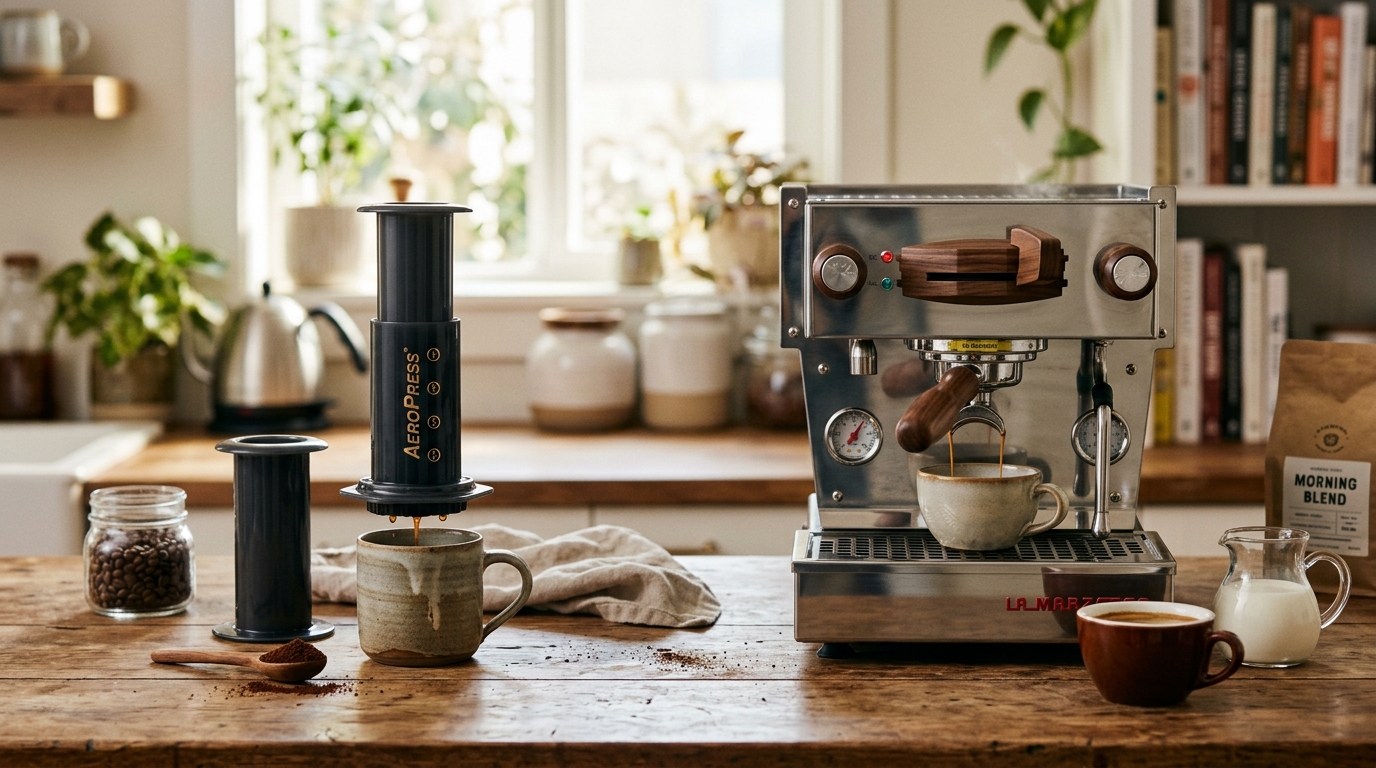
The AeroPress makes strong, smooth, versatile coffee for $40 with virtually no learning curve. An espresso machine delivers true 9-bar espresso with crema and steam capability starting around $400–700 for a capable setup. For bold coffee on a budget or on the road, the AeroPress is hard to beat. For real lattes, cappuccinos, and authentic espresso, only a pump-driven machine will do.
How each method works: the fundamental mechanical difference
The AeroPress and the espresso machine can both produce concentrated coffee, but the mechanics and the results differ significantly. Understanding how each one works tells you immediately which is the right fit.
The AeroPress is a plastic immersion brewer with a rubber plunger. You add medium-fine grounds and hot water to the chamber, stir briefly, and press the plunger down slowly over 30–60 seconds. The plunger creates pressure as it pushes water through a thin paper or metal filter and into your cup below.
The pressure generated is roughly 0.35–0.75 bar — far below true espresso territory. What you get is a smooth, concentrated coffee that is less bitter and more forgiving than most methods. The AeroPress produces a cleaner cup than a French press (the paper filter removes fine particles and most oils) and is more concentrated than drip. The inverted brewing method, different steep times, and varying grind sizes all change the flavor dramatically — the AeroPress is one of the most versatile brewers ever made.
The espresso machine uses an electric pump to force hot water at exactly 9 bar of pressure through a tightly packed portafilter basket of finely ground coffee over 25–30 seconds. That pressure is not incidental — it emulsifies coffee oils and dissolved CO2 into crema, the reddish-gold foam that sits on top of a properly extracted shot. This crema-bound concentration is what allows a double espresso to remain distinctly coffee-flavored even when poured through several ounces of steamed milk.
The pressure difference matters enormously. A 9-bar machine operates at roughly 12–25 times the pressure of an AeroPress press. That gap determines texture, concentration, and whether you can make a real latte.
Side-by-side comparison
| Product | Best for | Rating | Notes | |
|---|---|---|---|---|
| Brew pressure | Espresso: fixed 9-bar pump pressure every shot | — | AeroPress: 0.35–0.75 bar from manual plunger force — not true espresso | — |
| Crema | Espresso: thick golden crema on every proper shot | — | AeroPress: no real crema; light foam dissipates quickly | — |
| Entry cost | AeroPress: around $40 for the brewer itself | — | Espresso: $400–700 minimum for machine plus a burr grinder | — |
| Brew time | AeroPress: 90 seconds total, no warm-up needed | — | Espresso: 30-second shot after 15–25 minutes of warm-up | — |
| Milk-based drinks | Espresso: true lattes and cappuccinos with proper crema | — | AeroPress: concentrate added to frothed milk works, but dilutes too much | — |
| Learning curve | AeroPress: first cup is great with no experience required | — | Espresso: 2–4 weeks of active grind dial-in before shots are reliable | — |
| Portability | AeroPress: weighs under 200g, packs flat, no electricity needed | — | Espresso machine: countertop only; requires a dedicated electrical outlet | — |
| Cleanup | AeroPress: pop the puck, rinse the chamber — under 15 seconds | — | Espresso: daily backflushing, purging steam wand, monthly descaling | — |
Taste: what you are actually drinking
This is where the comparison matters most, and where marketing creates the most confusion.
AeroPress concentrate brews at low pressure through a paper or metal filter. The paper filter removes most oils and fine sediment, producing a cup that is smooth, clean, and bright compared to a French press. The total dissolved solids (TDS) in a standard AeroPress recipe run roughly 1.5–3%, putting it above drip but far below true espresso. The flavor profile depends heavily on brew time, water temperature, and grind — short brews at lower temperatures highlight clarity and fruit notes; longer brews at higher temperatures pull more body and roast.
The concentrate AeroPress produces can be diluted to an Americano-style drink that is genuinely excellent. Used straight as a concentrate base, it tastes intensely of coffee but without the thick mouthfeel or crema of espresso.
True espresso at 9 bar measures roughly 8–12% TDS. The pressure emulsifies oils into crema and creates a syrupy, thick shot that concentrates coffee flavor to a degree that holds up through milk. A double espresso (36–40g output) poured into 6 oz of steamed milk produces a real latte because the espresso base is strong enough to taste through dairy. An AeroPress concentrate at the same volume, added to the same milk, produces a noticeably milder, thinner drink — the concentration is simply not there.
For black coffee or simple Americano-style drinking, the AeroPress produces an outstanding cup that rivals most pour-over and drip methods at a fraction of the cost. For milk-based drinks, the physics of concentration make the espresso machine the only credible option.
Cost reality: what you actually spend
The cost difference between these two methods is significant and touches every tier.
AeroPress entry cost is among the lowest of any serious coffee brewer. The AeroPress Original retails for around $40. The AeroPress Go — a compact version designed for travel — is around $50 and includes a mug. Both use inexpensive paper filters (about $7 for 350 filters) or a reusable metal filter (around $15 as a one-time purchase). A decent hand grinder for $40–60 completes the setup. Total cost: well under $120, with almost no ongoing expenses.
You do not need a special grinder for an AeroPress. It is tolerant of varied grind sizes, brew temperatures, and steep times. This means even a modest hand grinder or modestly priced burr grinder delivers great results. Pre-ground coffee works too, though fresh grinding makes a noticeable difference.
Espresso machine entry cost is a different budget category. The minimum for a setup that produces genuinely good espresso is around $300–500 for the machine plus $100–200 for a quality burr grinder. Below that threshold, pressurized-basket machines simulate crema chemically rather than extracting it, and blade-ground coffee makes dial-in essentially impossible.
The most commonly recommended entry setup is the Gaggia Classic Pro ($450–500) paired with the Baratza Encore grinder ($170) for about $650 all-in. The Breville Barista Express ($700) bundles machine and grinder in one body and is a strong alternative. Consumable costs are also higher with espresso: quality beans for espresso typically run $18–25 per 12 oz bag, and machines require descaling solution ($10–15 every 1–3 months) plus portafilter cleaning tablets.
The break-even calculation matters: if you currently spend $5–7 per day at a café for lattes, a $700 home espresso setup pays for itself in roughly 4–5 months.
Daily workflow: what making coffee actually looks like
AeroPress routine:
- Boil water and let it rest for 30–45 seconds (target 80–96°C depending on roast level)
- Add 15–18g of medium-fine ground coffee to the AeroPress chamber
- Pour 200–240g of water over the grounds
- Stir 5–10 times and place the plunger on top
- Wait 60–90 seconds total steep time, then press slowly over 20–30 seconds
- Pop the puck into the bin and rinse the chamber
Total: under 3 minutes start to finish, with immediate cleanup that takes 15 seconds. No warm-up, no electricity, no maintenance schedule.
Espresso machine routine:
- Turn on the machine; allow 15–25 minutes for thermal stabilization (or 5–8 minutes for fast-heating machines like the Breville Barista Pro)
- Weigh and grind 18g of fresh beans; note whether yesterday’s shots ran fast or slow and adjust grind by one click
- Distribute grounds evenly in the portafilter basket using a WDT tool, then tamp level with firm, even pressure
- Lock the portafilter, place a scale and cup underneath, and start the shot
- Target 36–38g of output in 25–30 seconds; record the result for tomorrow
- Steam milk if making a latte; purge and wipe the steam wand immediately after use
- Backflush the portafilter and rinse the group head; knock out the spent puck
Total: 10–20 minutes of active time, more with cleanup. Dialing in shots across different bean bags requires ongoing micro-adjustment that becomes second nature after a few months but demands attention from the start.
When the AeroPress makes more sense
Choose an AeroPress if:
- Budget is a hard constraint. No other brewer delivers this quality at $40. The AeroPress is the best coffee value in existence at its price point.
- You drink black coffee or Americano-style. The AeroPress shines brightest here — smooth, clean, and intensely flavored without bitterness.
- You travel frequently. The AeroPress weighs less than 200 grams, requires no electricity, and is TSA-carry-on legal. It pairs with any kettle or hot-water source.
- You want great results immediately. There is no dial-in period, no learning curve, and no adjustment routine. The AeroPress is forgiving in a way that espresso machines fundamentally are not.
- You want to experiment. The AeroPress rewards tinkering — inverted method, Japanese iced coffee, different steep times, wildly varying grind sizes. It is the most adaptable brewer in home coffee.
Best for strong versatile coffee at $40 with no learning curve
AeroPress Original Coffee Press
The AeroPress Original is a lightweight plastic immersion brewer that produces smooth, strong coffee in about 90 seconds. Use the standard recipe for a clean concentrated cup, or experiment with the inverted method, longer steep times, or different grind sizes — the AeroPress rewards tinkering more than almost any other brewer. It weighs under 200 grams, packs flat, and works on any heat source without electricity. A box of 350 paper filters costs around $7 and lasts two to three years with daily use.
★★★★★ 4.8 · 60,000 reviews
Check current price on Amazon→When an espresso machine makes more sense
Choose an espresso machine if:
- You drink lattes, cappuccinos, flat whites, or cortados. These drinks require a true 9-bar espresso base. AeroPress concentrate poured into steamed milk dilutes too much to produce a real milk drink — the concentration is not there.
- You are already spending $5–7 daily at a café. The break-even math on home espresso is straightforward. A $650–700 setup pays for itself in 4–5 months if it replaces daily café visits.
- You enjoy craft and process. Pulling a well-dialed shot — watching the timer, adjusting the grind by one click, seeing a steady blond extraction — is genuinely satisfying for people who enjoy precision hobbies. Many home baristas find the morning routine meditative.
- You want complete control over extraction variables. Espresso gives you precise control: dose, grind size, extraction time, yield, water temperature, and pressure. It is one of the most tunable systems in food preparation.
Best for the benchmark entry-level machine for serious home baristas
Gaggia Classic Pro Home Espresso Machine
The Gaggia Classic Pro is the gold-standard entry-level recommendation in home espresso. A 58mm commercial-size portafilter, a 3-way solenoid valve for dry pucks and immediate repulling, and a commercial pannarello steam wand that textures real microfoam define the feature set. Shots at 9 bar rival machines at twice the price once dialed in. Pair with a Baratza Encore or Eureka Mignon Notte grinder for best results. The learning curve is real — expect 2–3 weeks before shots become reliable — but the ceiling is very high.
★★★★★ 4.5 · 8,100 reviews
Check current price on Amazon→Can the AeroPress make espresso-style drinks?
This question deserves a direct answer: the AeroPress can produce a concentrate that resembles espresso in strength and color, but it is not espresso by any technical definition, and the distinction matters when choosing a brewer.
True espresso requires exactly 9 bar of pump pressure. The AeroPress generates roughly 0.35–0.75 bar. The AeroPress cannot physically produce crema from this pressure level — the light foam that forms on an AeroPress shot disperses within seconds and is not the same emulsified, CO2-rich crema that a pump machine produces.
The taste difference is real. AeroPress concentrate is smooth, often bright, and low in bitterness. True espresso is thicker, more syrupy, and higher in total dissolved solids. Both are excellent coffee — they are simply different drinks produced by different physics.
Products marketed as “AeroPress espresso” or “AeroPress lattes” typically mean adding the AeroPress concentrate to frothed milk. The resulting drink is pleasant but noticeably weaker than a café latte. If a real latte is your daily drink, only a pump-driven espresso machine will satisfy you long-term.
FAQ
Frequently asked questions
Is AeroPress coffee the same as espresso?
Can I make a latte with an AeroPress?
Which is easier to use: an AeroPress or an espresso machine?
Is an AeroPress good for beginners?
What grind size does the AeroPress use?
Is the AeroPress worth buying if I already have an espresso machine?
Bottom line
The AeroPress wins on value, simplicity, and versatility. For $40, it produces smooth, strong, endlessly adjustable coffee in under 3 minutes with 15-second cleanup. If you drink coffee black, enjoy experimenting with brew methods, or travel frequently, the AeroPress delivers more enjoyment per dollar than almost anything else.
The espresso machine wins on café-quality output and milk drink capability. For $400–700 all-in, it delivers true 9-bar extraction, real crema, and the concentrated base that lattes and cappuccinos require. If your daily drink is a milk-based beverage, or if you enjoy the craft of dialing in shots, an espresso machine is the only way to make it correctly at home.
For choosing an espresso machine: our full machine picks, the under-$500 guide, and the home espresso setup walkthrough. For the full moka pot comparison: moka pot vs espresso machine.