guides
Nespresso vs Espresso Machine: Which Is Right for You?
Nespresso vs espresso machine compared on taste, cost, drinks, and convenience with a clear verdict for every buyer type.
 Elena Marchetti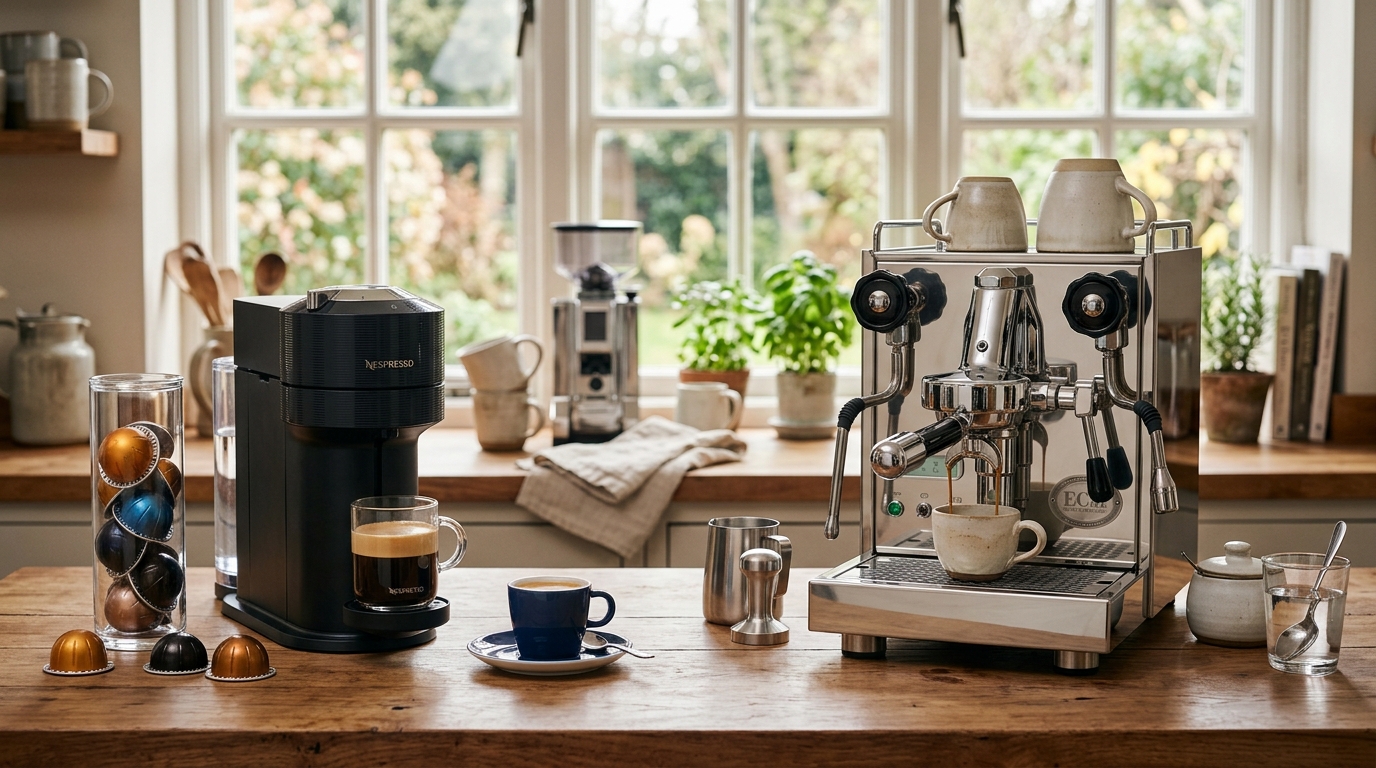
Nespresso machines make consistent espresso-style drinks with zero effort for $100–200. Traditional espresso machines deliver authentic 9-bar espresso with full flavor complexity and steam-wand capability for $400–700 or more. For true café-quality lattes and cappuccinos at home, only a real espresso machine will satisfy. For a fast, reliable espresso-flavored drink with no learning curve or ongoing skill requirement, Nespresso is genuinely excellent.
How Nespresso works vs how espresso machines work
Understanding the core mechanical difference tells you immediately which machine fits your life.
Nespresso uses pre-sealed aluminum capsules containing pre-ground, nitrogen-flushed coffee. When you insert a capsule and press a button, the machine punctures it and forces hot water through the grounds under pressure. The Original line brews at 15–19 bar of pump pressure, producing genuine espresso-style extraction. The Vertuo line uses a proprietary centrifusion mechanism that spins the capsule at up to 7,000 RPM while water is injected, producing a different flavor profile and a thick nitrogen-infused foam.
Either way, the drink reaches your cup in under 30 seconds from button press. The trade-off is total capsule lock-in: you cannot choose your beans, adjust grind size, vary dose, or control yield. Every shot is fixed by what the capsule manufacturer decided at production time. The Vertuo line enforces this further — a proprietary barcode system blocks all third-party capsules entirely.
Traditional espresso machines force water heated to 90–96°C through a tightly packed dose of freshly ground coffee, typically 18–21g, at exactly 9 bar of pump pressure for 25–30 seconds. That 9-bar pressure emulsifies coffee oils and dissolved CO2 into crema — the thick, caramel-colored foam that defines authentic espresso and holds up through steamed milk. The physics are the same ones used in every specialty café in the world.
The variables you control — grind size, dose, yield, extraction time, water temperature — are the same variables professional baristas spend years mastering. That is why the learning curve is real. It is also why the ceiling is so much higher: a properly dialed double shot on a Gaggia Classic Pro will out-extract any Nespresso capsule in flavor complexity, body, and crema quality once the home barista learns to use it.
Side-by-side comparison
| Product | Best for | Rating | Notes | |
|---|---|---|---|---|
| Brew mechanism | Traditional: 9-bar pump pressure through fresh-ground beans | — | Nespresso: pre-portioned capsules at 15–19 bar (Original) or centrifusion (Vertuo) | — |
| True crema | Traditional: real CO2-rich crema from fresh grounds on every shot | — | Nespresso Original: genuine crema; Vertuo: largely nitrogen-infused foam, not true crema | — |
| Grind control | Traditional: full control over grind size, dose, and yield per bag | — | Nespresso: zero — all extraction variables are fixed by the capsule at manufacture | — |
| Consistency | Nespresso: same capsule equals identical result every time | — | Traditional: variable — improves significantly with a quality grinder and practice | — |
| Milk drinks | Traditional: commercial steam wand textures real velvety latte microfoam | — | Nespresso: Aeroccino frother makes decent airy foam, not true microfoam for lattes | — |
| Cost per shot | Traditional: $0.30–0.80 with freshly ground specialty beans | — | Nespresso: $0.70–1.50 per Original capsule; $0.90–1.50 per Vertuo pod | — |
| Machine cost | Nespresso: $100–200 upfront (revenue model relies on capsules) | — | Traditional: $300–700+ for machine; add $100–200 for a quality burr grinder | — |
| Maintenance | Nespresso: descale every 2–3 months; empty drip tray daily | — | Traditional: daily backflush, steam wand purge, monthly descaling; more hands-on | — |
| Learning curve | Nespresso: ready on day one with zero experience required | — | Traditional: 2–4 weeks of daily practice before shots are reliably excellent | — |
| Bean freshness | Traditional: fresh-roasted whole beans ground immediately before extraction | — | Nespresso: capsules are shelf-stable but freshness is fixed at manufacture | — |
Taste: the honest comparison
Nespresso Original capsules produce drinkable, consistent espresso-style coffee. The Original line (Livanto, Ristretto, Arpeggio, and others) uses conventional pump extraction at 15–19 bar through real ground coffee, and it genuinely produces crema and a concentrated shot. Flavors range from bright and fruity to deep and chocolatey depending on the capsule. For someone accustomed to drip coffee or café lattes, Nespresso Original is a meaningful upgrade and consistently better than what most beginners pull on a traditional machine without training.
The Vertuo line is a different matter. Centrifusion technology and the thick, foamy pour look impressive, but the foam is largely nitrogen-infused rather than the CO2-rich crema produced by 9-bar pump extraction. The larger cup volumes — 230ml for Double Espresso, 535ml for Alto — dilute the coffee significantly compared to a traditional double espresso at 36–40ml. The flavor profile is pleasant but noticeably different from authentic espresso in body, concentration, and aftertaste.
A well-dialed traditional espresso machine operating at 9 bar produces a fundamentally different drink. True extraction emulsifies coffee oils and CO2 into crema that is richer, thicker, and more complex than any capsule output. Side-by-side, a quality home espresso shot is denser, more nuanced, and more aromatic than a Nespresso Original. The gap is clear to any specialty-coffee drinker; it is sometimes imperceptible to someone who drinks coffee primarily with milk and sugar.
For milk-based drinks, the gap widens further. The Aeroccino frother that comes bundled with most Nespresso machines produces warm, airy foam — adequate for a basic cappuccino, but not the velvety, glossy microfoam that a commercial-style steam wand creates. A real steam wand heats milk to 60–65°C while stretching and texturing it into pourable latte microfoam. The difference is significant in mouthfeel, sweetness, and the ability to pour latte art. If a flat white or properly textured latte is your daily drink, Nespresso’s frother will eventually frustrate you.
Cost reality: capsules vs fresh beans
The total-cost picture over multiple years often surprises Nespresso buyers.
Nespresso cost model: Machines are deliberately priced low. A Vertuo Next lists at $99–149; Original line machines start at $80. The revenue comes from capsules. Standard Nespresso capsules cost $0.70–0.80 each (Original) or $0.90–1.50 each (Vertuo), sold in sleeves of 10. At two shots daily, capsule costs run $1.40–3.00 per day — roughly $500–1,000 per year. Compatible third-party capsules exist for the Original line at $0.40–0.60 each, which significantly reduces ongoing cost. Vertuo’s barcode lock-out blocks all third-party pods, so Vertuo buyers pay full Nespresso prices indefinitely.
Over five years of two shots daily, Nespresso capsule costs alone reach $2,500–5,000 depending on line and usage — excluding the machine.
Traditional espresso cost model: A capable entry setup — Gaggia Classic Pro ($450) plus a Baratza Encore grinder ($170) — costs around $620 upfront. Specialty espresso beans cost $15–25 per 250g bag, with a daily 18g double shot consuming about $0.43–0.72 per shot. Daily bean costs run $0.43–0.72, or roughly $155–260 per year.
Over five years, the total traditional setup cost is roughly $1,400–2,000 including machine, grinder, beans, and consumables — typically less than the capsule spend alone, and with a noticeably better cup. The break-even against Nespresso Original (without third-party pods) arrives at around 18–24 months of daily use.
Convenience: where Nespresso wins clearly
The convenience difference is real, and for many buyers it is the deciding factor.
A Nespresso shot takes under 60 seconds from cold: the machine heats in 25–30 seconds, the capsule handles everything else, and cleanup means dropping the spent capsule in the recycling bin. The machine is also forgiving of inattention — you can set it going, walk away to grab your bag, and come back to a finished drink. Multiple people in the same household can each make exactly the drink they want with zero coordination or skill transfer. Nespresso is genuinely excellent for households with diverse coffee preferences, busy morning schedules, or anyone who views coffee as fuel rather than craft.
A traditional espresso machine on a dialed-in morning takes 15–25 minutes including thermal warm-up (15 minutes for most machines; 5–8 minutes for fast-heating models like the Breville Barista Pro), grinding, tamping, pulling, and steaming milk. Dialing in a new bag of beans — necessary every 5–10 days for active users — requires pulling test shots and adjusting grind by one click until the extraction time hits target. This is genuinely satisfying for people who enjoy precision morning rituals. For people who need coffee faster than they wake up, it can feel like too much.
When to choose Nespresso
Choose a Nespresso machine if:
- You want a consistent, fast coffee with zero skill required. No other machine delivers a drinkable espresso-style drink in 60 seconds. The Vertuo Next and Essenza Mini are the right tools if speed and reliability matter more than ceiling quality.
- Budget under $200 all-in. The Nespresso entry machines are legitimate options at their price. No traditional espresso machine at that price produces comparable quality — below $300, pressurized-basket machines use chemical crema simulation rather than real extraction.
- Your household has multiple, varied coffee preferences. Nespresso’s range of capsule profiles means every person gets their preferred cup without one person operating the machine for others. Original line also has a wide variety of compatible pod brands.
- Consistency matters more than absolute quality. Capsule-to-capsule variance is essentially zero. There is no bad morning, no sour under-extracted shot, and no adjustment needed for weather or altitude. For office use, vacation homes, or as a second machine, Nespresso is extremely practical.
- You prefer the Vertuo size range. If you want a single machine to produce everything from a 40ml ristretto to a 535ml mug-size coffee, the Vertuo line covers that in one device with no compromise.
Best for zero-skill espresso convenience in under 60 seconds
Nespresso Vertuo Next Coffee and Espresso Machine
The Nespresso Vertuo Next brews five cup sizes from espresso (40ml) to Alto (535ml) using centrifusion and barcode-optimized extraction per pod. Heat-up takes 25 seconds; used capsules eject automatically into an internal container. Most bundles include the Aeroccino 3 milk frother for cappuccino and flat white preparation. For households that want consistent, hands-off coffee without a learning curve or ongoing adjustment, the Vertuo Next delivers reliably every morning.
★★★★★ 4.5 · 42,000 reviews
Check current price on Amazon→When to choose a traditional espresso machine
Choose a traditional espresso machine if:
- You drink lattes or cappuccinos every day. A commercial-style steam wand textures milk into velvety microfoam that the Aeroccino frother cannot match. If a properly made flat white or latte is your daily drink, the steam wand is not optional — it is the product.
- Bean quality and freshness matter to you. Freshly roasted, freshly ground whole beans from a specialty roaster taste fundamentally different from pre-ground capsule coffee. If you swap roasters seasonally, value single-origin traceable coffees, or care about freshness in the cup, capsule lock-in is a real constraint.
- You enjoy the process. Pulling a well-dialed shot — watching the timer, adjusting the grind by one click after a fast run — is genuinely satisfying for a certain type of person. The morning espresso ritual becomes meditative practice rather than obligation.
- Long-term cost is a factor. At two shots daily, a Gaggia Classic Pro setup becomes cheaper than Nespresso Original capsule costs within two years and continues saving money every year after. The financial case for traditional espresso is strong over any time horizon past 24 months.
- You want the actual product. A Nespresso shot is good for what it is. It is not the same drink as 9-bar espresso from a freshly ground, freshly dialed dose of quality beans. If you have had great espresso at a specialty café and want to replicate it at home, only a real machine gets you there.
Best for authentic 9-bar espresso with a 58mm commercial portafilter
Gaggia Classic Pro Home Espresso Machine
The Gaggia Classic Pro is the benchmark entry-level recommendation for serious home baristas. A 58mm commercial-size group head, 3-way solenoid valve for dry pucks and immediate repulling, and a commercial pannarello steam wand capable of real microfoam define the feature set. Shots at 9 bar rival machines at twice the price once dialed in. Pair with a Baratza Encore or Eureka Mignon Notte grinder for best results. Expect 2–3 weeks before shots become reliably excellent, then a very high ceiling from there.
★★★★★ 4.5 · 8,100 reviews
Check current price on Amazon→FAQ
Frequently asked questions
Is Nespresso as good as a real espresso machine?
Is Nespresso cheaper than an espresso machine?
Can Nespresso make lattes and cappuccinos?
Which is easier to use: Nespresso or an espresso machine?
Does Nespresso use real espresso beans?
Can you use any capsules in a Nespresso machine?
Bottom line
Nespresso wins on convenience, consistency, and upfront cost. If you want a quick, reliable espresso-style drink every morning with zero skill and a machine under $200, the Vertuo Next or Essenza Mini are excellent tools. The capsule model is good enough for the majority of home coffee drinkers who prioritize speed and predictability.
A traditional espresso machine wins on quality, long-term value, and ceiling. If you drink lattes or cappuccinos daily, value freshly roasted specialty beans, or want to replicate the authentic café experience at home, a real pump machine paired with a quality burr grinder produces a noticeably better drink and pays for itself within two years of daily use.
The practical recommendation: if you are new to home espresso, start with Nespresso. If capsule coffee satisfies you, keep it. If you find yourself wanting more complexity, more control, or a proper steam wand, that is the signal to step up.
For the best traditional espresso machines: our full machine picks, the Gaggia Classic Pro in-depth review, best machines under $500, and the full Nespresso lineup guide.